
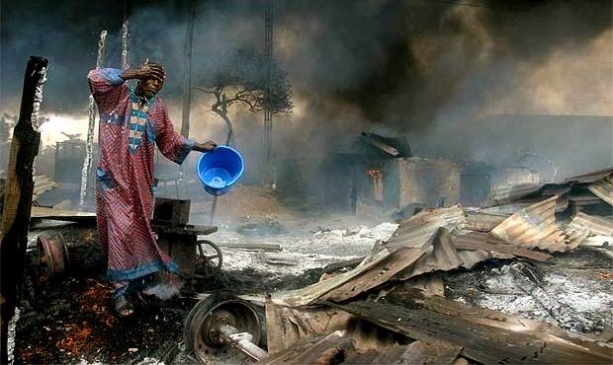
In another vein, this period also witnessed state terrorism. The response by the government to these violent protests was brutal. Several military administrators from the 1980s through the 1990s responded violently to these protests, thereby creating an atmosphere of fear. Ogundiya and Amzat posited that certain incidences capture the fact that, in suppressing opposition to economic policies by the military government, diverse acts of state terrorism weere carried out successfully. For instance, Ken Saro Wiwa, the leader of the Movement for the Survival of the Ogoni People (MASOP), was executed by the then military ruler General Sanni Abacha; the assassination of Dele Giwa, an editor and environmental activist, through a letter bomb in October 1986; the assassination of Kudirat Abiola in June 4 1999; and the assassination of Moshood Abiola in July 7, 1998.[43]
Therefore, all these factors highlighted above affirm the viewpoint that among the disadvantages of globalization is the consequence of terrorism in Nigeria. The economic policies and advice of the Bretton Woods institutions such as the IMF, World Bank, and World Trade Organization, which are agents and forces of globalization, have negative influences on the economy of developing nations such as Nigeria. This kindles the fire of hatred of the people of these developing countries on their government and the western collaborators.
GLOBALIZATION AS A MEANS OF TERRORISM IN NIGERIA
The tools of globalization have become a veritable means for terrorists to carry out their activities successfully. This makes most terrorists ideological hypocrites. Murphy observes that the major instruments of globalization, which are the information and communication technologies, such as mobile phones, the internet, mass media, etc., have ensured that terrorist plans are executed with the same ease at which commerce is carried out among nations in the world.[44] He further states that, “using technological advances in communication, these groups (terrorist) can easily contact and operate”.[45] Pillar further states that “the use of information technologies such as the internet, mobile phones, and instant messaging has extended the global reach of many terrorist groups.”[46] Of one very essential tool of globalization, the internet, Theohany and Rollins state that “it is used by Insurgents, Jihadists, and terrorist organization as a tool for radicalization and recruitment, method of propaganda distribution, a means of communication, and ground training.”[47]
In Nigeria, there is an emerging trend among terrorist groups. They have adopted the methods used by other terrorists, particularly in the Middle East and North Africa, by using information technology, and particularly the internet, to communicate to the people and the government on their activities. In the same vein, the leader of the Al Qaeda network, Osama Bin Laden, had been able to communicate to terrorists in Nigeria through the media, promising to support the quest to destroy their fellow countrymen. Karon reported that, in February 2003, Osama Bin Laden stated that Nigeria is a country that is ripe for “liberation”; that is, Nigeria is a country worthy of jihad. This statement was made available by Al Jazeera through a video message broad cast.[48] Furthermore, The Guardian newspaper reported in 2004 that Al Qaeda had been communicating to certain terrorist groups in Nigeria through email addresses.[49] In addition, terrorist groups in Nigeria, such as the Movement for the Emancipation of the Niger Delta (MEND), Niger Delta Volunteer Force (NDVF), and other related militants groups were using the internet to communicate to the government by claiming responsibility for attacks on crude oil installations. The Boko Haram sect in Nigeria claimed responsibility through the internet for the Christmas Eve bombings of some parts of Plateau state.
Furthermore, the media have ensured that the objectives of the terrorists in Nigeria are achieved. This is because news of impending terrorist attacks by the mass media creates an atmosphere of fear and suspicion in the country. There had been reported cases of threats by terrorists to attack Lagos, the country’s commercial nerve center, and Abuja. These threats were quickly disseminated, therefore sending a message that the government could no longer protect its citizens from the activities of these terrorists.
Another emerging trend of terrorism in Nigeria is cyber terrorism. Although Nigeria has not reached the desired level of information and communication technology needed to electronically run every activities of the government, the fact that cybercrimes are in existence in the country is a warning sign that the future may be bleak if the government completely goes online. “It is estimated that there are about 40 million computers in Nigeria. Without the owners ever suspecting it, each of these computers can be deployed as foot soldiers, even by an attacker in another country, to do the biddings of some evil geniuses.”[50] Cases abound of how cybercriminals and hackers have swindled companies in and outside the country. Terrorist groups can hire these hackers or cyber criminals, popularly known in Nigeria as “yahoo yahoo boys,” to wreak havoc in the future on the nation’s network system.
CONCLUSION
This article has attempted to establish the link between globalization and terrorism in Nigeria; specifically, how globalization results in terrorism and how globalization has continued to aid terrorism in Nigeria. Pre-modern globalization brought about colonialism in Africa and other parts of the Third World. Colonial authorities established an economic system that ensured the continued subordination of the Nigerian people. Consequently, resistance to these economic policies of the colonial authority has led to the establishment of a culture of violent resistance or domestic terrorism in the country today. Moreover, in the quest to suppress this opposition by the colonial subjects, the colonial authorities applied all manner of state-terrorism upon the people. This period kicked-off the modern terrorism in Nigeria. After independence, the ruling elites, trapped by the international economic system they have been prematurely integrated with wherein competition is at its highest, relied on the advice of the western capitalist states, through their forces of globalization such as the IMF, World Bank, WTO, etc., thereby guaranteeing the continued subordination of their economic system. As a result of this, the people reacted through terrorist activities, this time against their own government, whose officials are now perceived as agents of foreign capitals. In another vein, instruments of globalization, such as the mass media, the internet, and mobile phones, have continued to make the activities of terrorists in Nigeria very easy to carry out and difficult for the government to tackle. Terrorists in Nigeria are creating an atmosphere of fear and insecurity through bombings and threats of bombings, and this information is quickly disseminated by the media. The internet has become a useful tool to communicate to the government and the people claiming responsibility of attacks, a similar tactic employed by terrorist networks elsewhere. More so, due to the porosity of the network system in Nigeria, where cyber criminals are everywhere, it portends danger in the future, if the government decides to completely carry out its tasks online.
Notes
1. Cronin, Audrey Kurth Behind the curve. Globalization and international terrorism. International Security. Vol. 27, No. 3 2003.
2. Rourke, John.T. Taking sides. Clashing View on Controversial Issues in World Politics 11th edition. 2005.
3. Ibid, p. 45
4. Hungton, Samuel P. “The Clash of Civilization? Foreign Affairs, Vol 72, No. 3 (summer 1993); Benjamin R. Barber, Jihad vs Mcworld: Terrorism’s challenges to Democracy. New York: Randon House, 1995; Samuel P. Hungton, The Clash of Civilization and the Remaking of world order (New York: Simon and Schuster, 1996)
5. Canadian Minister of Commerce Paul Martins statements after the terrorist attack on the United State of America. 2001
6. Karacasulu, Nilüfer. Security and Globalization in the Context of International Terrorism.” Uluslararasi Hukuk ve Politika Cilt 2, No:5. ss. 1-17 ( 2006). p. 3
7. Sean, K.alic. Combating a Modern Hydra Al Qaeda and the Global War on Terrorism” Global War on Terrorism Occasional Paper 8 Combat Studies Institute Press Fort Leaven Worth, Kansas. 2005
8. US States Department. Patterns of global terrorism 1990
9. Wiotti, R. and Kauppi, M. International Relations,word politics, Security, Economy and Entity 4th ed. Peasrson Educational inc. New Jersey. 2009
10. Wilkinson, Paul. International Relations: A very Short Introduction New York, Oxford University Press Inc. 2007.
11. Ibid, p.33
12. Rensselaer, Lee and Raphael, Pearl, “Terrorism, the Future and US Foreign Policy.” Foreign Affairs, Defence & Trade Division (Congressional Research Service. The Library of Congress (Order Code 1B95112) CSR-3. 2002
13. Speigel, Steven L. and Wehling, Fred.L. World Poltics in the New Era (2nd ed) Harcourt Brace College Publishers California. 1999
14. African Union Convention Cited in Omotola, Shola J. Assessing Counter Terorism Measures in Africa: Implications for Human Rights and National Security. 2008
15. The Nation, February 23, 2011
16. International Terrorism and Security Research. 2008
17. The UN Policy Working Group on Terrorism, 2001, 5
18. Alasuutari, Pertti. “Globalization and the Nation-State: An Appraisal of the Discussion.” Department of Sociology and Social Psychology. University of Tampere, Finland. 2000
19. Tomlinson, J. Globalization and culture. Cambrige: Polity Press. 1999
20. Ibid, p.4
21. Ibid, p.2
22. Ibid, p.260
23. Ibid, p.22
24. Ibid, p.8
25. Ibid, p.9
26. Ibid, p.43
27. Ibid, p.463
28. Oyeniyi, AB. “Terrorism in Nigeria: Groups, Activities, and Politics”. International Journal of Politics and Good Governance. Vol.1,No1.1 Quarter I ISSN No.0976-1195 2010
29. Hübschle, Annette. The T-word: Conceptualising Terrorism. African Security Review 15.3 Institute of Security Studies. 2005
30. Ibid, p.8
31. Ibid, p.9
32. Chinweizu, The West and the Rest of Us. Nok Publishers. Nigeria Ltd Lagos. 1978
33. Osaghae, Eghosa.E. and Suberu, Rotimi.T. A History of Identities, Violence, and Stability in Nigeria. Center for Research on Inequality,Human Security and Ethnicity, CRISE working Paper No.6 University of Oxford 2005
34. Falola, T. (2009). Colonialism and Violence in Nigeria. Bloomington: Indiana University Press
35. Ochonu, Moses .E “Colonial Meltdown”. Ohio University Press. 2009
36. Ibid, p.5
37. Ibid, p.7
38. Ibid, p.7
39. Ibid, p.8
40. Libcom.org “The Development of Class Struggle in Nigeria-ICG 2006
41. Ibid, p.3
42. Ibid, p.4
43. Ogundiya, S. and Amzat, J. (2008). Nigeria and the Threats of Terrorism:Myth or Reality. Journal of Sustainable Development in Africa (Vol.10, No. 2) ISSN 1520-5509 Clarion University of Pennsylvania, Clarion, Pennsylvania
44. Murphy, D. (2002). “Activated Asian Terror Web Busted” Christian Science Monitor and “Al Qaeda South Asia Reach” Washington Post.
45. Ibid, p.8
46. Pillar, P.R. (2001). Terrorism and U.S Foreign Policy. Washington D.C p.47
47. Ibid, p.47
48. Theohany C.A. and Rollins J. (2011). “Terrorist Use of the Internet: Information Operations in Cyberspace. Congressional Research Service. 7 – 5700
49. Karon, T. (2003) “Why African has Become a Bush Priority. Time Magazine, July 7
50. Guardian, 2004 “suspect Links e-mail Address to Al Qaeda” August 5, p.1
51. www.nigeriabestforum.com/index.php? topic = 90059.0
