
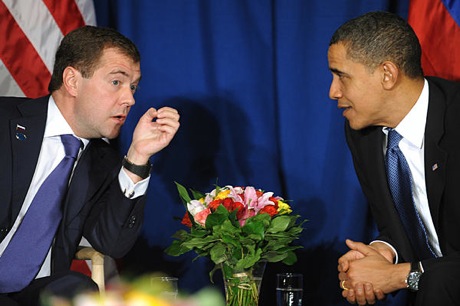
With regard to redressing the U.S. defense architecture under the auspices of NATO, some experts have argued that, given the technical and security difficulties, cooperation between the Alliance and Russia on missile defense would take time and be limited to the exchange of early warning information.[12] It is important to note that Russia’s new Military Doctrine — approved in February 2010 — identifies NATO as one of the main external threats to the Federation.[13] In particular, the Alliance’s enlargement in proximity to Russia’s borders and its Article 5 collective defense mechanisms are seen as undermining Russia’s strategic stability.[14] With regard to missile defense, the initiation of President Bush’s plans were seen by Moscow as putting the joint NATO-Russia effort towards missile defense for deployed forces on hold.[15] Russia’s willingness to restart this cooperation will thus depend on Obama’s continual consultations and reassurances vis-à-vis Moscow. Given the recent efforts of the present Administration to expand the European missile defense pillar towards Bulgaria and Romania, relations between U.S and Russia could experience a downturn, inevitability affecting the NATO-Russia Council. The latter is particularly vulnerable now that President Medvedev has proposed an alternative European security treaty and architecture.
The present financial instability experienced by a number of European allies might also prove an obstacle to U.S. PAA to missile defense in the region. While President Obama has expressed willingness to share the burden of missile defense with allied states, the abrupt decline in national defense budgets would make it hard for some European states to share the high cost of the project. For instance, within the auspices of NATO, twenty out of its twenty-six members have been struggling to fulfill their two percent of GDP defense spending target.[16] Among the six states with high contributions, Greece experienced a major debt crisis and the U.K.’s new coalition government is faced with enormous budget deficit.[17] At present, Germany is contemplating cutting more than €9.3 billion from its defense budget and Britain has just slashed 8% from its £36.9-billion defense bill. The progress of the PAA to missile defense may therefore depend on U.S. willingness to incur the bulk of the cost for the project. Sparing allies the financial burden of contributing in a meaningful way to regional defense could increase skepticism within the U.S. Congress, resulting in further constraints on the President’s ability to act.
Finally, Iran’s decision not to ‘withdraw even one inch from its stance’[18] — regardless of the international pressure — has helped rationalize Obama’s missile defense agenda, based on the perceived ongoing threat from Iran. In the long run, the perceived Iranian threat can become an overwhelming challenge to the PAA, making it extremely difficult to prove its effectiveness. The first test mimicking a strike from Iran was carried out in February 2010 and experienced malfunction in the Sea-Based X-band (SBX) radar, which failed to intercept its target,[19] even though the head of the MDA anticipated landmark results from the $150 million simulation.[20] Given the significance of the SBX radar in the GMD system, which is meant to defend the U.S. from long-range missiles, future failures of test exercises would raise further question about the reliability of Obama’s PAA to missile defense.
Conclusion
Progress has been made in demonstrating America’s non-aggressive intentions toward Russia, reassuring allies and securing ratification of the New START and a possible endorsement of the CTBT. At the same time, persisting technical limitations and political realities in the U.S. have introduced more variables to the future progress of President Obama’s PAA to missile defense. President Obama’s ability to maneuver through the political landmines that await his next two years in office will ultimately determine whether his PAA to missile defense becomes a reality.
For President Obama, the primary objective of maintaining the security status quo requires nuclear nonproliferation and disarmament , coupled with a desire to maintain strategic stability and cooperation. Ballistic missile defense has become essential to the achievement of both. The PAA has offered a less aggressive and more transparent variation of the former missile defense approach through gradual development and deployment of proven, flexible and movable capabilities, complemented by regular consultations with the parties concerned.
The ‘less offensive’ missile defense manifesto of the present Administration will allow for further joint ventures with Russia in missile defense, disarmament and non-proliferation. NATO’s present search for a new strategic concept — and the subsequent advancement of the Alliance’s missile defense effort — has presented an opportunity to share the burden of European missile defense with regional allies. The inclusion of the new PAA to missile defense within the Group of Expert’s 2010 report on NATO’s new security strategy suggests that President Obama’s ambition to make U.S. missile defense a national contribution to the Alliance’s Active Layered Theatre capability is likely to be accepted.
[1] Rose, Frank A. (2010), ‘Prospects for U.S.-Russia Missile Defense Cooperation’, Remarks at the 11th Royal United Services Institute for Defence and Security Studies (RUSI) Missile Defence Conference, London, United Kingdom 27 May 2010, U.S. Department of State, http://www.state.gov/t/vci/rls/142329.htm, 18 June 2010.
[2] Ibid.
[3] Ibid.
[4] Dyomkin, Denis (2010), ‘Russia’s Medvedev calls for alliances with U.S., EU’, Reuters, 12 July 2010, http://in.reuters.com/article/idINIndia-50061520100712, 12 July 2010.
[5] Jaseb, Hossein and Fredrik Dahl (2010), ‘Iran Plans Major Nuclear Expansion Over Next Year’ Reuters, 8 February 2010, http://www.reuters.com/assets/print?aid=USLDE61705120100208, 8 February 2010.
[6] Mostafavi, Ramin (2010), ‘Iran “Could Cancel Uranium Deal over Sanctions”’, Reuters, 20 May 2010, http://www.reuters.com/assets/print?aid=USTRE64J3K520100520, 20 May 2010 (2010).
[7] Hafezi Parisa and Reza Derakshi (2010), ‘Iran Says Will Respond to Any Sanctions’, Reuters, 16 February 2010, http://www.reuters.com/assets/print?aid=USTRE61F2Z920100216, 16 February 2010.
[8] ‘Medvedev Promotes Ratification of “New START”, NTI–Global Security Newswire, 25 June 2010, http://www.globalsecuritynewswire.org/gsn/nw_20100625_6180.php, 8 July 2010.
[9] ‘Medvedev Submits New START for Ratification’, Voice of Russia, 28 May 2010, http://english.ruvr.ru/rtvideo/2010/05/28/video_8669968.html, 8 July 2010.
[10] Faulconbridge, Guy (2010), ‘Russia Says May Lift Veil on Nuclear Arsenal’, Reuters, 12 May 2010, http://www.reuters.com/assets/print?aid=USTRE64B2U920100512, 18 May 2010.
[11] ‘U.S.-Polish Missile Shield Collaboration Moves Ahead’, NTI-Global Security Newswire, 6 July 2010, http://www.globalsecuritynewswire.org/gsn/nw_20100706_2466.php, 8 July 2010.
[12] Brunnstrom, David (2010), ‘NATO Urges Missile Defense Pact, Cites Iran Threat’, Reuters, 26 March 2010, http://www.reuters.com/assets/print?aid=USTRE62P1U520100326, 29 March 2010.
[13] Russian Military Doctrine (2010), Carnegie Endowment for International Peace, http://www.carnegieendowment.org/files/2010russia_military_doctrine.pdf, 31 March 2010.
[14] ‘Russia’s Foreign Minister Sergei Lavrov on Relations with Nato, the EU and the WTO’, The Telegraph, 22 June 2010, http://www.telegraph.co.uk/sponsored/russianow/politics/7847648/Russias-foreign-minister-Sergei-Lavrov-on-relations-with-Nato-the-EU-and-the-WTO.html, 25 June 2010.
[15] Ibid.
[16] Brunnstrom, David (2010), ‘NATO Emphasizes Defense Spending Despite Crisis’, Reuters, 17 May 2010, http://www.reuters.com/article/idUSTRE64G48920100517, 6 July 2010.
[17] ‘Russia’s Foreign Minister Sergei Lavrov on Relations with Nato, the EU and the WT’ (2010).
[18] Mostafavi, Ramin and David Alexander (2010), ‘U.N. Resolution vs Iran “Not Worth Penny”’: Ahmadinejad’, Reuters, 12 May 2010, http://www.reuters.com/assets/print?aid=USTRE64B2RN20100512, 18 May 2010.
[19] Wolf, Jim (2010), ‘U.S. Missile Test Mimicking Iran Strike Fails’, Reuters, 1 February 2010, http://www.reuters.com/assets/print?aid=USTRE6104F420100201, 2 February 2010.
[20] Ibid.
