
There is a considerable manufactured controversy regarding the assertion that Jews were responsible for the crucifixion of Yeshua the Messiah (a.k.a. Jesus the Christ). According to this narrative, anyone who suggests Jews had a role is implicitly an anti-Semite, and comparisons to the Nazis and invocation of the Holocaust are seemingly obligatory in such arguments.
In a recent example, Stephen C. Webster writes in Raw Story that Glenn Beck, in saying that “the Jews murdered the biblical messiah Jesus Christ” was siding “with Nazi propaganda”. Webster argues that, “as the story goes, Jews did not kill Jesus. The Roman empire had him executed after Jewish religious leaders became worked into a frenzy over his ideas—or so the New Testament claims. Armed Roman guards allegedly beat and lashed him, then hung him on a cross until death.” He asserts that “claiming as fact that Jews killed Jesus” indicates one’s adoption of “a meme otherwise endemic to anti-Semitic thought and literature. The implication that Romans were stalwarts of law and reason who merely appeased the bloodthirsty Jewish mob was a vital component of Nazi propaganda.”
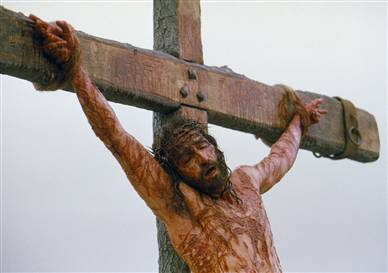
Jesus on the cross, from the film "The Passion of the Christ"
Arguments such as this, which deny that Jews had any responsibility for Yeshua’s death (beyond becoming “worked into a frenzy over his ideas”, that is), are common, and even appear from time to time in commentary in the mainstream media from time to time. Neocon pundit Charles Krauthammer, to cite another example, wrote, after the release of the film “The Passion of the Christ”, that it was necessary “to unteach the lesson” of 2000 years “that the Jews were Christ killers.”
Krauthammer similarly invoked Nazi persecution of the Jews in his argument, writing that “The blood libel that this story affixed upon the Jewish people had led to countless Christian massacres of Jews and prepared Europe for the ultimate massacre—6 million Jews systematically murdered in six years—in the heart, alas, of a Christian continent.” Krauthammer didn’t go as far as Webster in denying that, according to the Bible, “Jews did not kill Jesus”; he contented himself with suggesting that the Biblical account “lends itself to interpretation.”
But does it? It might perhaps be useful to examine for a moment what the New Testament actually has to say about it. For that, I’ll turn to David Stern’s Jewish New Testament translation, so that the charge of “anti-Semitism” is less likely to also be levied against the translator, or “anti-Semitic” against the translation.
See, the book of Matthew (Mattityahu) tells how “the head cohanim [priests] and the elders of the people gathered in the palace of Kayafa [Caiaphas] the cohen hagadol [high priest]. They made plans to arrest Yeshua surreptitiously and have him put to death” (26:3-4; emphasis added).
The book of Mark similarly also relates how “the head cohanim and the Torah-teachers were trying to find some way to arrest Yeshua surreptitiously and have him put to death” (14:1; emphasis added).
The book of Luke further explains how “the head cohanim and the Torah-teachers began trying to find some way to get rid of Yeshua, because they were afraid of the people”, and how Judas (Y’hudah) “approached the head cohanim and the Temple guard and discussed with them how he might turn Yeshua over to them. They were pleased and offered to pay him money. He agreed and began looking for a good opportunity to betray Yeshua without the people’s knowledge” (22:2, 4-5).
The book of John (Yochanan) additionally states that “the head cohanim and the P’rushim [Pharisees] called a meeting of the Sanhedrin [religious court; council] and said, ‘What are we going to do?—for this man is performing many miracles. If we let him keep going on this way, everyone will trust in him, and the Romans will come and destroy both the Temple and the nation.’ But one of them, Kayafa, who was cohen gadol that year, said to them, ‘You people don’t know anything! You don’t see that it’s better for you if one man dies on behalf of the people, so that the whole nation won’t be destroyed'” (11:47-50; emphasis added).
It is not clear which the Jewish religious leaders feared more: Yeshua’s rapidly growing following becoming a threat their own authority, or the risk of provoking the Romans into increasing their tyrannical grip on Judea. But what is perfectly clear from the Bible is that they wished Yeshua dead. And they didn’t just wish it—they acted upon their desires and actively saw to it that he was killed.
The Bible story continues, explaining how Y’hudah betrayed Yeshua with a kiss in Gethsamane (Luke 22:52-53), and how Yeshua was then taken before Kayafa and an illegal Sanhedrin, for the purpose of seeking false testimony against him in order to sentence him to death (on the illegality of this Sanhedrin, see Stern’s Jewish New Testament Commentary, p. 100).
Then the Sanhedrin brought Yeshua before Pontius Pilate, the Roman prefect of Judea, who initially answered their request for judgment by saying, “You take him and judge him according to your own law”. But not just any punishment would do. The Jews were out for blood, as demonstrated by their response that, “We don’t have the legal power to put anyone to death” (John 18:31).
As Stern explains, “although the Romans permitted the Judeans a measure of self-government, they did not allow the execution of a death sentence; capital punishment was reserved for Rome” (Commentary, p. 207). The Jewish historian Flavius Josephus also recorded how the Jewish leaders were obligated under Roman law to bring accused individuals to the Romans for the execution of a death sentence (Antiquities of the Jews, Book XX, Chapter 9).
When Yeshua would not answer the charges the Sanhedrin laid against him, Pilate pulled him aside and asked him “‘Are you the king of the Jews?’ Yeshua answered, ‘Are you asking this on your own, or have other people told you about me?’ Pilate replied, ‘Am I a Jew? Your own nation and head cohanim have handed you over to me; what have you done?'” (John 18:33-35; emphasis added).
When Pilate returned with Yeshua before the Sanhedrin, he declared, “‘I find no fault in this Man.’ But they were the more fierce, saying, ‘He stirs up the people, teaching throughout all Judea, beginning from Galilee to this place.'” When Pilate heard that Yeshua was from Galilee, he sought to relieve himself of responsibility by saying Yeshua should be sent to Herod Antipas, who had jurisdiction there. But Herod, after he and his men had mocked and mistreated Yeshua, sent him back once more to Pilate.
Then Pilate again said to the Sanhedrin, “You brought this man before me on a charge of subverting the people. I examined him in your presence and did not find the man guilty of the crime you are accusing him of. And neither did Herod, because he sent him back to us. Clearly, he has not done anything that merits the death penalty” (Luke 23:13-16; emphasis added).
The book of Matthew explains further that “It was the governor’s custom during a festival to set free one prisoner, whomever the crowd asked for.” So “the head cohanim persuaded the crowd to ask for Bar-Abba’s release and to have Yeshua executed at the stake” (27:15, 21; emphasis added).
When Pilate once more appealed to the Jews, “because he wanted to release Yeshua”, the Jews “yelled, ‘Put him to death on the stake! Put him to death on the stake!'” So Pilate said he would agree “to have him flogged and set free”. But insisting on blood, the Jews “went on yelling insistently, demanding that he be executed on the stake; and their shouting prevailed” (Luke 23:20-23; emphasis added).
Pilate relented and agreed to the Jews’ demand. “When Pilate saw that he was accomplishing nothing, but rather that a riot was starting, he took water, washed his hands in front of the crowd, and said, ‘My hands are clean of this man’s blood it’s your responsibility.’ All the people answered, ‘His blood is on us and on our children!‘” (Matthew 27:23-24; emphasis added).
So the Romans took Yeshua and flogged him, and put a crown of thorns on his head. And Pilate again said, “You take him out yourselves and put him to death on the stake, because I don’t find any case against him.” It was not for violating Roman law that Yeshua was crucified, for “the Judeans answered him, ‘We have a law; according to that law, he ought to be put to death, because he made himself out to be the Son of God'” (John 19:6-7; emphasis added).
Now, one could argue that the New Testament account is not historically accurate, and the whole business about Jews having responsibility for the death of Yeshua was entirely an invention of the gospel writers. Matthew, Mark, Luke, and John, apparently, if we hold to Webster’s logic, were Nazi propagandists ahead of their time, and also perhaps—Luke excepted—”self-hating Jews” (as a Gentile, Luke would have been just a regular old “anti-Semite”).
But there’s no sense at all in denying that the Bible says what it says, as Webster does—something which forces us to the conclusion either that he’s either never actually ever read the gospel accounts before, or simply chooses to be dishonest in the hopes his readers have never actually read them. Or perhaps he thinks he has Jedi mind powers, like Obi-Wan Kenobi when he waves his hand and tells the stormtroopers, “These aren’t the droids you’re looking for.”
Besides the gospels, there is also the account offered by the Jewish historian Flavius Josephus, who alludes to the role of the Jewish religious leaders in Yeshua’s death by noting that “Pilate, at the suggestion of the principal men amongst us, had condemned him to the cross” (Antiquities of the Jews, Book XVIII, Chapter 3; emphasis added).
Now, none of this is to say the Gentiles did not kill Yeshua. The Romans were—needless to say—guilty of the crime of executing an innocent man. As Stern notes, Pilate “did not escape his share of the responsibility for Yeshua’s death by merely washing his hands” (Commentary, p. 82).
But if we reject that Josephus and the gospel writers were their era’s equivalent of Nazi propagandists, then neither can Stephen C. Webster and Charles Krauthammer (and whomever else) wash the Jews’ hands of the whole affair—who were equally guilty in the crime as Pilate and the Roman soldiers who actually nailed Yeshua to the cross.
Nor is any of this to say that there hasn’t been persecution of Jews by anti-Semitic Christians through the centuries.
Rather, observation being made here is that both Christians who invoke the Jews’ role for the killing of Yeshua in the Bible in an attempt to justify their anti-Semitism and Jews who invoke anti-Semitism in an attempt to whitewash their role are missing the whole point of the story. As Stern explains, “Everyone, Jew and Gentile alike, is a sinner. By sinning, everyone, Jew and Gentile alike, killed him. Therefore everyone, Jew and Gentile alike, is guilty of Yeshua’s death.”
One needn’t subscribe to the Christian religion or believe the Bible is the Word of God in order to benefit from the moral of this story. It’s a story played out all around the world every day. You can see it told on the evening news. You can read it in the papers. As the gospel of Bob Marley puts the question to us, “How long shall they kill our prophets, while we stand aside and look?”
Every human being makes choices, both individually and as a society, and those choices have consequences—often bloody, with the deaths of innocents.
The Jews of Israel, for instance, cannot simply wash their hands of the consequences of their choices—such as the deaths and suffering of the people of Gaza—any more than could Pontius Pilate cleanse himself of guilt in the crucifixion.
Similarly, the U.S. government cannot simply wash its hands of the bloody consequences of its choice to support Israel and to defend its policies and its actions.
Nor can the American people wash off the blood that is on their hands as a result of their choice to ignore what their government does around the world, to pretend they have no power or control over what choices their leaders make, to look the other way, to say, “It’s not my problem.”
Many are quick to deny and point the finger and pin responsibility elsewhere. Many are the hypocrites, who, like the religious leaders of Yeshua’s time, present themselves as righteous and innocent of wrongdoing, while refusing to apply to themselves the same standard by which they judge others; who refuse to heed Yeshua’s warning: “Don’t judge, so that you won’t be judged. For the way you judge others is how you will be judged—the measure with which you measure out will be used to measure to you.… You hypocrite! First, take the log out of your own eye; then you will see clearly, so that you can remove the splinter from your brother’s eye!” (Matthew 7:1-2, 5)
Jew and Gentile alike, Israeli and American alike, we have all been warned. We all have a choice. The New Testament teaches that choosing contrary to the moral choice leads down a path towards self-destruction. Regardless of whether one is religious or not, it would be wise to heed this sensible warning.
The United States of America, like Israel, is slowly destroying itself. This fact is evident in the violent actions of its government; in the state of its economy; in the destruction of the environment; in its unsustainable drive to control and consume natural resources; in the attribution to institutional corporate behavior consequences that are the result of individual and collective human choices; in the intellectual culture of its political commentators; in the hypocrisy of its religious leaders; in the ignorance and apathy of its citizens.
How long will we continue down the path of self-destruction? How long will we wash our hands of the consequences of our own actions? How long will we, Jews and Gentiles alike, continue to nail Yeshua to the cross?
