
Corrections appended, May 11, 2010: In certain places, this article read “M.B.A.” where it should have read “a masters degree”, “M.P.A.” and “M.P.P.”, respectively. The text has been revised to correct the error.
If David Cameron, leader of England’s Conservative party, is able to form a government, he would become the twenty-sixth British Prime Minister educated at Oxford. Early last year Barack Obama became the eighth Harvard alumnus to serve as President. He succeeded another Harvard graduate, George W. Bush.
The preeminence of Harvard and Oxford in the education of their own political leaders is generally well known. Less appreciated is the role of these two institutions in the training of leaders from other countries. From 1945 through early 2010, 71 heads of state and government from 41 countries have attended, or earned degrees, or held a variety of special scholarships and fellowships at Harvard or Oxford.
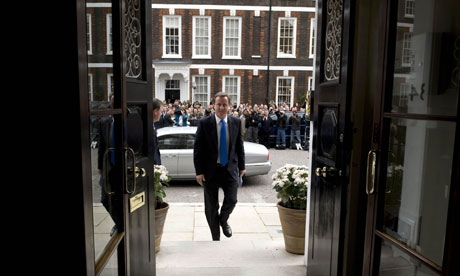
If David Cameron, leader of England’s Conservative party, is able to form a government, he would become the twenty-sixth British Prime Minister educated at Oxford. (Photo: Jeremy Selwyn/PA)
Recently inaugurated as President of Chile (March, 2010) Sebastian Pinera became the 28th foreign head of state or government who attended Harvard. 15 months earlier, Abhisit Vejjajiva became Prime Minister of Thailand and the 45th Oxford-connected national executive.
Two chief executives attended both Harvard and Oxford. Incumbent Columbian President Alvaro Uribe received a Certificate of Special Studies from Harvard and later was a Senior Associate Member of St. Anthony’s College at Oxford. Twice Prime Minister of Pakistan, the late Benazir Bhutto earned a B.A. from Harvard and spent four years at Oxford, where she was President of the Oxford Union.
Oxford’s 45 students represent 25 countries, 14 of which are members of the Commonwealth. Pakistan is the leading source of students, with six. The 28 former Harvard students are relatively more diverse in that they came from two dozen countries, a third of which are in Latin America. Three Mexican Presidents are the most Harvard alums from any single country.
Executives who attended Harvard experienced a different type of education than those at Oxford. Almost 80 percent of the Harvard students enrolled in post-baccalaureate programs, but fewer than half the Oxonians pursued that level of study. Almost twice as many Harvard students (64 percent) earned advanced degrees as did Oxford graduates (36 percent).
Harvard’s Kennedy School of Government played a particularly important role in the education of foreign leaders. 11 of the 28 Harvard alums earned a masters degree from that entity. Most of the advanced Harvard degrees (61 percent) were awarded by that school. By contrast, Oxford students enrolled in half of the university’s 44 colleges and halls, with none of them predominating.
All but one political leader attended Harvard or Oxford before becoming head of state or government. The exception was Frederick Sumaye, Prime Minister of Tanzania, who earned an M.P.A. at Harvard’s Kennedy School of Government after he left office.
Three sets of Oxford alumni served simultaneously for part of their tenure. In the mid-1960s, Indian Prime Minister Indira Gandhi and President Sarvepalli Radhakrishnan held office at the same time. Ghanaians John Kufuor and Kofi Busia, President and Prime minister respectively, served together in the early 1970s. President Penaia Ganilau and Prime Minister Kamisese Mara of Fiji were both in office from late 1987 through mid 1993. Mara succeeded Ganilau as President.
Most recently, from mid 2005 through mid 2006, Peru had a Harvard President and an Oxford Prime Minister. President Alejandro Toledo was a visiting fellow at Harvard, and Prime Minister Pedro Pablo Kuczynski had an Oxford B.A.
A majority of the figures in this report were Presidents and Prime Ministers, but seven monarchs, all of whom attended Oxford, are included. The Kings of Jordan, Norway, and Tonga are currently on their thrones. Harald V of Norway succeeded his father, and fellow Oxonian, Olav V.
Three Oxford educated Malaysian monarchs served during this period but they do not appear to be related. Malaysia functions under an “elected” monarchy in which one of the hereditary rulers of the Malay states is selected as the Yang di-Pertuan Agong or “King” for a five year term.
Monarchs are not the only executives who are related. Thai Prime Ministers Seni and Kukrit Pramoj were brothers and Oxford graduates. Zulfiqar Bhutto is the father of fellow Pakistani Prime Minister Benazir Bhutto; both attended Oxford, and Benazir also earned a Harvard degree. The Greek Papandreou family is represented by the late Prime Minister Andreas, the father of incumbent chief executive George. Andreas earned a Ph.D from Harvard and taught there for two years. George attended that institution as an undergraduate and later returned as a Fellow at the Weatherford Center for International Affairs.
Top national political leaders from Harvard and Oxford were not just a mid-20th century phenomenon. They are a 21st century reality. 40 percent of those included in this report held office sometime in the last decade. A majority of those with a Harvard connection and nearly a third of the Oxonians have served since 2000. As of this writing, about a third of the former Harvard students and almost a fifth of Oxford group are in office.
Graduates of these two institutions will continue to occupy the top offices in their countries for some time to come. The Crown Princes of Japan and Bhutan are alumni of Oxford’s Merton College and St. Peter’s College, respectively.
The scions of three Asian political dynasties are in position to climb further up the political ladder. Bilawal Zardari Bhutto, the son and grandson of respective Oxford-educated Bhutto Prime Ministers, is a student at Oxford and the Chairman of the Pakistani People’s Party. Rahul Gandhi, of India’s Nehru-Gandhi dynasty, attended Harvard and sits in the Indian parliament. The Marcos political family of the Philippines has yet to produce a Harvard or Oxford President, but Ferdinand Marcos, Jr. (Oxford A. B.) is a former Governor, current member of the House of Representatives, and candidate for the Senate.
Two Rhodes Scholars could become a president or a prime minister. Incumbent Louisiana Governor Bobby Jindal seems poised to step onto the national political stage. He could join Bill Clinton as the second President to have attended Oxford. Tony Abbott is the Leader of the Opposition in the lower house of the Australian Parliament. If his party wins the next election, he would become prime minister.
Nobel Peace Prize recipient Aung San Suu Kyi of Myanmar was about to become Prime Minister in 1990, but the election was annulled and she has been under various forms of detention for most of the last 20 years. She earned a B.A from Oxford’s St. Hughes College.
Almost 40 percent of the Harvard-educated executives in this survey completed a master’s degree at the Kennedy School of Government. The center has more than 400 international students from 86 countries in degree programs this academic year and claims alumni in at least 170 countries. Several of those graduates are already making their mark in nation politics.
Four have held cabinet positions in Serbia, New Zealand, Iraq, and Vietnam within the last five years. Two are currently in office. Vuk Jeremic is Serbia’s Foreign Minister and Cao Duc Phat is the Minister of Agriculture in Vietnam. Incumbent Philippine Senator Francis Pangilinan held the position of Senate majority leader from 2004-2008. In South Africa, Frank Chikane recently served as Director General of the Presidency.
Venezuelan Leopoldo Lopez, a former mayor, is the most likely future presidential candidate with a Harvard M.P.P. Banned by the Chavez administration from running in the 2008 elections, Lopez is a prominent leader of the opposition to President Chavez, a role which may lead to a run for the presidency in 2012.
Why do these two universities have such a disproportionate international impact? Part of the answer lies in Harvard and Oxford’s known contribution to the education of political leaders in their own countries. Each surpasses its nearest domestic rival in educating its nation’s political elite
Harvard leads Yale in educating American Presidents by a margin of eight to five, but Yale is narrowing the gap. Four of its five have served in the last 35 years (Ford, George H. W. Bush, Clinton, and George W. Bush). By contrast, Harvard has had but two in that period: Barack Obama and George W. Bush, who graduated from both.
However, other evidence indicates Harvard’s predominant role in the education of American political leaders. In the second half of the 20th century, Harvard educated more than 11 percent of the top national American political elite, compared to Yale’s less than seven percent. One Harvard program alone, the Law School, produced 37 national leaders, in contrast with the 38 who graduated from all of Yale’s colleges combined (author and M. A. Simon The Social Science Journal, 2007).
In the United Kingdom, Cambridge can claim but 15 Prime Ministers in contrast to Oxford’s 25. The most recent Cambridge alumnus to be Prime Minister was Stanley Baldwin, who left office in 1937. Since then, eight former Oxford students have held that office. International students and scholars will be attracted to these two institutions because of this record of educating British and American political leaders.
Three other factors – age, prestige, and recruiting efforts – set these two universities apart. Each is the oldest institution of higher education in its country. Age alone confers prestige. More objectively, both are regularly at or near the top of national and international rankings of universities. Both have made conscious efforts to attract foreign undergraduates, graduate students, and mid-career professionals who are likely to have a future policy impact in their countries.
Once the alumni of a school develop a reputation for success in a certain area others with career plans in that direction tend to gravitate to those universities. Ambitious foreign politicians see an association with elite British or American university as a significant addition to their resumes. Harvard and Oxford will likely remain the world’s major political universities for some time to come.
