
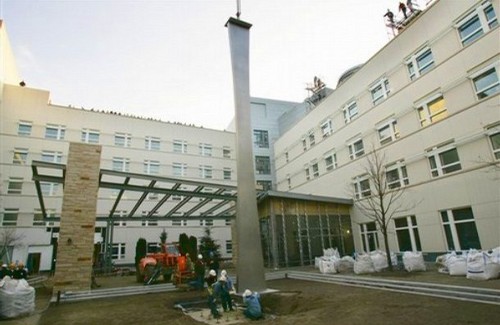
Furthermore, our mission is not necessarily and by no means exclusively to “advertise the hallmarks of American culture.” Rather, it is to use art as a language to encourage cross-cultural dialogue. As such, the artist draws inspiration from the local host-culture when conceiving and producing the piece. The work also promotes dialogue by offering host-country citizens a chance to view, first-hand, American works of art.
You may admit that the embassies are not considered to be among the general public places and only a certain group of citizens will visit them regularly. Why don’t you expand FAPE’s coverage to municipalities and governments to install artwork in cities, squares, boulevards and museums, especially since you’ve gained the free sponsorship of renowned artists?
To FAPE, U.S. Embassies represent the face of our country abroad. These physical sites make indelible impressions on everyone from hopeful U.S. visitors to the diplomatic community to the general public and beyond. As such, we consider these spaces of diplomacy a critical part of our public-face abroad.
Many of our projects are located on the grounds of the Embassy and are visible from the street so you don’t have to go inside an embassy to experience the great artwork. We love the idea of public art in cities and streets as you suggest, but alas, there is only so much that FAPE can take on. By focusing our efforts on art in embassies, we have the opportunity to create a broader conversation specifically on art’s role in cultural diplomacy and in civic life.
For example, we recently honored Associate Justice Stephen Breyer for his work on the Boston Courthouse. Justice Breyer is committed to advancing the integration of art and architecture in the civic sphere. Both he and Judge Douglas P. Woodlock and others, oversaw the design and construction process of the John Joseph Moakley Federal Courthouse in Boston, Massachusetts. Justice Breyer’s guidance ensured that the building represented our nation’s finest cultural traditions, including Ellsworth Kelly’s Boston Panels, 21 monochrome aluminum panels created in 13 colors. The Courthouse led the way to the Design Excellence Program that the General Services Administration established in 1994, which changed the course of public architecture in the Federal Government.
How do you consider the fine arts to be sources of “soft power” when they do not practically convey any sort of political message? What and how many tangible examples can you present to indicate art as a prevailing and potent means of furthering cultural diplomacy, such as Elyn Zimmerman’s Tanzania piece?
Culture plays an integral role in the concept of soft power. Since American artists capture the essence of who we are as a nation, their works of art espouse those positive attributes of American culture.
Moreover, art represents freedom of expression, which is one of the most essential elements of political engagement. By virtue of where FAPE’s art is placed and the unique collaboration process in which government and artist combine to produce such art, each of FAPE’s pieces communicates that our culture is one that first and foremost values the democratic tenet of free expression.
Do you have future programs in store? Have you ever considered cooperating with non-American artists working inside the U.S. who may be interested in donating their artwork to FAPE?
Current and future site-specific installations include the U.S. Embassy in Kingston, Jamaica for 2009, the U.S. Consulate in Mumbai, India for 2009, the U.S. Mission to the United Nations, New York for 2010, the U.S. Embassy in Beijing, China for 2011 and the U.S. Embassy in Guangzhou, China for 2011.
During installations abroad, FAPE artists work with local artisans and local fabrication teams wherever possible. For instance, for the upcoming Mumbai Consulate project, artist Lynda Benglis will work with Indian artisans to apply gold leaf to her works budget-permitting. Also, both Martin Puryear and Joel Shapiro have expressed interest in working with local artisans and local fabrication teams for the upcoming Embassies in China in 2011.
What is the general viewpoint of the high-ranking U.S. officials about your endeavors? To date, how many of them, especially those in the new administration, have commented on your cultural efforts?
The support of several acting and honorary board members demonstrates the value of FAPE’s work. Our honorary patrons include former Secretaries of State including Madeline K. Albright, James A. Baker III, Warren Christopher, Alexander M. Haig, Jr., Henry A. Kissinger, Colin L. Powell, and George P. Shultz.
Given President Obama’s recent appointment of an arts and culture czar and dedication to diplomacy, the FAPE mission is particularly timely as well. Secretary of State Hillary Clinton hosted FAPE’s members at its annual State Department dinner on May 11, and Kareem Dale, Special Assistant to the President on Arts and Culture, attended the event. Former Secretary of State Colin Powell was also a guest, and Dorothea Rockburne’s maquette of her 40-foot high mural to be installed at the U.S. embassy in Kingston, Jamaica, which is being done in honor of General Powell and his family who come from Jamaica, was unveiled.
Also at the dinner, U.S. Supreme Court Justice Stephen Breyer was awarded FAPE’s first Leonore and Walter Annenberg Award for Diplomacy through the Arts this year. [To view his speech about FAPE, visit this link on the U.S. Supreme Court’s website.]
Moreover, in a letter to FAPE’s members, which was printed in FAPE’s May 11 State Department dinner program, Secretary Clinton wrote:
“As our nation and world confront the multiple challenges of our time, effective communication is imperative. Bypassing written and spoken words, art expresses the human spirit and human creativity, connecting all citizens on a deeper level. The presence of American art in our embassies enhances and enriches our country’s diplomatic efforts to engage with other nations and cultures. FAPE is a crucial partner in making this powerful means of communication available to our government’s representatives abroad, to the benefit of America and the world.”
