
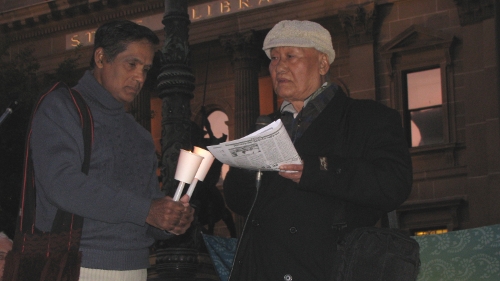
Like so many activists from Burma now living in Australia, Sin Kye’s political activism has a strong connection with the ’88 Generation’ movement. He headed the Burmese Literary and Cultural Organisation (BLCO), coordinated mass marches and organised strategies, encouraging other artists and writers to participate in a demonstration on behalf of Daw Suu Kyi at the western gate of Shwedagon Pagoda. He also worked alongside previous members of the National League for Democracy’s Central Committee, including Maung Thaw, U Wen Tin and Win Khed.
The military twice detained Sing Kye in calling for public dissent against the junta; once during the 1988 revolution, and again in a military operation during the 1990 election whilst in the Irrawaddy Delta, acting as Secretary of the Union of Karen League (UKL). “I advised the Burmese Army that they should not conduct a raid because their safety would be jeopardised,” he says. “As a member of the Karen ethnic minority, I wanted to prevent them from being in any danger (as a result of military incursions).” For this, Sin Kye was detained for criticising the SPDC.
Sin Kye released details of his imprisonment in a poem entitled The Traveller in Monerplaw. The period of incarceration, according to the elderly writer, was part of the SPDC’s attempt to destroy him, but insists they will never win. He says that he was not tortured but refused to go into further detail, saying, “I want to return to Burma and become a candidate for the 2010 elections, but sources (from within Burma) have advised against doing so because the SPDC will re-arrest me and continue the psychological torment I received while in jail,” Sin Kye says.
The author believes that it will take the Irrawaddy Region between three to five years to recover. Sin Kye says that Burma’s reclusive leader, General Than Shwe, boasts of the government being self-sufficient due to the country’s rice surplus able to feed 100 million people. “I can tell you that civilians are still being forced to eat dead rats that are floating in floodwaters.”
It seems that Burma’s military rulers have not learnt the lessons from recent natural disasters in the Asian region. Sin Kye cites two examples. He tells me the 2004 tsunami in Aceh led to a truce and new spirit of cooperation between the Indonesian military and Acehnese rebels, and together they rebuilt the province. Similarly, the earthquake in China’s Sichuan province provoked a human element in authorities. Leaders met affected people, handed out food and shared their sorrows with families of the deceased. “But the SPDC has not offered one word of sympathy to the victims of Cyclone Nargis. They lack humility,” he laments.
In reflecting on how he felt about reading his poem at Melbourne’s vigil, Sin Kye speaks openly of the experience. “I was choked with emotions; tears were flowing from my eyes. The people of Burma, regardless of our ethnicity, are all socially, politically and spiritually connected.”
Throughout all of his years of writing, the one burning question in my mind related to a journalist’s biggest fear in Burma.
Sin Kye indicates that based on his experience, a slow painful death through local and global ignorance is equivalent to being stabbed in the back. “We never fear hunger, thirst or physical harm. The most that we writers fear is having our endeavour and efforts ignored by the people that we love. We are afraid that they do not recognise us and what we are attempting to do.”
Sin Kye says that while he believes a civilian led democracy will ultimately be formed in Burma, he warns everybody not to expect drastic changes that will immediately benefit long suffering citizens. Mature democracies, he says, take time to develop. But there can be no compromise as to who should preside over the next civilian government; the National League for Democracy.
Sin Kye intends to publish further writings about the history and plight of his people. He plans to release literature about the first Karen President of Burma, Mahn Nwin Maung, and We Love Yo Ma, which is a frank description of life before the 1988 People Power revolution.
“As an ethnic Karen, time is running out for me. For the sake of peace, how many young lives must we sacrifice? We can only continue to conduct a brutal war if plenty of lives can be afford to be sacrificed. But we are not given that luxury, and this is not something anybody wants to see (again).”
General Than Shwe and the SPDC should sit down and listen to the iconic anti-war song Blowin’ In The Wind by Bob Dylan. More than four decades later after its release, we still have no response to the line, “How many deaths will it take till he knows/That too many people have died.”
The innocent people of Burma can no longer wait for an answer.
