In Thailand’s north-western town of Mae Hong Son, I am waiting in a safehouse to be transported to a camp for teaching English to ethnic minority Shan people in Burma, on the Thai-Burma border. Soon, I will be crossing illegally into an Internally Displaced Persons (IDP) camp in Loi Tailang.
Around the time I agreed to cross the border and undertake a task of teaching English at one of the schools, the Thai Prime Minister of the day, Samak Sundaravej, was in Rangoon, meeting leaders of Burma’s State Peace and Development Council (SPDC) as part of an effort to develop closer relations between Thailand and Burma on all accounts except for humanitarian matters and pushing the issue of improving human rights. All effective border crossings were closed.
 For months, I had been following the course taken by Shan human rights activist and author Antonio Graceffo, who was in Loi Tailang documenting human rights abuses against the residents of Shan State by the Burmese military junta, the SPDC. Graceffo is a man who has dedicated much of his time and energy to raise awareness of the gradual destruction of the Shan people while the international community looks away.
Loi Tailang is located in the mountains of Shan State on the Burma-Thai border. It is the site of an IDP camp for ethnic minorities who are residents of Shan State. Following Burma gaining its independence from Britain in 1948, the Panglong Agreement saw the Shan protectorates (separate principalities under British rule) become Shan State, and along with other ethnic minority groups in their respective states, agree to the right to secede from Burma after 10 years.
However, with the arrest of the last Shan Sao Pha by the Burmese military and his subsequent disappearance, Burmese General Ne Win’s coup d’etat in 1964 meant the end of the Panglong Agreement and established military domination in Shan State. Despite a sustained campaign of resistance by the Shan State Army, including a call for independence by its government-in-exile (one that was opposed by ethnic Shan living elsewhere in Burma and Aung San Suu Kyi’s National League for Democracy Party), the Burmese military continue to brutally suppress all ethnic minorities living in Shan State.
According to Andrew Marshall’s book “The Trouser People” going to Burma and going into Burma are two different concepts, and this is something I need to get right. Going toBurma, according to the author, implies being a tourist, oblivious to the harsh realities of tragedy that is inevitably a part of war. Going into Burma indicates entering borders with a mission to achieve a specific goal such as delivering medical assistance, teaching or reporting on the conflict. By Marshall’s own definition, I have used the latter explanation to qualify my reasons for undertaking a risk to enter Loi Tailang village.
My travel escorts arrive in the form of two motorcyclists. One will carry two backpacks that I am taking, and the other will carry me. Between now and whatever time I land at my destination, my safety and well-being is in their hands.
For what feels like hours, we travel through a number of hills and small villages in Thailand. Then suddenly in the distance, I spot an unmanned checkpoint up ahead signifying an exit from Thailand heading towards to Shan State, Burma. My stomach ties in knots as I realize that I am entering a land that time, and sadly, the world at large, has forgotten about.
There are no border patrols up here and apart from overtaking a disused, burnt out oil tanker and several convoys of oxen straying everywhere, the road is deserted. I can hear gunfire from beyond the hills, but I cannot establish whether it is a military training exercise or actual shelling across the Thai-Burma border between the two armies. It is here that I begin to come to terms with the fact that I am actually in Burma, a country that rules its people by pointing a gun at their heads.
The motorcyclists take an unorthodox route through forests and farms full of laborers bearing machetes used for cutting trees and slashing grass. Occasionally, I am required to hop off the motorcycle and walk through some very difficult terrain, predominately forests and steep winding mountains. We constantly avoid Thai soldiers patrolling the area. I rely on a system of catcalls and whistles to communicate with my guides and local farmers serving as lookouts.
Occasionally, I am told to walk further ahead; something that petrifies me because I think of the possibility there might be landmines. Being my first time in the region, how was I to know what areas can be considered safe? Everywhere I step, the thought of unexploded landmines terrifies me, and I step as lightly as possible.
As the night closes in, I dread being asked to let the riders take their bikes up the hills, switching on their lights to ride over inhospitable ground in the pitch-black darkness. The moment they are out of sight, thoughts enter my head about being left alone with only the clothing on my back and something going horribly wrong.
The final hour of the journey causes the most anxious moments, for I sit with my eyes shut remaining perfectly still. On more than one occasion I fear the possibility of a head-on collision as we go around the mountainside, with nothing to break a fall of hundreds of meters rolling down the face of the mountain. I would later refer to this stretch as “the catwalk” because the path was so narrow.
Then my heart skips a few beats as I hear the sound of a few motorcycles in the distance and sense some individuals in military uniform passing by. This is the end, I think to myself. Thankfully, I am incorrect.
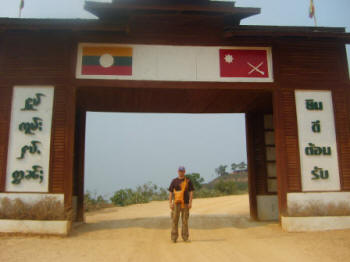
After 4 hours of travelling, I finally cross the border into Shan State at 7:20 pm local time. Immediately after passing the checkpoint, I hop off the motorcycle and simply stare through the gates to Loi Tailang. I feel tiny and insignificant as I gaze upon the Shan State coat of arms. Two flags are directly above me; one the Shan flag of three vertical stripes of yellow, green and red with a white sun, and the other the Shan State Army flag of double crossed swords on a red flag with the army emblem.
Although the arrival is somewhat unceremonious, I can feel adrenalin rushing through me and I express a massive sigh of relief as the dusty old bike splutters down a rocky hill and heads into what I perceive to be the main street, where the villagers live.
On my first day of teaching, I collect my village attire and discover that my uniform is unlike anything I had ever possessed; a bright new Shan State Army soldiers’ uniform, consisting of an olive green hat with a triangular yellow, green and red embroidering on the front (the colors of the Shan State flag), and a matching set of dark green shirt and pants. The school director and male student dormitory owner, Kyawn Myi, tells me that if I wear the military uniform, I will have good luck for the period of my stay.
The Thai border post is approximately 500 meters from the kindergarten where I will teach, and although by my own estimations there is a low likelihood of being spotted, who would not be willing to undertake every precaution?
The teaching day for kindergarten children commences at 9:00 am. I will be working along with two Shan women who each have young children to care for. As I arrive on the back of a motorcycle, I find myself being stared at by 45 young children who share a mixture of delight, confusion and fear upon seeing me, a white guy dressed in Shan State Army clothing.
The children are of a mixture of nationalities, including Shan, Lisu, Pa-O, Muse and Chinese, but under the Shan definition, all of these group are considered equal or are a part of the Shan nationality. Most of them live in the IDP camp itself. Some kids are dressed in traditional outfits, while others wear discarded Western clothing that has been delivered by various organizations able to truck in supplies.
A few boys and girls even wear U.S. Army khaki caps, t-shirts and shorts or long pants. I immediately wish that none of these children will ever have to personally enter into a warzone environment when they are older.
Normally, the class size is approximately 60 children, but with frequent border closures and parents fearing the possibility of retribution if either they or their children are caught crossing onto the Thai side of the border, some parents choose not to send their kids to school.
Upon receiving the greeting of respect, mai soong khaa, collectively we proceed to enter the classroom. Each child seems too shy to approach me or say hello, even upon their teacher’s instruction. Looking into the box of toys, I decide to pull out a stuffed toy rabbit and use him as a communication tool to my audience of pre-schoolers. I use simple actions, noises and word to tell a story before launching into singing and repeating If You’re Happy and You Know It Clap Your Hands.
The difficulties of working with children who grow up surrounded by the stench of war, grief and isolation are all too obvious. One little boy who arrived late came in kicking and screaming with his father and older sister. It was a distressing moment to say the least. He was restrained by 2 teachers who stopped him from reaching the door in desperation to follow his Dad. At that point, my heart nearly ate itself and coughed up the remains. Only the presence of his older sister, who deemed it necessary to remain behind, quelled his chilling screeches. Later, I would learn that his Dad was on his way into the forest to search for vegetables to put on the family dinner table.
Lunch is eaten at 11:00 am, and all of the kids and teachers gather together on long wooden benches. Children bring in their own cooked rice from home and the cook provides them with a mixture of vegetables and fried soy bean. On rare occasions, small chunks of meat are available, depending on whether any forest animals have been killed when male villagers have gone on their hunting expeditions the previous day.
From 11.30 am until 2.00 pm, children take a nap before taking the opportunity to go use the outside toilet, a hole in the ground inside a wooden cubicle that is in the line of sight of the Thai border post. Because there are only two toilets, the children simply find a place in the open and squat to relieve themselves.
Before commencing the final hour, the kids are allowed to have a snack of a soy milk drink and chocolate wafer before I launch into some group games.
The day’s end is reached at 3:00 pm, when parents and grandparents collect the children as they line up single file, excited and ready to exit the gate. One by one, each child places their palms facing inward, raise the tips of their fingers nose height to the heavens and say to me in Shan language, “Mai soong khaa.” It is an awkward feeling for me to think that I deserve this, for I have done, and will probably do little to improve their lives. I admire the teachers in the kindergarten, for they work tirelessly for little in return.
The people of Shan State look east to Thailand for its influence and hope, dream of democracy, and worship the Thai King. However, the population is firmly entrenched in what can best be described as an Orwellian nightmare. In Loi Tailang, so many men, women, boys and girls of all ages have endured a lifetime of nightmares in getting to this sanctuary of relative safety.
Far too many people have been forcibly relocated between villages and towns and are now at the edge of inhospitable rural Burma, yet unable to enter Thailand and gain refugee status. They have abandoned their farms, livestock and relatives for the sake of finding security and peace. Just about everybody has experiences of torture, rape, summary execution, and the fear of not knowing of the fate of loved ones left behind.
The junta has taken fathers and sons to become human mine detectors and porters. Everybody, it seems, is a slave to the army when captured, or a slave-in-waiting, living on borrowed time if they do not flee for a life of further uncertainty.
Amidst this backdrop, my education in Shan State is only just beginning.