
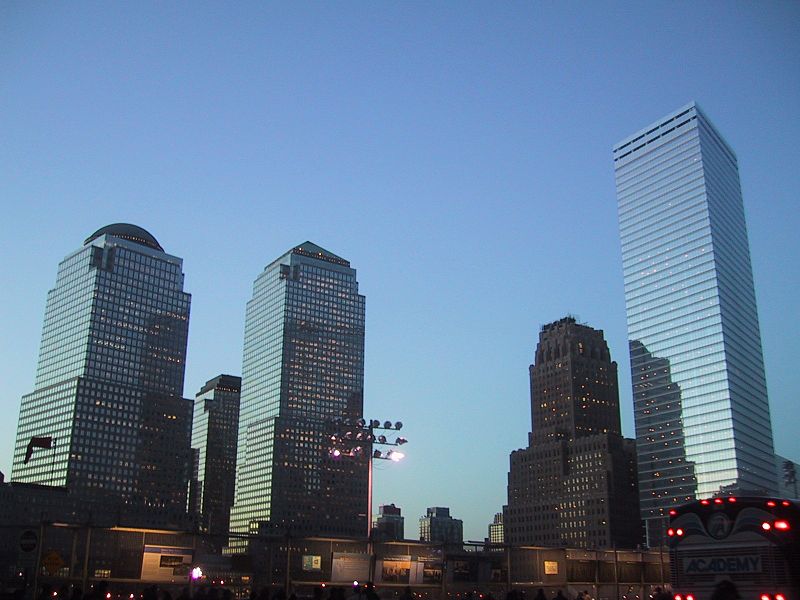
What changes have been made as a result of the World Trade Center (WTC) investigation conducted by the National Institute of Standards and Technology (NIST)? Are tall buildings around the world safe from the risk of global collapse due to fire as described by the official explanations?
In 2008, NIST began claiming that its investigation would help ensure the safety of future buildings. NIST said that such buildings “should be increasingly resistant to fire, more easily evacuated in emergencies, and safer overall” as a result of the WTC investigation. Commerce Secretary Carlos Gutierrez, the Bush Administration cabinet member in charge of NIST at the time, said, “The lessons learned from the tragic events of 9/11 have yielded stronger building and fire codes for a new generation of safer, more robust buildings across the nation.”[1]
Is this true? If so, we should be able to see improvements being made to the design and construction processes for tall buildings around the world. We should also expect that existing buildings would be evaluated for design problems and retrofitted in an urgent manner to ensure that fires do not bring buildings crashing down as they did on 9/11, killing thousands of unsuspecting victims.
Unfortunately, there are no signs that such design evaluations and retrofit projects have occurred. This is a strong indication that the international building community has not taken the NIST WTC reports seriously.
In a few stunning instances, the NIST findings were never considered at all prior to building design and construction. An example is the new WTC building 7, which was fully completed in 2006. That same year, NIST spokesman Shyam Sunder was saying, “We’ve had trouble getting a handle on building No. 7.”[2] To clarify, in 2006 NIST had no idea what happened to the original WTC 7, a 47-story skyscraper that was not hit by a plane yet collapsed into its own footprint in a matter of seconds on 9/11. Therefore the new, even taller, WTC 7 could not have incorporated any design or construction changes resulting from the NIST investigation. Apparently people still use the building, however, and do not seem bothered by the risk.
How about for other buildings in New York City and elsewhere, including the widely publicized replacement for WTC 1 being completed this year? In order to answer that question, we should review a little history behind the NIST WTC investigation.
The NIST WTC Investigation
According to NIST, the original Twin Towers were built to meet the 1968 NYC building code requirements.[3] This code required three hours of fire resistance for the steel column components and two hours of fire resistance for the floor assemblies. A startling discrepancy here is that the south tower was said to be completely destroyed less than one hour after the fires began. And what people often don’t realize is that fire is the primary explanation for failure of all three WTC buildings.
NIST did not explain this discrepancy directly. Instead, the NIST WTC reports, which amount to tens of thousands of pages, reflected the results of computer modeling that proposed three root causes.
- “Widely dislodged” fireproofing – the Twin Towers
- Linear thermal expansion – WTC 7
- “Progressive global collapse” – all three buildings [4]
Progressive global collapse was a term that NIST used frequently throughout its investigation despite the fact that no tall building had ever collapsed completely due to fire. In fact, the only three instances of progressive global collapse for any reason other than demolition occurred all in the same place (at the WTC) at the same time (on 9/11).
With respect to the fireproofing (i.e. insulation) loss in the towers, NIST said, “The WTC towers would likely not have collapsed under the combined effects of aircraft impact and the extensive, multi-floor fires if the thermal insulation had not been widely dislodged or had been only minimally dislodged by aircraft impact.”
At the time of the 9/11 attacks, the WTC towers were undergoing a fireproofing upgrade to better ensure the buildings’ fire resistance. In an incredible coincidence, the floors where the full fireproofing upgrades had been completed were the same floors that were struck by the aircraft on 9/11.[5]
The true condition of the fireproofing in the WTC towers at the time of impact has been misrepresented by supporters of the official account. These official account supporters produce old photos of the fireproofing condition prior to the upgrades. What they don’t tell you is that the upgraded fireproofing, for example on the impact floors of the north tower, was measured before the attacks and found to be 3.25 inches thick. This was twice what was required by the NYC code. What’s more, inspectors found that the adhesion, or bond strength, of the newly installed fireproofing was twice as high as what was required.[6]
How did this newly installed, superior fireproofing in the towers get “widely dislodged” as proposed by NIST?
We don’t know because NIST produced a startling lack of scientific evidence for its central claim that the fireproofing was widely dislodged. In fact, the only evidence NIST presented for this was a test in which 15 rounds from a shotgun were aimed at various non-representative samples. A shotgun may have been needed due to the fact that other tests NIST had performed showed the bond strength of the WTC fireproofing to be “considerably greater” than what was expected.[7]
For WTC 7, the root cause cited by NIST was the dislocation of a girder caused by the linear thermal expansion of floor beams. The expanding composite beams were said to have caused the breakage of over one hundred high-strength bolts and other structural connections, and thereby the failure of a girder supporting a critical column.
However, other scientists submitted public comments to NIST about actual physical tests they had done, which NIST avoided entirely, that indicated such a sequence was not realistic. “Having conducted numerous fire tests on composite beams, we have never observed this,” wrote Dr. David Proe of Victoria Universty.[8]
As a whole the NIST WTC reports were found to be unscientific and false.[9] And because the computer models upon which these reports were ultimately based have never been made available to the public, the NIST findings cannot be replicated.
Ignoring NIST’s Recommendations
Regardless of the lack of scientific validity of the WTC reports, NIST represents a standard making body of the U.S. government and its findings should compel U.S. professionals to make changes to their practices. To see if building professionals and local government regulators have followed NIST’s lead, we should examine the relevant building codes for any updates resulting from the NIST WTC investigation.
The International Code Council (ICC)’s International Building Code (IBC) provides a general guidance for local code makers in the United States. Following the IBC code is not a requirement for local governments, however. Translation of the code into local code requirements is strictly a discretionary decision.
Although the ICC praised NIST and its contractors for the hard work that had gone into the NIST WTC investigation, the fact is that ICC did not incorporate relevant changes into its IBC code as a result.
In its 2008 press release on the subject, NIST claimed that the IBC code had changed to “address areas such as increasing structural resistance to building collapse from fire and other incidents; requiring a third exit stairway for tall buildings; increasing the width of all stairways by 50 percent in new high-rises; [and] strengthening criteria for the bonding, proper installation and inspection of sprayed fire-resistive materials.”
Of course, additional and wider exit stairways cannot prevent the catastrophic collapse of a skyscraper from fire. But NIST was not telling the truth about the ICC having adopted code changes to increase structural resistance to the kinds of building collapse phenomena proposed by the WTC reports.
A 2010 press release from NIST added “better communications” to the list of ICC-adopted recommendations from the WTC investigation.[10] It’s true that the radios used by firefighters in the WTC were a concern, and were actually known by NYC officials to be faulty as early as 1993.[11] However, no amount of radio-related code differences would have prevented the unprecedented destruction of the buildings. Similarly, NIST’s evacuation recommendations had no relevance to the root cause of the WTC destruction.
NIST had to admit that ICC did not adopt the recommendations that called for building professionals to “address areas such as designing structures to mitigate disproportionate progressive collapse.”[12]
In a January 2011 letter to NIST, the ICC confirmed that this was still the case.[13] The only code changes that ICC adopted were:
“1) Luminous egress path marking required; 2) exit stairway enclosures required to be separated by no less than 30 feet; 3) enhanced inspection requirements for Sprayed-on Fire-Resistant Material (SFRM).”
And for buildings higher than 420 feet:
“1) Increased bond strength for SFRM; 2) a second, additional exit stairway, with a minimum separation between stairwells; 3) a requirement to increase structural integrity of exit enclosures and elevator hoist enclosures; 4) redundant sprinkler system risers with alternate floor requirements.”
Of these changes, only the two related to SFRM can be seen as linked to the official account of the collapse of the buildings. But even these changes were not planned for addition to the IBC code until release of the 2012 edition. Apparently the concerns about the SFRM and its bond strength were not that great.
That might be because it’s tough to see how the SFRM code changes were related anyway. That is, the ICC changes to require greater fireproofing bond strength cannot be reconciled with the fact that the fireproofing in the alleged failure areas of the towers was already far greater than what the code required. Yet still the buildings suffered “progressive global collapse,” a phenomenon for which the ICC made no changes.
As for the inexplicable collapse of WTC 7, the ICC made no changes there either. The alleged root cause of floor beam thermal expansion is not addressed by any ICC code change.
How about New York City and government leaders in general? Were federal and state leaders, municipalities and building professionals willing to put money into the relevant recommendations made by NIST, and thereby endorse the official explanations for what happened at the WTC? No, they were not.
The current (2008) NYC code includes changes that were said to be modeled after the ICC’s changes, which were said to be a result of the NIST WTC investigation. However, the actual changes made were not related to NIST’s three root causes of the WTC destruction. Instead, they focused on “widened stairwells in high-rise buildings, expanded sprinkler systems, and enhanced emergency voice communication systems.”[14]
The NYC building code includes a requirement for SFRM bond strength that clearly does not take the WTC investigation into account. The requirement is that the bond strength “shall not be less than 150 pounds per square foot (psf).“[15] The problem is that the bond strength of the fireproofing in the WTC was known to be much higher than this and yet we’re told it was still widely dislodged.
The Port Authority of NY and NJ provided 64 bond strength measurement values to NIST, taken from the fireproofing in the impact and failures zones of the WTC. NIST even listed these in its report. None were as low as 150 psf and most were twice that value.[16] The failure to increase the bond strength requirement in the building code, leaving it at a value that was far lower than what the WTC had in place, indicates that NYC officials are not in the least bit worried about bond strength.
Related to WTC 7, the 2008 NYC code also refers to the need to ensure that the fire-induced expansion of building components (e.g. steel beams) does “not adversely interfere with the system’s capabilities.”[17] But the 1968 code included similar requirements and even stated that the coefficient of expansion for all building materials needed to be addressed in test reports.[18]
More specifically, the 1968 code that WTC 7 was required to meet stated that the design “shall provide for forces and/or movements resulting from an assumed expansion corresponding to a change in temperature.” Therefore not only was there no change as a result of the NIST WTC 7 report, given the NIST account we might wonder if the original WTC 7 was constructed outside of the NYC code requirements.
Another Reason the NIST WTC Reports Are False
Despite its grandiose claims, NIST knows that the building community has ignored the WTC investigation findings. That’s clear from NIST’s own tracking sheet on its website. This tracks all 30 recommendations from the NIST WTC investigation and lists the code “outcomes” from each.[19] As of August 2011, the most recent update, not one NIST recommendation related to progressive global collapse, “widely dislodged” fireproofing, or linear thermal expansion has been adopted.
The two NIST recommendations that call for (unspecified) measures to prevent progressive global collapse have been completely ignored. Other things like an additional exit stairway, a fire service access elevator, and stairwells with glow-in-the-dark markings are simply not relevant.[20]
NIST might argue that there is one ICC change that calls for fireproofing to have increased bond strength and be installed and inspected correctly. But since bond strength was not a root cause of the WTC destruction, and measurements just before 9/11 showed that the fireproofing in the impact zones was far better installed and had far better bond strength than what was required, this is a red herring. That’s not to mention that no tests were ever done to indicate what bond strength was needed to resist flying aircraft debris.
Are tall buildings safer as a result of the NIST WTC report? No, they are most certainly not. And if people actually understood and believed the official account of what happened at the WTC they would not enter tall buildings because in doing so they would be putting their lives at risk.
The truth, however, is that the NIST WTC investigation was a politically motivated diversion that produced reports which are known to be false. This fact is re-emphasized by the knowledge that the international building community, including that of New York City, has not adopted code changes that can be traced to the root causes cited by NIST for the WTC destruction.
Notes
[1] NIST, Safer Buildings Are Goal of New Code Changes Based on Recommendations from NIST World Trade Center Investigation, October 1, 2008, http://www.nist.gov/el/wtc_100108.cfm
[2] Marc Jacobsen, The Ground Zero Grassy Knoll, New York Magazine, Mar 19, 2006, http://nymag.com/news/features/16464/
[3] NIST NCSTAR 1-1F, Executive Summary, p XXV, http://fire.nist.gov/bfrlpubs/fire05/PDF/f05176.pdf
[4] The NIST WTC reports can be found at http://wtc.nist.gov
[5] Kevin R. Ryan, Another amazing coincidence related to the WTC, 911Blogger.com, January 6, 2008, http://www.911blogger.com/node/13272
[6] For the SFRM thickness and adhesion values, see NIST WTC report NCSTAR 1-6A, figure A-60, http://fire.nist.gov/bfrlpubs/build05/PDF/b05035.pdf
[7] Kevin R. Ryan, The Short Reign of Ryan Mackey, Journal of 9/11 Studies, December 2007, http://www.journalof911studies.com/letters/b/MackeyLetter.pdf
[8] Public Comments Received by NIST on DRAFT Reports, August 2008,http://www.nist.gov/el/disasterstudies/wtc/upload/combined2008publicComments-2.pdf, See also – Fire Safety Researchers at Victoria University Disagree with NIST’s WTC 7 Report, http://uwaterloo911.wordpress.com/2012/03/15/fire-safety-researchers-at-victoria-university-disagree-with-nists-wtc-7-report/
[9] An easy way to see to understand the falsity of the NIST WTC reports is to watch my two short videos on the subject — Why the NIST Report for the Towers is False,https://foreignpolicyjournal.com/2011/08/16/why-the-nist-report-on-the-wtc-towers-is-false/ and Why the NIST WTC 7 Report is False,http://digwithin.net/2011/07/09/why-the-nist-wtc-7-report-is-false/
[10] NIST WTC Recommendations Are Basis for New Set of Revised Codes, June 9, 2010
[11] Wayne Barrett, Rudy Giuliani’s Five Big Lies About 9/11, The Village Voice, July 31, 2007, http://www.villagevoice.com/2007-07-31/news/rudy-giuliani-s-five-big-lies-about-9-11/full/
[12] NIST, Safer Buildings Are Goal of New Code Changes Based on Recommendations from NIST World Trade Center Investigation, October 1, 2008, http://www.nist.gov/el/wtc_100108.cfm
[13] National Institute of Standards and Technology: Request for Information, International Code Council, Docket No. 0909100442-0563-02, January 12, 2011, http://standards.gov/upload/35_ICC.pdf
[14] The Real Deal, New York City Real Estate News, New buildings must meet latest NYC construction code, July 01, 2009, http://therealdeal.com/blog/2009/07/01/new-buildings-must-meet-latest-nyc-construction-code-robert-limandri-nyc-construction-codes/
[15] 2008 New York City Building Code, section 909.4.2 Temperature Effect of Fire, section 1704.11.5 http://www2.iccsafe.org/states/newyorkcity/Building/Building-Frameset.html
[16] NIST NCSTAR 1-6A, p 45
[17] 2008 New York City Building Code, section 909.4.2 Temperature Effect of Fire, section 909.4.2 http://www2.iccsafe.org/states/newyorkcity/Building/Building-Frameset.html
[18] 1968 New York City Building Code, Article 2: Fire protection test Procedures, http://www.nyc.gov/html/dob/html/codes_and_reference_materials/code_internet.shtml
[19] Status of NIST’s Recommendations Following the Federal Building and Fire Investigation of the World Trade Center Disaster, NIST WTC website, August 8, 2011, http://www.nist.gov/el/disasterstudies/wtc/upload/WTCRecommendationsStatusTable.pdf
[20] Building design and Construction (Staff), NIST WTC recommendations finally adopted in the model building codes, August 11, 2011, http://www.bdcnetwork.com/nist-wtc-recommendations-finally-adopted-model-building-codes
