
A group known as Citizen Investigation Team (CIT) has proposed that the plane that was hijacked and turned back to aim at the Pentagon on 9/11 passed north of the former Citgo service station. From this position, it could not have done the observed damage; hence CIT claims that the damage was faked, using explosives, and that the plane must have flown over the Pentagon to avoid causing damage in the wrong direction.
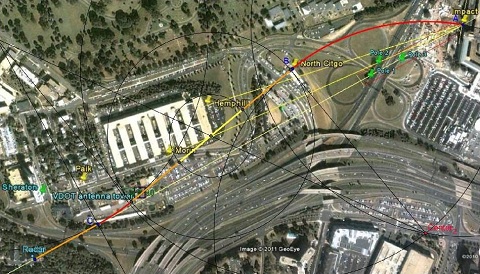
David Chandler and I prepared a paper proving this flight path to be highly improbable.[1] In calculating the easiest course, the assumption was made that the plane would deviate as early as possible, so as to minimize the bank angle and wing load. The path of the plane is shown in the image below (Fig. 1), copied from the original paper, where the turn-off is at the last radar position. The roll from a left to a right bank was assumed to be completed in 0.5 seconds. Calculation shows that the plane would have to be banked at 76.5 degrees, with a wing load of 4.3g, to perform the turn at the official speed. If the plane was flying faster, as indicated by the flight data recorder (FDR) file,[2] or if the roll took longer, the bank and wing load would be greater. Even a highly skilled aerobatic pilot would find this turn very difficult, and the survival of the plane would be at least in doubt, as its design load limit is only 2.5g.

Figure 1: Flight path assuming turnoff at the earliest reasonable point; the last radar position.
We pointed out in the paper that a bank of this order would be so unusual for a passenger plane that it would have astonished observers and would be unforgettable. In support of this opinion, an image of a plane banked at about 70 degrees is shown below (Fig. 2).[3] It is obviously a remarkable sight, yet most witnesses made no comment about bank angle and those that did mention it said the angle was slight.[4] The improbability of the many witnesses failing to comment on this extraordinary bank angle, had it occurred, was the basis for our conclusion that it did not occur and that the claimed north path could not have happened. If a south path is accepted, the observed damage is explained and there is no justification for invoking theories of flyover and faking of damage using explosives.

Figure 2: A passenger plane at a bank angle of about 70 degrees.
As stated above, an assumption was made in the previous calculations that the plane could complete its roll from a left to a right bank in 0.5 seconds. This very short period was chosen to avoid criticism that the calculation was biased against the north path. More relevant than roll rate would be the initial behavior of the plane when full control input was applied, as this plane, with its outboard engines and heavy fuel tanks in the wings, would have appreciable inertia. It seemed the initial roll action would be hard to discover, but an estimate may readily be obtained by studying the FDR file from United Airlines flight 93,[5] a portion of which is shown in an a National Transportation Safety Board (NTSB) animation released under the Freedom of Information Act (FOIA) and available on YouTube.[6]
Full application of the control wheel produces no more than about 40 degrees of roll in the first second. A similar period would be required to decelerate the roll as it nears completion. Well over two seconds would thus be required for the complete roll, consuming a considerable portion of the time available for the left and right turns. The values shown above, a bank of 76.5 degrees and a wing loading of 4.3 g, are thus found to be substantial underestimations. This strengthens the claim that the plane would be highly unlikely to survive the maneuver required to pass north of the Citgo service station and still arrive in the vicinity of the impact point.
It seems likely that the north path theory was derived from the faulty recollection of the approach path by a small number of carefully selected witnesses.[7] This is an important issue as many people apparently have not studied the evidence with care or have failed to recognize the implications of the evidence.
Witness Review
We now wish to return to the original discussion and focus attention on the best evidence available regarding the bank angle of the plane as it approached the Pentagon. All reports in which the bank has been described as slight contradict the north path theory as they indicate that the final few seconds of the flight must have been virtually straight, in agreement with the FDR file.[8] All witnesses who report seeing the impact contradict the flyover theory in the most direct way possible.[9] Among the many witnesses to impact are Albert Hemphill and Terry Morin. Hemphill says the plane was always on his right and descended straight to impact with the Pentagon.[10] Morin says he stepped out from between the wings of the Naval Annex and watched the plane descending, going parallel with the Annex, and therefore straight;[11] see their lines of sight in the image above (Fig. 1, more clearly identified in Fig. 7).
Darrell Stafford and Darius Prather provide testimony which is particularly convincing because of the way they illustrate it, using a model plane.[12] They describe the plane as flying with wings level, going over the roof of the Annex (Figs. 3 and 4). Their testimony is well known, but we are not aware of any thorough analysis of the implication of their observations.

Figure 3: Stafford: “Flat on top of the roof” (of the Naval Annex)

Figure 4: Prather: “This is the Navy Annex…” (referring to his left hand)
