Page : 1 2 3View All

Ex-ISI Chief Says Purpose of New Afghan Intelligence Agency RAMA Is ‘to destabilize Pakistan’

by Jeremy R. Hammond

August 12, 2009

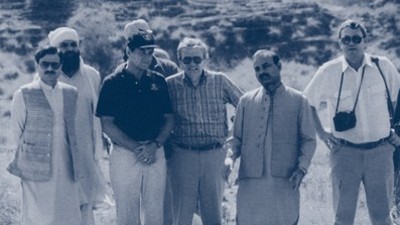
Then Maj. Gen. Hamid Gul, Director General of the ISI (far left), with William Webster, Director of Central Intelligence, Clair George, Deputy Director for Operations, and Milt Bearden, CIA station chief, at a training camp for the mujahedeen in Pakistan's North-West Frontier Province in 1987 (RAWA.org)

Then Maj. Gen. Hamid Gul, Director General of the ISI (far left), with William Webster, Director of Central Intelligence, Clair George, Deputy Director for Operations, and Milt Bearden, CIA station chief, at a training camp for the mujahedeen in Pakistan's North-West Frontier Province in 1987 (RAWA.org)

In an exclusive interview with Foreign Policy Journal, retired Lt. Gen. Hamid Gul responds to charges that he supports terrorism, discusses 9/11 and ulterior motives for the war on Afghanistan, claims that the U.S., Israel, and India are behind efforts to destabilize Pakistan, and charges the U.S. and its allies with responsibility for the lucrative Afghan drug trade.

Retired Lieutenant General Hamid Gul was the Director General of Pakistan’s Inter-Services Intelligence (ISI) from 1987 to 1989, during which time he worked closely with the CIA to provide support for the mujahedeen fighting the Soviet occupation of Afghanistan. Though once deemed a close ally of the United States, in more recent years his name has been the subject of considerable controversy. He has been outspoken with the claim that the terrorist attacks of September 11, 2001 were an “inside job”. He has been called “the most dangerous man in Pakistan”, and the U.S. government has accused him of supporting the Taliban, even recommending him to the United Nations Security Council for inclusion on the list of international terrorists.

In an exclusive interview with Foreign Policy Journal, I asked the former ISI chief what his response was to these allegations. He replied, “Well, it’s laughable I would say, because I’ve worked with the CIA and I know they were never so bad as they are now.” He said this was “a pity for the American people” since the CIA is supposed to act “as the eyes and ears” of the country. As for the charge of him supporting the Taliban, “it is utterly baseless. I have no contact with the Taliban, nor with Osama bin Laden and his colleagues.” He added, “I have no means, I have no way that I could support them, that I could help them.”

After the Clinton administration’s failed attempt to assassinate Osama bin Laden in 1998, some U.S. officials alleged that bin Laden had been tipped off by someone in Pakistan to the fact that the U.S. was able to track his movements through his satellite phone. Counter-terrorism advisor to the National Security Council Richard Clarke said, “I have reason to believe that a retired head of the ISI was able to pass information along to Al Qaeda that the attack was coming.” And some have speculated that this “retired head of the ISI” was none other than Lt. Gen. Hamid Gul.

When I put this charge to him, General Gul pointed out to me that he had retired from the ISI on June 1, 1989, and from the army in January, 1992. “Did you share this information with the ISI?” he asked. “And why haven’t you taken the ISI to task for parting this information to its ex-head?” The U.S. had not informed the Pakistan army chief, Jehangir Karamat, of its intentions, he said. So how could he have learned of the plan to be able to warn bin Laden? “Do I have a mole in the CIA? If that is the case, then they should look into the CIA to carry out a probe, find out the mole, rather than trying to charge me. I think these are all baseless charges, and there’s no truth in it…. And if they feel that their failures are to be rubbed off on somebody else, then I think they’re the ones who are guilty, not me.”

General Gul turned our conversation to the subject of 9/11 and the war on Afghanistan. “You know, my position is very clear,” he said. “It’s a moral position that I have taken. And I say that America has launched this aggression without sufficient reasons. They haven’t even proved the case that 9/11 was done by Osama bin Laden and al Qaeda.” He argued that “There are many unanswered questions about 9/11,” citing examples such as the failure to intercept any of the four planes after it had become clear that they had been hijacked. He questioned how Mohammed Atta, “who had had training on a light aircraft in Miami for six months” could have maneuvered a jumbo jet “so accurately” to hit his target (Atta was reportedly the hijacker in control of American Airlines Flight 11, which was the first plane to hit its target, striking the North Tower of the World Trade Center at 8:46 am). And he made reference to the flight that hit the Pentagon and the maneuver its pilot had performed, dropping thousands of feet while doing a near 360 degree turn before plowing into its target. “And then, above all,” he added, “why have no heads been rolled? The FBI, the CIA, the air traffic control — why have they not been put to question, put to task?” Describing the 9/11 Commission as a “cover up”, the general added, “I think the American people have been made fools of. I have my sympathies with them. I like Americans. I like America. I appreciate them. I’ve gone there several times.”

At this point in our discussion, General Gul explained how both the U.S. and United Kingdom stopped granting him an entry visa. He said after he was banned from the U.K., “I wrote a letter to the British government, through the High Commissioner here in Islamabad, asking ‘Why do you think that — if I’m a security risk, then it is paradoxical that you should exclude me from your jurisdiction. You should rather nab me, interrogate me, haul me up, take me to the court, whatever you like. I mean, why are you excluding me from the U.K., it’s not understandable.’ I did not receive a reply to that.” He says he sent a second letter inviting the U.K. to send someone to question him in Pakistan, if they had questions about him they wanted to know. If the U.S. wants to include him on the list of international terrorists, Gul reasons, “I am still prepared to let them grant me the visa. And I will go…. If they think that there is something very seriously wrong with me, why don’t you give me the visa and catch me then?”

‘They lack character’

I turned to the war in Afghanistan, observing that the ostensible purpose for the war was to bring the accused mastermind of the 9/11 attacks, Osama bin Laden, to justice. And yet there were plans to overthrow the Taliban regime that predated 9/11. The FBI does not include the 9/11 attacks among the crimes for which bin Laden is wanted. After the war began, General Tommy Franks responded to a question about capturing him by saying, “We have not said that Osama bin Laden is a target of this effort.” The Chairman of the Joint Chiefs of Staff, Richard Myers, similarly said afterward, “Our goal has never been to get bin Laden.” And President George W. Bush himself said, “I truly am not that concerned about him.” These are self-serving statements, obviously, considering the failure to capture bin Laden. But what, I asked General Gul, in his view, were the true reasons for the invasion of Afghanistan, and why the U.S. is still there?

“A very good question,” he responded. “I think you have reached the point precisely.” It is a “principle of war,” he said, “that you never mix objectives. Because when you mix objectives then you end up with egg on your face. You face defeat. And here was a case where the objectives were mixed up. Ostensibly, it was to disperse al Qaeda, to get Osama bin Laden. But latently, the reasons for the offensive, for the attack on Afghanistan, were quite different.”

Page : 1 2 3View All

  • Share/Bookmark
Jeremy R. Hammond is an independent political analyst whose articles have been featured in numerous print and online publications around the world. He is the founder and editor of Foreign Policy Journal (www.foreignpolicyjournal.com), an online source for news, critical analysis, and opinion commentary on U.S. foreign policy. He was a recipient of the 2010 Project Censored Awards for Outstanding Investigative Journalism. Read more articles by Jeremy R. Hammond.
http://www.jeremyrhammond.com
Tags: , , , , , , , ,
1 Star2 Stars3 Stars4 Stars5 Stars (6 votes, average: 5.00 out of 5)
Loading ... Loading ...

56 Comments for “Ex-ISI Chief Says Purpose of New Afghan Intelligence Agency RAMA Is ‘to destabilize Pakistan’”

  1. Steve Real

    General Gul sounds like he’s nut job.
    He has the art of conspiracy theories and propaganda down to a politikal science.
    He believes his own hype
    instead of the facts and that’s a real problem.

  2. Caknucklehead

    Well Steve I’d like to know what you think are “the facts?” Just like well trained sheeple to point out that the conspiracy theorists are just plain ol’ nut jobs. I would agree that he sounds like he is spouting some propaganda, and well versed indeed, but just because it doesn’t come for the “main-stream media” doesn’t mean that it doesn’t have some truth behind it.
    Yeremie, this is an excellent story that is sure to open up some eyes, mine included. Great job!

  3. Khurram Zaki

    Interesting replies from Gen Gul. Till this date FBI not dare to indict OBL for 9/11 and no one answers why. Because they have not got any evidence for the purpose and there are serious circumstantial evidence coming out that this was inside job indeed.

  4. David Ray Griffin

    I would encourage readers, rather than dismissing Gul as a “nut job,” to check Patriots Question 9/11 (patriotsquestion911.com), where they can find that Gul’s views about 9/11 are shared not only by many other political leaders but also by numerous architects, engineers, physicists, pilots, firefighters, and former military and intelligence officers. Perhaps “the facts” were somewhat different from what the Bush-Cheney administration claimed they were.

  5. The TAPI pipeline motive suggested by Gul along with his statement that the aggressors sought to keep the Chinese away fails to be confirmed by the facts. Haliburton and G.E. are presently working for China building alternate pipelines and pumping stations from Central Asia directly to China. That conflicts with Gul’s position. He should stick to the facts or at least develop a theory that makes sense.

    Too bad, because he does have some interesting things to say. His credibility is undermined by his adoption of a baseless meme.

    • So, what, atheo, the U.S. isn’t competing with China for the world’s energy resources? Really? And the suggestion that they are doesn’t square with “the facts”? Really? That’s a bit hard to swallow, I must confess.

      General Gul is actually point on about UNOCAL. They led an American consortium that was competing with an Argentine company in wooing the Taliban. The U.S. had no problem with the Taliban until two things happened: 1) a women’s rights movement arose pressuring the Clinton administration to get tough with them, a cause Madeleine Albright took up, and 2) UNOCAL informed the Congress that no pipeline deal could go forward unless the Taliban regime was replaced.

  6. Deryck

    Pretty interesting. What he says is plausible because there are always underlying circumstances beside those that are ostensibly stated that lead a country into a war. From my research into the negative impacts of IMF and World Bank policies in poor countries I realise what he is saying could be true. His insights deserve some investigation.

  7. ROBinDALLAS

    I agree with David Ray Griffin. When it comes to 9/11/01, cui bono? The US military industrial complex and the transnational oil and gas companies were the big winners in both illegal wars. 911 was an inside job. The evidence is overwhelming.

  8. entactogen

    Thanks for providing Guls viewpoint.

    As to UNOCAL one could have added the fact that Karzai (as well as Khalizad) worked for them.

    In regard to the drug trade it´s interesting to note that UNODCs Executive Director Antonio Maria Costa claims to have evidence that some banks have been bailed out by drug money. Unfortunately he does not say which, but a August 14, 2001 article on AIG/Government Sachs by M. Ruppert claims that those institutions are part of the CIA´s laundering of Drug Money.

  9. Rana Asif

    RAMA is realy a news for me.

  10. Sorry Jerry but your world view seems to fail at explaining a few things such as the facts that Sinopec is not only the fastest growing energy producer in North America, but it is also publicly traded in New York. One would also have to wonder why China has been financing the US militarism. Perhaps you should try to answer those questions before becoming to attached to the ‘struggle with China for resources’ meme. If the US were out to stymie Chinese participation in energy production and distribution they could easily start right at home where many of the big new projects are relying not only on Chinese corporations but Chinese engineers also. Who gives them the visas? How do they get the leases? Licenses and Permits? No, America is not in an existential struggle with China for energy. That’s bogus disinformation.

    UNOCAL actually stole the Bridas project from the Argentinians in a complex scheme (you can study the court records). But as it has turned out it’s just a loss all the way around. It would be interesting to see your claimed proof that UNOCAL demanded the Taliban’s ouster, but that would fail to explain the situation anyhow. The new pipelines that have since been built would make any resurrection of the TAPI pipeline uneconomic.

    The best explanation for the NATO presence in the Middle East is that they are securing Israel’s regional dominance by threatening Iran and destabilising Pakistan with its ‘Islamic bomb’. This theory actually comports with reality, the big new military bases in Afghanistan are built closer to Iran than to the Pashtun areas of resistance.

    • atheo, I don’t know how you deduced my “world view” out of a few sentences. More to the point, the fact that there is cooperation between the U.S. and China in some regards doesn’t mean they aren’t also in competition for the world’s energy supplies. It’s absurd to say it’s “bogus disinformation” that the U.S. competes with China for resources. But this is only one motive for the war. You’ve given others, equally valid.

      • “In recent years, China and Russia have forged a strategic alliance, as part of a group called the Shanghai Cooperation Organization, to squeeze the United States out of Central Asia, after the U.S. established military bases here. They have largely succeeded.” – AP http://seattletimes.nwsource.com/html/nationworld/2004077633_chinagame17.html

        Looks like AP fell for this “bogus disinformation”. I guess nobody warned them about the “meme” pitfall. This one example suffices. There’s much more, of course. Take this study: “Managing China-U.S. Energy Competition in the Middle East” http://www.cfr.org/publication/9569/

        • “China will not stop its drive for energy resources in the Middle East, and Middle Eastern energy producers will not follow exhortations from Washington to cut off China. The smarter and potentially more successful U.S. policy would be to try to work with China to give it both a sense of energy security and a shared interest in a stable Middle East.” – Managing China-U.S. Energy Competition in the Middle East

          This has been an evolving policy.

Leave a Reply

Help sustain FPJ

Log in | Designed by Gabfire themes

Switch to our mobile site