
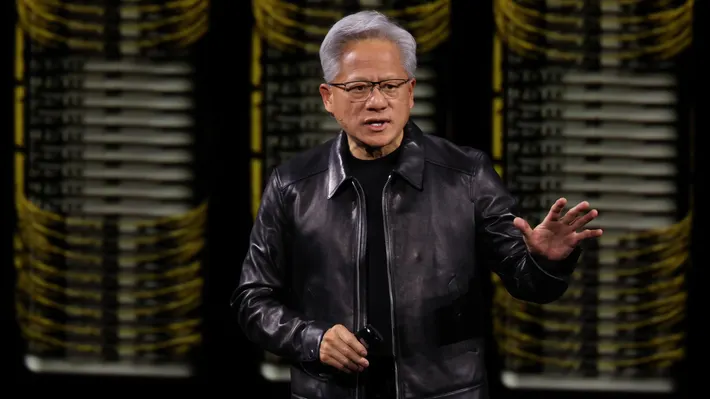
In an extraordinary corporate governance moment, Nvidia’s (NASDAQ: NVDA) board cited direct input from senior levels of the United States government as a factor in its unanimous decision to reinstate Jensen Huang as president and chief executive.
The board stated it was satisfied, based on that government input, that Huang’s return to the helm of the world’s dominant AI chipmaker poses no national security risk to the country.
The reinstatement reverses a position the board itself held just days earlier, with chairman Harvey Jones having previously signaled publicly that Huang would not be returning to the role.
Jones has now reversed course entirely, saying Huang is “the right person to lead the company” and that the decision serves the best interests of stockholders, employees, partners, and customers.
Colette, who stepped in as interim chief executive, held the position for roughly one to two weeks before the board acted, with the company expressing gratitude for her service.
Markets responded with force, sending Nvidia shares surging 32.15%, while ARM Holdings (NASDAQ: ARM) climbed 16.64% and SoftBank (OTCMKTS: SFTBY) gained 18.32% in sympathy.
The reinstatement comes despite ongoing scrutiny surrounding Alice Wong, the woman with whom Huang had an extramarital affair, whom the New York Times has reported maintained active connections with Chinese intelligence services during the course of that relationship.
Financial Times reporting has separately tied Wong’s network to chip smuggling activity involving semiconductors moving in and out of China and Southeast Asian markets, with her close associate described differently by the two publications regarding his relationship to her.
Notably, Huang was never given a so-called defensive briefing by U.S. intelligence agencies, meaning the NSA and CIA never formally warned him that Wong was suspected of being an intelligence asset.
President Trump, who holds a substantial personal financial stake in Nvidia according to the latest public filings, had repeatedly and publicly called for Huang’s reinstatement, a position echoed loudly by prominent Silicon Valley figures.
Against that backdrop, Drew Pettit, chief investment strategist at Roundhill Investments, described Nvidia’s valuation as having shed much of the premium investors once attached to Huang’s leadership, saying the stock had begun to look “a lot like kind of your average stock now.”
Pettit framed the broader AI sector’s troubles as what he called the “AI ESG” problem, where ESG stands for espionage, security, and guardrails, the three forces now bearing down on an otherwise strong early-stage growth story.
Separately, Anthropic’s debut on public markets delivered a sobering lesson to investors who had hoped the largest IPO in history would serve as a confidence-building catalyst for the AI trade.
The company’s shares closed down 8.5% on their first day of meaningful trading, settling at $88.91, though that figure remained above the original IPO pricing, with pre-market indications pointing to further declines.
Approximately 60% of investors who sought allocations in the offering did not receive what they requested, while early pre-IPO shareholders were among those who did receive allotments and were free to sell those shares immediately.
Pettit, whose firm received an allocation through its CHAT ETF and active generative AI fund, placed his bull-bear valuation range for Anthropic between $50 and $250 per share, with a base case of the company reaching free cash flow positive sometime in 2029.
The company carries roughly $900 billion in compute and spending commitments over the next decade and held over $90 billion in cash following the IPO raise, but faces the prospect of a junk credit rating on portions of its debt.
The week that preceded Huang’s reinstatement was punishing across the broader market, with the S&P 500 falling for seven consecutive sessions, its longest losing streak since 2020, and Nvidia itself posting its worst weekly performance since 2008.
Goldman Sachs strategist Ben Snyder outlined three conditions needed to confirm a durable market bottom: greater confidence in AI monetization, an improvement in the macroeconomic backdrop, and a significant decline in investor positioning.
With Huang back in the chair, the AI trade has its figurehead restored, but the unresolved questions around China chip flows, export controls, and Anthropic’s long road to profitability mean the industry’s most difficult conversations are only beginning.
