
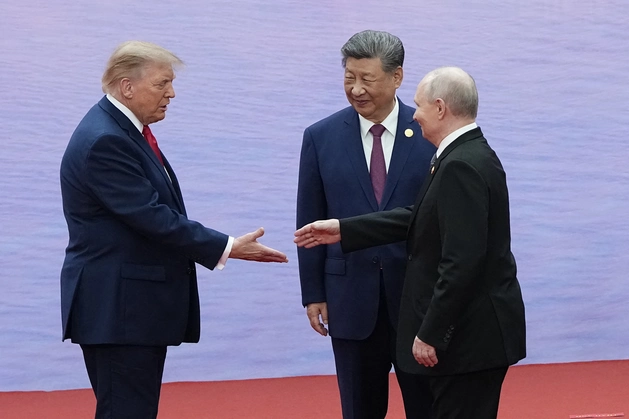
While global attention focused on a trilateral summit in Shenzhen, China, the leaders of the United States, China, and Russia jointly committed to flooding world markets with more refined petroleum.
A joint statement from the summit between Presidents Donald Trump, Xi Jinping, and Vladimir Putin declared that “the three countries plan to increase the production and supply of refined petroleum products for the benefit of all nations.”
The pledge came as fuel prices surged globally, driven by the ongoing wars in Ukraine and Iran, adding economic urgency to a geopolitical alignment that has few modern precedents.
Roughly 5,000 miles west, at the United Nations climate conference in Antalya, Turkey, a revised draft of the summit’s final decision was quietly stripping out every reference to fossil fuels.
An earlier version of the text had demanded “accelerated action to phase out” oil, gas, and coal, language that now appears to have been abandoned entirely in the updated draft circulated to negotiators.
The new draft also removed references to “clean” electricity, a deletion that analysts noted could effectively permit countries to expand fossil fuel-based power generation to meet rising demand.
The dual developments represent a significant setback for climate advocates, who had hoped the Antalya conference would build on the landmark 2023 agreement – the only time a COP final decision had ever referenced fossil fuels – to “transition away” from them.
Saudi Arabia and other oil-producing states had pushed back hard against any restrictive language, making consensus on the earlier, stronger draft text politically unviable heading into the final days of the conference.
Antwi-Boasiako Amoah, who chairs the African group of negotiators at the talks, said the Shenzhen summit represented a direct contradiction of multilateral climate commitments, warning it would mark “hypocrisy in the whole process” if nations agreed to curb fossil fuels at one forum and reversed course at another.
Amoah stated bluntly that “if fossil [fuels] is something that we want to do away with as parties, let’s be honest to our commitment,” adding that he had not been briefed on the Shenzhen agreement before speaking to reporters.
One official present in Antalya, identified as Bowen, pushed back against the idea that the Shenzhen summit signaled disengagement from the climate process, noting that “China is here engaging constructively with us, very actively” and that Beijing was approaching the talks “in a spirit of helping us make it work.”
Bowen’s remarks made no mention of the United States, which is not formally represented at the Antalya conference, nor of Russia, leaving the scope of his defense notably narrow.
Most delegations that were approached for comment Thursday said they needed more time to review the revised draft text, declining to offer immediate reactions to the proposed rollback of fossil fuel language.
