
A federal contract modification worth $985 million went to SpaceX (NASDAQ: SPCX), Blue Origin, and United Launch Alliance on November 16, with Rocket Lab (NASDAQ: RKLB) absent from the list of winners.
That exclusion sent RKLB shares down 4% to $55.20, though the decline follows an 11% monthly gain that left the stock well above where it traded just weeks ago.
SpaceX shares climbed 2% to $140.01 after the award, reinforcing its standing as the dominant force in government launch procurement.
What makes the moment more complex is that both Cathie Wood’s ARK Invest and David Tepper’s Appaloosa Management have been adding to their SpaceX positions, according to the firms’ disclosures.
Yet ARK’s quarterly filing for the period ending September 30 shows the firm simultaneously expanded its Rocket Lab stake, suggesting the fund sees both companies as viable long-term holdings rather than a binary choice.
Rocket Lab’s own commercial pipeline offers some insulation from the government contract setback, with CEO Peter Beck stating that “Nearly $1 billion of that backlog comes from new launch contracts, signed in Q3 2026 alone, as well as $470 million signed for Space Systems.”
The company’s total backlog hit a record $3.57 billion, underpinned by 18 HASTE launches for Space Force Systems Command and eight committed Neutron missions.
Third-quarter revenue surged 72.7% year over year to $267.83 million, though a GAAP loss of $0.12 per share missed analyst expectations, weighed down by a $27.26 million charge for retiring convertible notes and $21.34 million in costs related to a pending acquisition.
Beck has positioned Rocket Lab as one of only two commercial launch operators to have actually scaled a vehicle, telling investors on the November 9 earnings call, “Fundamentally, there have been two commercial companies that have developed a vehicle, brought it to market, and scaled. That has been SpaceX and Rocket Lab.”
Peers trading lower on the same session include AST SpaceMobile (NASDAQ: ASTS), off 3% to $27.75, and Intuitive Machines (NASDAQ: LUNR), down 4% to $11.27, with neither directly competing for orbital launch contracts the way Rocket Lab does.
AST SpaceMobile relies on external launch providers including SpaceX and Blue Origin for more than 100 planned satellite deployments in 2027 and 2028, while its own Blacklift rocket is not expected to fly until late 2028.
An analyst quoted in a November 17 report described AST SpaceMobile’s ambition to build its own rocket within two years as “totally unrealistic,” a remark that also underscores how difficult Rocket Lab’s own Neutron development remains.
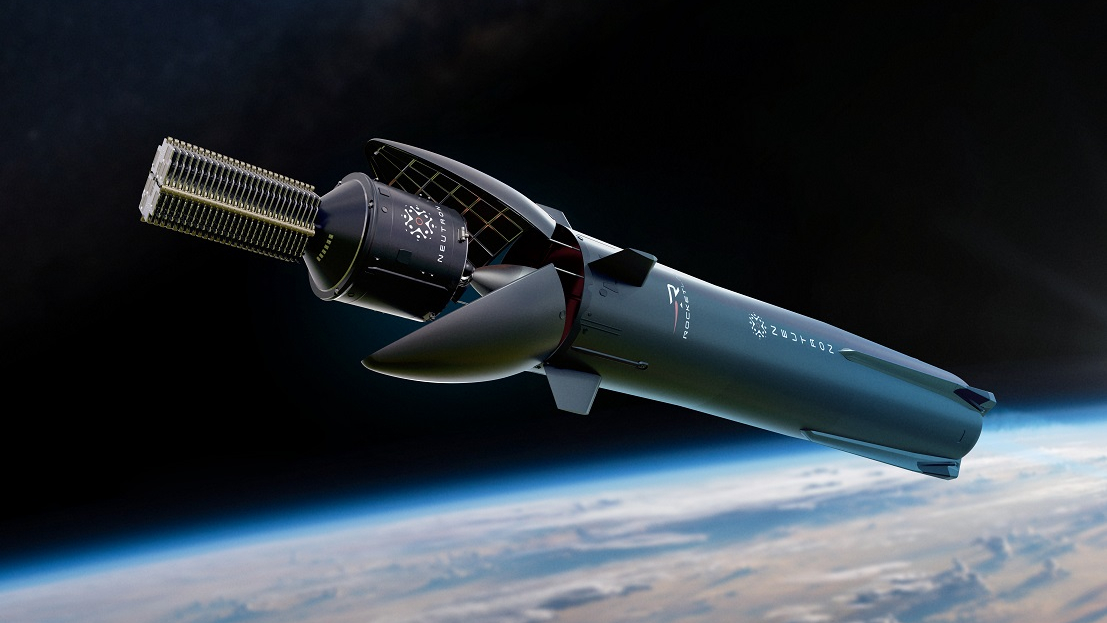
Neutron, a reusable medium-lift vehicle targeting its first flight no earlier than 2027, is Rocket Lab’s primary instrument for competing on larger government payloads currently dominated by SpaceX.
The first 16 Neutron launches are already contracted, with the next available slots pushed into the 2030s, a detail bulls cite as evidence of strong latent demand.
Beck’s argument for the broader opportunity rests on a supply constraint, with the CEO noting that “Launch is extremely constrained,” implying that SpaceX cannot absorb all available government and commercial business alone.
Bears, however, point to the Neutron timeline slippage, persistent GAAP losses, and dilution risk from ongoing at-the-market stock sales as structural headwinds that keep Rocket Lab trailing its larger rival in scale and financial firepower.
Broader market sentiment is also a factor, with investors pulling back on risk assets ahead of an upcoming earnings report from NVIDIA (NASDAQ: NVDA) that is expected to set the tone for technology and growth stocks.
