
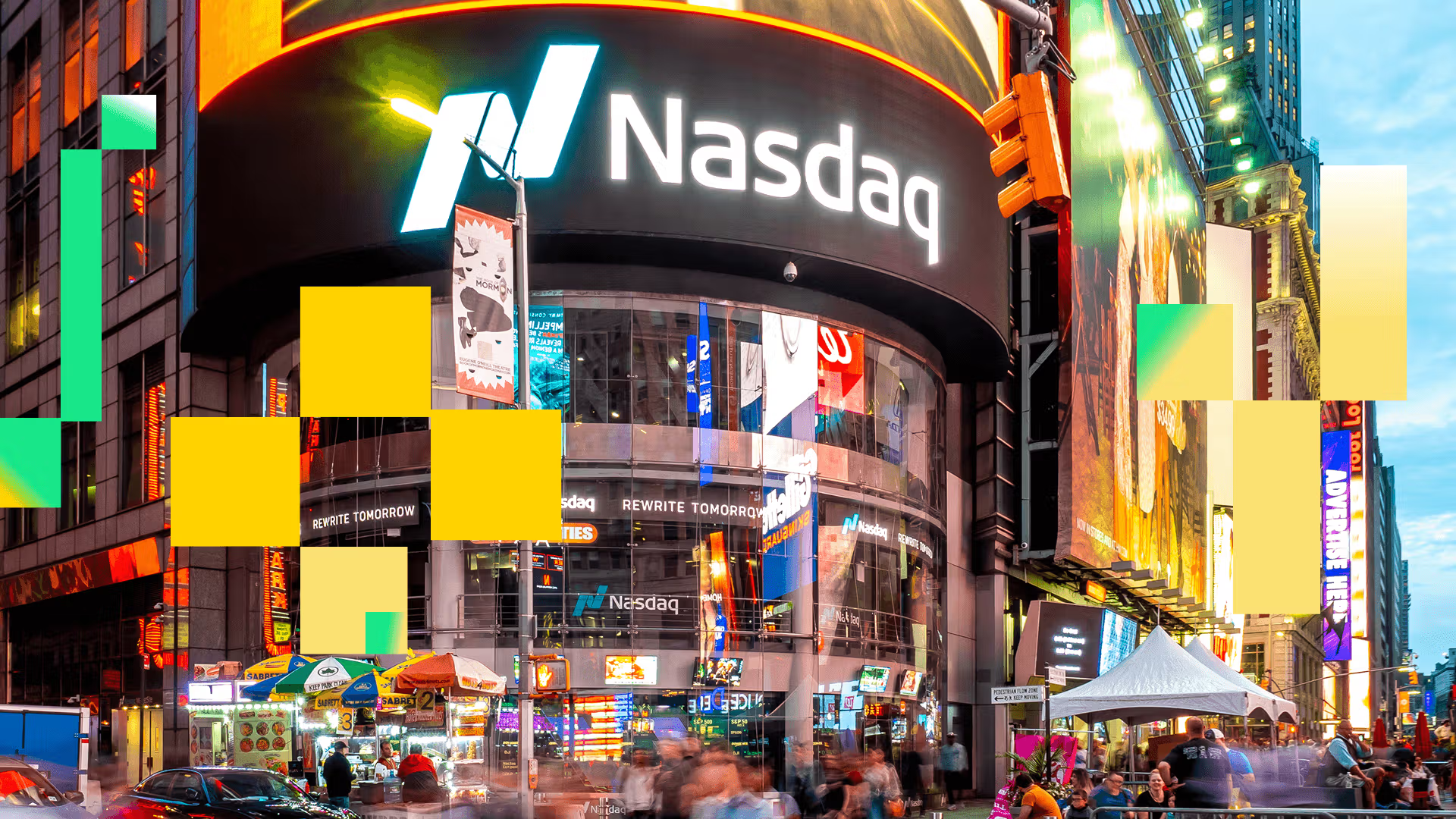
The Invesco QQQ Trust’s (NASDAQ: QQQ) 3.63% surge during the week of Nov. 9 to Nov. 13 marked its strongest single-week performance since August, snapping a four-week losing streak.
The SPDR S&P 500 ETF Trust (NYSE: SPY) advanced 2.59% over the same period, also reversing four straight weeks of declines and providing a rising tide for sector funds.
Consumer ETFs rode that momentum, with the Consumer Staples Select Sector SPDR Fund (NYSE: XLP) posting a 2.52% gain to notch its sixth consecutive weekly advance.
The Consumer Discretionary Select Sector SPDR Fund (NYSE: XLY) added 2.04%, completing a fourth straight week in positive territory, though both sector funds trailed the broader market’s pace.
The Trade Desk (NASDAQ: TTD) delivered the week’s most dramatic individual move, surging 21% after third-quarter results that blew past both analyst estimates and the company’s own lowered targets.
Revenue came in at $736 million, flat year-on-year but well ahead of the roughly $651 million analyst consensus and the company’s prior guidance floor of at least $650 million, while adjusted EPS of $0.33 topped the $0.25 consensus.
Adjusted EBITDA reached $266 million, and the company boosted its share buyback authorization by $731 million, bringing remaining repurchase capacity to $1 billion.
Looking ahead, The Trade Desk set Q4 revenue guidance of at least $755 million alongside at least $280 million in adjusted EBITDA, with customer retention holding above 95%.
CEO Jeff Green described the quarter as “meaningful progress” while conceding that growth remains “below the level of growth we expect from ourselves,” and CFO Nate Olmstead noted political advertising contributed a mid-single-digit percentage of Q3 revenue.
Piper Sandler responded by lifting its price target on TTD to $16 from $14 but maintained a ‘Neutral’ rating, citing better-than-expected underlying business performance even after temporary tailwinds faded.
Charter Communications (NASDAQ: CHTR) climbed 17% after its Nov. 6 earnings call, where CEO Chris Winfrey outlined a sweeping operational reset aimed at halting the company’s loss of internet subscribers.
Winfrey said the company is “fundamentally rethinking how we compete, how we allocate resources, and how we run our business,” with a target of $2 billion in incremental annualized operating expense savings over the next 18 months.
The recently closed Cox acquisition brought 11 million additional passings and more than 5 million customers, alongside more than $1 billion in projected synergies.
Interim CFO Kevin Howard indicated the bulk of free cash flow would be directed toward debt paydown, with Charter targeting a net debt-to-adjusted EBITDA ratio of 3.5 times within three years of finalizing both the Cox and Liberty Broadband transactions.
Tesla (NASDAQ: TSLA) advanced 8.9% as reports emerged that merger discussions between the electric vehicle maker and SpaceX had progressed, with a potential announcement possible as early as December, though sources indicated the timeline could extend into early 2027.
SpaceX carries a market valuation exceeding $1.9 trillion against Tesla’s roughly $1.5 trillion, but significant hurdles persist, including how to ring-fence Tesla’s Chinese operations and handle national security sensitivities tied to SpaceX defense contracts.
JPMorgan analyst Rajat Gupta described those complications as “key dynamics that are at odds with each other,” while Democrats who gained control of Congress in the midterms pledged to scrutinize Elon Musk’s business dealings.
Tesla’s shareholder meeting is scheduled for Dec. 3, adding another near-term focal point for investors tracking the potential combination.
On the losing side, Groupon (NASDAQ: GRPN) plunged 19% after reporting weaker-than-expected Q3 results and trimming its outlook, prompting Goldman Sachs to slash its price target to $11 from $16 while maintaining a ‘Sell’ rating.
Stellantis (NYSE: STLA) dropped 13% amid a standoff with Canadian authorities over its idled Brampton, Ontario plant, with Industry Minister Melanie Joly issuing a notice of default after the automaker offered to return only C$24 million ($16.8 million) of the federal support it received, despite Joly’s assertion that the company owes hundreds of millions.
Alibaba (NYSE: BABA) fell 13% as Chinese technology firms scrambled to secure overseas Nvidia-powered computing capacity, fearing that controversy surrounding Nvidia CEO Jensen Huang could accelerate passage of the Remote Access Security Act, which has cleared the House and now awaits a Senate vote, targeting countries that attempt to circumvent U.S. technology export controls.
