
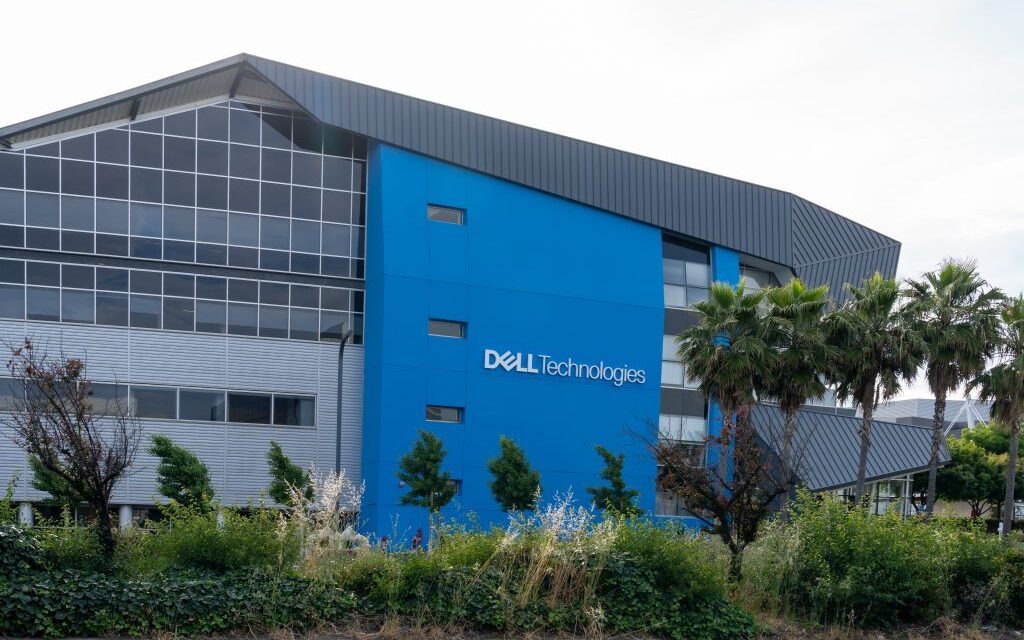
A record $95 billion AI order backlog may be the only buffer standing between Dell Technologies (NYSE: DELL) and a deeper reckoning after an industry-wide selloff erased billions in market value Friday.
Dell shares fell 11% in afternoon trading to $421.74, compared with the prior session’s close of $475.51, even as the stock holds a remarkable 239% gain year to date.
The trigger was Intel (NASDAQ: INTC) CEO Lip-Bu Tan, who on the company’s October 29 earnings call delivered a stark assessment of the PC supply chain’s condition.
“In recent weeks, our customers began signaling a PC slowdown based on the memory prices and availability,” Tan said, adding that “our OEM partners are aggressively managing inventory to match the softer sell-through.”
Intel indicated it does not expect conditions to improve until memory prices and availability begin to normalize, a timeline that offers little comfort to hardware assemblers dependent on affordable components.
The squeeze cuts two ways for Dell, which sells consumer and commercial PCs through its Client Solutions Group while running a high-growth AI server and networking business through its Infrastructure Solutions Group.
That AI division recorded $60.9 billion in orders and pushed the company’s backlog to $95 billion, figures Dell disclosed on September 1 alongside a raised fiscal 2027 revenue outlook of $192 billion.
Dell’s most recent quarterly earnings per share came in at $3.89, beating analyst estimates, giving bulls a concrete data point to push back against Friday’s sell pressure.
HP Inc. (NYSE: HPQ) suffered the next-largest decline among major hardware names, dropping 9% to $28.99, though the stock remains 35% higher for the year.
HP’s exposure to the Intel warning is arguably the most direct of any company in the group, given that Personal Systems accounts for the majority of its revenue, and the company already flagged rising memory and storage costs as a risk when it reported a 16% drop in PC unit shipments on August 26.
Hewlett Packard Enterprise (NYSE: HPE), which focuses on enterprise servers and networking rather than consumer PCs, fell 7% to $54.70 but retains a 130% year-to-date gain, supported by server revenue growth of 35.3% in Q3 FY2026.
Super Micro Computer (NASDAQ: SMCI), a pure-play AI server builder with no consumer PC exposure, also declined 7% to $32.10, leaving it up just 10% for the year and well below its annual high of $51.40.
Options sentiment around Super Micro looks cautious ahead of its November 3 earnings report, with Schaeffer’s noting a 10-day call/put volume ratio of 4.99 that ranks above 90% of the past year’s readings, a historically bearish signal.
Super Micro has averaged a 14.2% post-earnings move and finished lower after eight of its last 12 reports, though it has strung together three consecutive double-digit gains following recent quarters.
A separate line of concern running beneath the PC supply story involves the sustainability of hyperscaler capital spending, which analyst Brian Sozzi of Yahoo Finance identified as a driver of the broader technology selloff.
Google’s quarterly free cash flow turned negative $9.1 billion, while Amazon’s trailing 12-month free cash flow reached negative $42.4 billion, raising questions about how long data center buildout can continue at its current pace.
Hardware assemblers like Dell and its peers are particularly vulnerable to both pressures because thin margins leave little room to absorb rising component costs or a slowdown in customer orders.
The resolution of memory supply constraints and the trajectory of hyperscaler server commitments will likely determine whether Dell’s AI backlog proves sufficient to offset the weakness in its PC business through the remainder of the fiscal year.
