
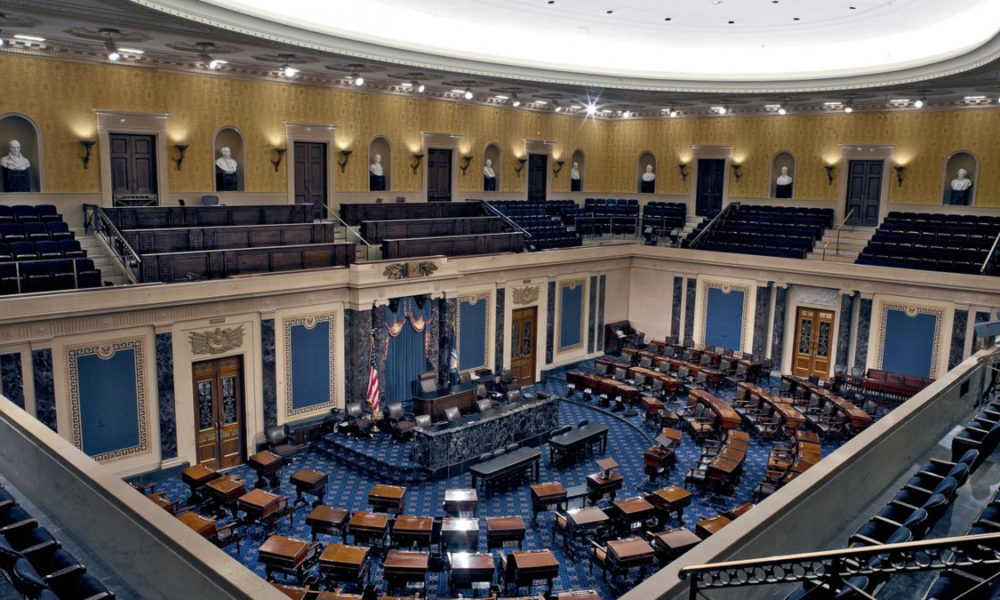
With most federal policy requiring Congressional approval before taking effect, the November 3 midterm elections will determine how freely President Donald Trump can pursue his domestic and foreign priorities.
Republicans currently hold majorities in both chambers, but their margins are narrow, with the House standing at 218 Republicans against 214 Democrats and one independent who typically sides with the GOP.
Analysts widely expect Democrats to claw back the lower chamber, where they need just four additional seats to reach the 218 required for a majority, with competitive toss-up districts identified in Iowa, Virginia, and Montana.
Election analyst J. Miles Coleman of the Center for Politics at the University of Virginia put the situation bluntly, telling CBS in late October that “it would be a surprise if the Democrats don’t at least take the House [of Representatives].”
In the Senate, Republicans hold a more comfortable 53-seat advantage over 45 Democrats, with two independents who generally vote alongside the Democratic caucus, and Democrats would need four additional seats there to flip control.
When Senate votes deadlock at 50-50, Vice President JD Vance currently holds the tiebreaking power, a dynamic that would disappear entirely if Democrats secured their own majority.
Among the Senate contests drawing the most attention is Texas, where Democrat James Talarico sits level in current polls with Republican rival Ken Paxton, a race that would be a political earthquake given that no Democrat has carried the state at that level since 1994.
Talarico’s campaign has drawn an unlikely source of encouragement, winning backing from members of the Bush family, the Texas Republican dynasty that produced both former President George H.W. Bush and his son, former President George W. Bush.
Beyond Congress, 36 states are holding gubernatorial elections, and two races carry the potential to produce a historic first, with Black candidates competing for governor in both Minnesota and Georgia.
In Georgia, Black Democrat Keisha Lance Bottoms faces Republican Rick Jackson in a race that polling describes as genuinely competitive, giving Bottoms what analysts consider a realistic path to becoming the first Black woman elected governor in American history.
Minnesota’s contest pits Democrat Amy Klobuchar, a senator of nearly two decades’ standing in the state, against Black Republican Lisa DeMuth, though DeMuth is considered an underdog in a state with a strong Democratic voting pattern.
Coleman has long described midterm elections as “often a referendum on the president and party currently in power,” a framework that weighs heavily this cycle given that Trump’s approval ratings have sunk to a record low.
All 435 House seats are contested simultaneously, with each member serving two-year terms and representing a single electoral district allocated according to population, meaning states like Wyoming hold just one seat while New Jersey commands 12.
The Senate’s 100 seats, two allocated to each state regardless of size, operate on six-year terms with roughly one third coming up for election every two years, leaving 35 seats on the ballot in this cycle.
Voter participation in midterms has historically trailed turnout seen in presidential election years, but the outcome will shape the practical limits of executive power in Washington for years ahead.
