
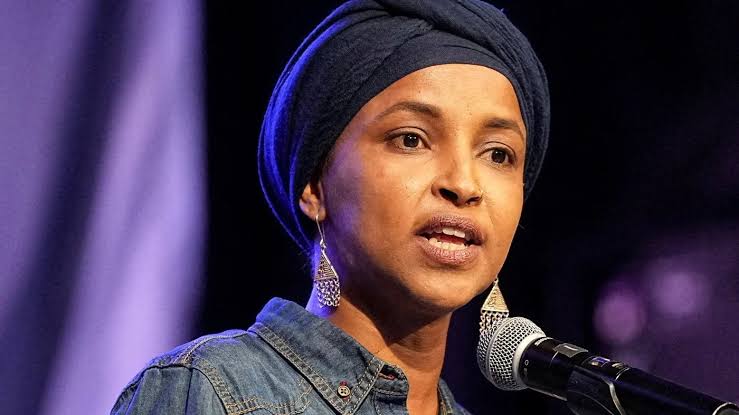
A Gaza-born real estate mogul with a federal conviction on his record welcomed Rep. Ilhan Omar (D-Minn.) back into public view last Friday, hosting her at Minneapolis’s Karmel Mall of Somalia just eleven days after federal agents raided her Washington home.
The Oct. 12 raid has placed Omar under intensifying scrutiny, with sources familiar with the criminal investigation identifying her legal name as Ilhan Nur Said Elmia rather than the name she uses publicly.
Karmel Mall owner Basim Sabri, who spent 33 months in federal prison following a 2005 bribery conviction involving a Minneapolis public official, has built one of the city’s most distinctive commercial landmarks since his release.
The four-floor, 900-vendor structure on Lake Street operates more like a covered bazaar than a conventional American shopping center, with tenants lifting metal garage doors each morning to signal that their shops are open.
Sabri describes it as the world’s largest Somali mall and also claims it surpasses every other retail complex within Minneapolis city limits, a distinction that puts it in conversation with the Mall of America located just miles away in Bloomington.
“It is kind of an incubator setting where many businesses start in here, and then many succeed and grow and move somewhere else, to a bigger space,” Sabri said, framing the mall as a launching pad for immigrant entrepreneurs.
Omar arrived after she and Minnesota Attorney General Keith Ellison cast early votes at a Minneapolis polling station, and the pair were accompanied throughout their visit by security personnel.
The mall’s dining area, where Omar lunched with members of the Somali community and Ellison, is draped in Somali, Palestinian, and American flags displayed at equal height, beneath a light-blue ceiling painted with a white star echoing the Somali national banner.
Vendors in the food hall serve sambusas, a flaky fried pastry stuffed with meat and spices, alongside bijaye, a fried cornmeal dish comparable to a hush puppy, and plates of goat meat with basmati rice.
Beyond the food stalls, the mall houses prepaid international SIM card vendors, money transfer shops including World Direct Link Corp. which facilitates remittances to Somalia and Kenya, travel agencies routing customers to East Africa and the Middle East, traditional Somali clothiers, and barbershops.
Elderly men in traditional dress and koofiyad, the brimless white caps common in Somali culture, occupy metal chairs along the open walls, while English functions as a secondary language throughout the building.
Sabri’s personal profile adds further complexity to the setting: he sends his son to Institut Le Rosey in Switzerland, an elite boarding school known as the “School of Kings” that carries an annual tuition of roughly $184,000.
He holds considerable sway over local political figures, whom he colorfully described to reporters as “whores,” and he leveraged that influence to arrange a press interview with Minneapolis City Council Vice President Jamal Osman.
Sabri previously demonstrated his willingness to use the mall as a political instrument when he barred Democratic Mayor Jacob Frey from the premises in February 2024 after Frey vetoed a City Council resolution calling for a ceasefire in Gaza.
He told Fox News Digital he was personally acquainted with Omar’s late father, though he declined to elaborate on the nature of that relationship or discuss details of the elder’s reported background.
On the broader question of his community’s reputation, Sabri acknowledged friction while pushing back firmly: “Yes, there’s some crooks in every society…just like every other community. But my experience is that Somalis are very, very intelligent and extremely hard-working people.”
Omar, greeted warmly by mall patrons who stopped for brief conversations and photographs, appeared comfortable in surroundings where outsiders carrying cameras drew visible scrutiny from both security staff and shoppers.
Sabri framed the commercial enclave as proof of successful integration: “You can see [the] Somalis not only integrating in the community, but also prospering,” adding that he considers the mall and its surrounding blocks an area others refer to as the Islamic Peace Village.
