
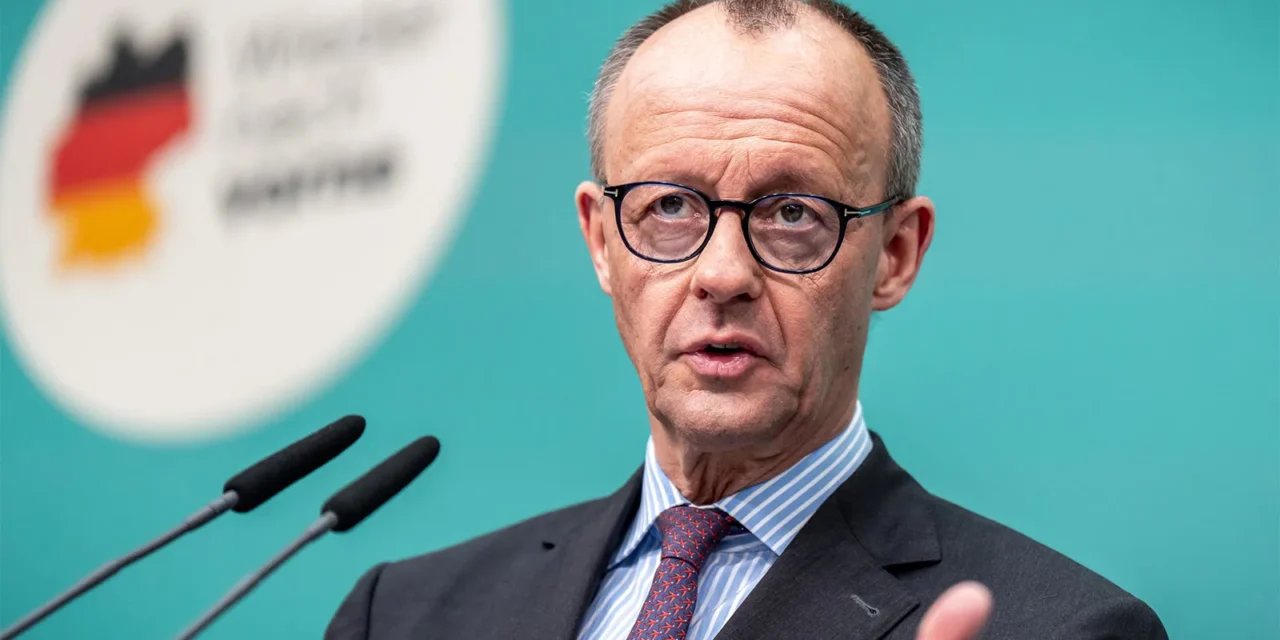
A delegation of 30 senior German executives from industry, technology, defense, and energy sectors has joined Chancellor Friedrich Merz on a five-day sweep through Singapore, Japan, and South Korea.
The sheer scale of the business entourage signals that Berlin views deepening economic ties in Asia as inseparable from its broader security strategy amid mounting geopolitical turbulence.
German President Frank-Walter Steinmeier is simultaneously traveling to China, and while the two trips carry no official connection, both reflect a coordinated effort to shore up Germany’s relationships across a volatile region.
Merz opened the tour in Singapore, where he delivered a major foreign policy address and held talks with Prime Minister Lawrence Wong, before heading to Tokyo.
In Japan, the Chancellor is scheduled to meet Prime Minister Sanae Takaichi and participate in the German-Japanese Business Summit, an agenda that experts say carries real strategic weight.
Ben Ascione, an assistant professor of politics and international relations at Waseda University in Tokyo, said the visit arrives at a pivotal moment for Japan’s foreign policy posture.
“For more than a decade, Japan has been looking to generate new security allies and closer trade partnerships,” Ascione told DW, noting that Takaichi is building directly on the outreach framework established under former Prime Minister Shinzo Abe.
Growing Chinese assertiveness in the Indo-Pacific, Beijing’s deepening alignment with Moscow and Pyongyang, and uncertainty surrounding the second Trump administration have all sharpened Tokyo’s appetite for reliable partners in Europe.
Ascione noted that conflict over Taiwan or the disputed South China Sea islands would send shockwaves through global commerce, dragging Germany into consequences it could not easily absorb.
“Japan and Germany have different primary security threats at the moment, with Germany focused on the Russian invasion of Ukraine and Japan keeping a close watch on China, North Korea and Russia, but I do believe that Germany has come more into line with Takaichi’s perception of the security threat that is posed by China,” he said.
Germany has already demonstrated its willingness to project military presence in the region, with the frigate Bayern becoming the first German Navy vessel to dock in Tokyo in two decades in May 2021, followed by Eurofighter Typhoon aircraft conducting air drills over northern Japan alongside Japanese fighters in July 2024.
Control over rare earth materials, which China largely dominates and which underpin everything from electric vehicles to advanced weapons systems, is expected to feature prominently in the Merz-Takaichi discussions on supply chain resilience.
The final leg of the trip takes Merz to Seoul, where he will meet President Lee Jae-myung and open the 19th Asia-Pacific Conference of German Business, though the backdrop is considerably more complicated than in Tokyo.
Saeme Kim, a research fellow at The Asan Institute for Policy Studies, says European governments are watching Seoul’s diplomatic maneuvering with growing unease.
“It’s not just Germany, I think a lot of European countries will be irritated by the Lee administration trying to improve relations with North Korea and Russia,” Kim said, pointing to discussions around petroleum exports to Moscow and Seoul’s attempts to establish a communication channel with Pyongyang.
South Korea maintains that it has not breached international sanctions on Russia, yet the optics remain troubling for partners who are simultaneously supporting Ukraine against Russian aggression.
Kim cautioned that Seoul risks undermining its own strategic position, warning that “the government needs to keep in mind that some of these policies are going to be damaging to South Korea’s own interests over the long-run.”
Merz’s planned visit to the Demilitarized Zone could offer him a firsthand look at the peninsula’s frozen conflict, though the stop may be canceled after a North Korean mine injured three South Korean soldiers last month, with Pyongyang denying responsibility and accusing Seoul of fabricating the incident.
Germany’s own reunification in 1990 may offer Seoul a historical reference point, though Kim cautioned that “there are lessons that South Korea can learn, of course, but there are a lot of differences,” given that the two Koreas remain technically at war and the North is pursuing nuclear capability.
