
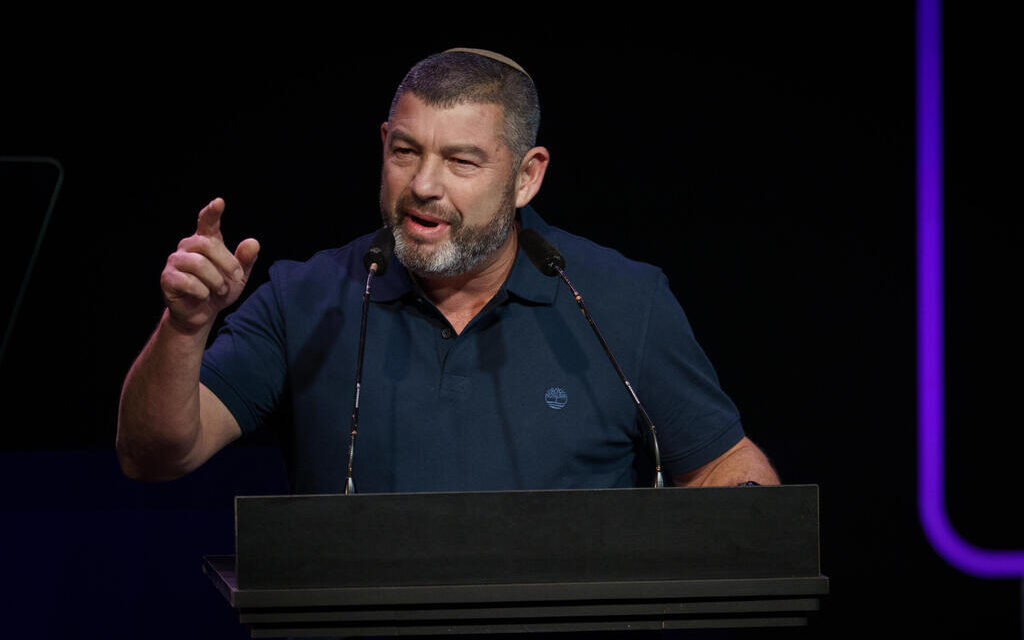
How the former brigadier general built Amcha Israel, what his military record reveals, and the unresolved questions surrounding his move into democratic politics.
Ofer Winter is attempting a transition that has shaped Israeli politics for generations: from military command to elected leadership. The retired Israel Defense Forces brigadier general launched Amcha Israel in August 2026, presenting a new right-wing political platform after a 34-year military career. For Winter, the move opened a second public chapter. For Israeli voters, it introduced another name into a crowded debate about national security, political accountability and the country’s direction after the Hamas-led attacks of October 7, 2023.
The rise of a former officer in Israeli politics is not unusual. What distinguishes the story of Ofer Winter is the particular combination of his religious identity, battlefield reputation, public controversies and decision to build a party rather than join an established organization. That combination raises questions about leadership as well as policy: what can a military career contribute to politics, and what aspects of politics cannot be learned through military command?
Winter’s supporters emphasize his experience in combat and senior command. His critics scrutinize his past controversies, the implications of his security proposals and the consequences of a small right-wing party competing under Israel’s electoral rules. A full account requires both perspectives. It also requires separating the appeal of a leader’s biography from the detailed work of governing.
A career defined by military command
Ofer Winter spent more than three decades in the Israel Defense Forces before entering party politics. He was born in 1971 in northern Israel, grew up in Kiryat Ata and followed an educational path associated with religious Zionism and military service. He joined the IDF in 1990 and served in elite formations including Sayeret Matkal and Maglan, before advancing into command positions that brought him increasingly into public view.
Winter eventually commanded the Givati Brigade, a prominent infantry formation, during the 2014 Gaza war. He subsequently served as military secretary to the defense minister and commanded the 98th Division. These roles placed Winter at different levels of Israel’s security establishment: the tactical level of soldiers operating under fire, the organizational level of divisional command, and the political-military interface at which security advice reaches civilian decision-makers.
The distinctions matter. A commander must make decisions under operational pressure, but a defense minister must weigh military recommendations against diplomatic constraints, economic resources and political responsibilities. Winter’s career exposed him to both environments without providing him with a record as an elected lawmaker. That difference is central to assessing his move into politics.
His military service also brought controversy. During the 2014 conflict, Winter used explicitly religious language in a message to soldiers, sparking debate about the role of faith in an army serving a religiously and ethnically diverse country. Operations around Rafah also drew scrutiny concerning civilian harm. Winter has remained an identifiable figure in public arguments about the military’s mission, religious identity and the exercise of force. A serious political profile must include those disputes alongside his command experience.
October 7 changed the political questions
The Hamas-led attacks of October 7, 2023, reshaped Israel’s national-security debate. Intelligence assessments, border defenses, emergency response and the relationship between the government and the security establishment all came under scrutiny. The attacks also shifted public discussion toward a broader question: what kinds of leadership and institutional accountability were required after such a failure?
Winter’s entry into politics developed against that background. He had not been serving as an elected official responsible for the government’s Gaza policy, but his public identity was closely associated with military operations and the expectation of decisive command. As the country argued about the assumptions behind its prewar security doctrine, Winter presented his own preferred response: a more proactive approach to threats and greater emphasis on what he calls decisive outcomes.
The contrast between containment and initiative has become a recurring part of his political language. Yet the concepts are not self-executing policies. Preventive operations depend on intelligence confidence, proportionality, operational feasibility and the likelihood of escalation. The practical test of such a doctrine is how it would work in real situations, not only how it sounds in a campaign speech.
The disaster also created renewed demands for an independent national investigation. Winter’s new party has proposed its own commission model, involving judicial leadership, professional members and representation from affected families. The plan is one entry in a contested debate over whether parliamentary involvement in appointments can coexist with investigative independence. Its merits would depend on the legal powers, safeguards and accountability rules built into the final mechanism.
The launch of Amcha Israel
On August 25, 2026, Ofer Winter launched Amcha Israel in Jerusalem. The name evokes a sense of belonging to the people of Israel, and the new party placed the former brigadier general at the head of an electoral list drawn from military service, media, local government, legal advocacy and civic activism.
The decision to establish a separate party mattered as much as the launch itself. Israel’s proportional system allows new political organizations to contest national elections, but parties must receive at least 3.25 percent of valid votes to enter the 120-seat Knesset. That creates a sharp boundary for smaller lists: an organization polling near the threshold can look close to representation in one survey and below it in another.
Winter’s move drew a response from Prime Minister Benjamin Netanyahu, who warned that several small parties on the right could divide votes and damage the bloc’s parliamentary representation. Winter maintained that an independent list was justified by its policy commitments and the demand for alternative representation. The argument is not unique to his party. It reflects a structural tension between pluralism and strategic electoral coordination in coalition-based democracies.
The candidate list helped distinguish Amcha Israel from a conventional party built around long-serving lawmakers. Yoseph Haddad, an Arab-Israeli Christian and wounded IDF veteran known for advocacy on Israel’s behalf, was given second place. Other names announced at the launch included journalist Netali Shem Tov, former Jerusalem deputy mayor Fleur Hassan-Nahoum, attorney Eran Ben Ari, and candidates whose lives were marked by military service or bereavement after the war.
That composition reflects an attempt to connect political authority with experiences outside parliament. It also raises a question about coherence: can people with different backgrounds and public priorities operate as a unified legislative team? A list’s diversity does not, on its own, establish a shared governing program. That would have to be demonstrated through policy detail and future parliamentary work.
Military service as a political dividing line
One of Winter’s most visible policy priorities concerns the distribution of military obligations. Israel’s long-running debate over the recruitment of ultra-Orthodox men intensified after October 7, as prolonged reserve service placed pressure on soldiers, families, employers and the national economy.
Winter has argued for actual recruitment of Haredi men, with consequences for noncompliance and greater benefits for those who serve. He has also said he could enter a government alongside ultra-Orthodox parties if an acceptable recruitment arrangement were agreed. The position highlights the difference between rejecting potential coalition partners and insisting on a legislative condition.
For Winter, the issue serves as a link between military leadership and social policy. But legislation would have to answer numerous technical questions: how exemptions are defined; how the army would train and absorb new personnel; what sanctions would be lawful and enforceable; and how citizens who are unable to serve would be treated. It would also need to account for the economic costs of service and the protections required for religious freedom and equality.
Those questions matter to the public beyond ideological slogans. Reserve mobilization can interrupt careers and small businesses, while additional recruitment places new demands on training infrastructure and budgets. Any credible plan must therefore be evaluated not only by the number of people it seeks to recruit but by the operational and fiscal consequences of the design.
Security policies and their implications
Amcha Israel identifies with the nationalist right, rejects Palestinian statehood and advocates an assertive security posture. Winter has publicly endorsed a proposal framed as voluntary emigration from Gaza. These positions are significant elements of the party’s platform, and they carry implications beyond Israeli domestic politics.
The question of migration is especially sensitive. Any program involving civilians affected by prolonged war would have to be examined for genuine consent, the absence of coercion, lawful conditions and realistic receiving arrangements. International humanitarian law prohibits forcible transfer or deportation of protected civilians, subject to narrow exceptions. Calling a process voluntary does not itself resolve the legal or ethical questions.
Likewise, an approach centered on military initiative must confront the relationship between tactical gains and political end states. Military operations can change conditions on the ground, but durable security also depends on intelligence, civilian protection, diplomacy and the capacity of institutions to carry out decisions consistently.
Winter’s supporters see his operational background as relevant experience for these dilemmas. Critics question whether a battlefield-centered outlook provides enough room for legal safeguards, diplomacy and long-term administration. Neither view settles the matter. The most useful evaluation asks what precise objectives the proposals seek, what instruments would be used, and what evidence would establish whether they worked.
Faith, identity and the broader electorate
Winter is an openly religious figure, and his background in religious-Zionist education remains part of his public identity. He has connected Jewish tradition with ideas of responsibility and service. The role of religion in military and public institutions has sometimes made that identity controversial.
Entering electoral politics expands the circle of people to whom he must explain his views. Israel’s citizenry includes Jews of different religious traditions, secular Israelis, Arab citizens and other communities. A political platform rooted in Jewish national identity therefore faces ongoing questions about civic inclusion and equal treatment.
The selection of Haddad as the party’s second candidate is one notable feature of this discussion. Haddad’s biography and public advocacy demonstrate that support for Israel and military service are not confined to Jewish citizens. Yet one candidate’s inclusion does not by itself answer policy questions about the rights and place of minorities. Those answers require positions on legislation, public services and the distribution of state resources.
A transition from command to politics also demands a different style of accountability. Military decisions unfold within a hierarchy. Parliamentary politics exposes positions to open disagreement, coalition negotiation and public scrutiny. A politician may be called on to explain compromises as carefully as principles. Winter’s willingness and capacity to manage those competing demands are subjects for democratic evaluation, not assumptions established by his former rank.
A crowded right-wing arena
Winter’s entry did not occur in a political vacuum. Israeli voters on the right already had several parties offering different combinations of security policy, religion-state positions and attitudes toward Netanyahu. His new organization had to establish where it differed from those alternatives beyond the biography of its founder.
The most visible dispute concerned the electoral threshold. Party leaders and commentators argued over whether an independent run would broaden the choices available to voters or prevent some votes from producing seats. Polling close to the election has been inconsistent, with some measurements placing the party at parliamentary representation and others below the threshold. Polls are observations under different methods, not election results, and seat projections become especially volatile near the legal cutoff.
For an international audience, this uncertainty is essential context. Describing Ofer Winter as Israel’s next leader would imply a political outcome that has not occurred. It is more accurate to describe him as a former military commander who is seeking a new leadership role through a party that has yet to face its first election.
A separate question concerns his relationship with Netanyahu. Winter has criticized aspects of the existing government’s priorities while identifying his party with the political right. Public reporting has indicated his willingness to support Netanyahu for prime minister subject to policy demands. That combination may appear contradictory only if political competition and potential coalition cooperation are treated as mutually exclusive. In Israel’s parliamentary system, parties frequently negotiate with one another after contesting the same election.
The challenge of governing after campaigning
Founding a party and governing are fundamentally different undertakings. A campaign can concentrate attention on a small number of priorities. A government must make decisions across security, healthcare, infrastructure, education, economic policy and foreign affairs, often under budget constraints and coalition agreements.
Winter’s party has argued for reforms in military recruitment, security policy, judicial arrangements and accountability for October 7. Each issue requires mechanisms that survive contact with legislation and public administration. Who would implement the policy? How would it be funded? What oversight would apply? How would unintended effects be measured and corrected?
These questions should not be read as objections reserved for newcomers. Established parties also make promises that require scrutiny. They are, however, particularly important when a leader’s professional reputation comes primarily from a career outside elected office.
The new party’s economic statements have emphasized competition, imports and reduced bureaucracy, adding subjects that extend beyond Winter’s military background. How those proposals fit with demands for increased defense and service-related spending would require fiscal choices that campaign language alone cannot resolve. A government’s priorities can be judged only when competing commitments are reconciled in budgets and laws.
What Ofer Winter represents — and what remains untested
Ofer Winter’s political emergence reflects several overlapping developments in Israel: the trauma and institutional questions following October 7, continuing tensions over military service, debates about religion and national identity, and dissatisfaction among some voters with existing party options.
He brings an unusually extensive military biography to that conversation. The same record that gives him experience in security institutions also brings controversy and questions about how operational thinking translates into democratic governance. His candidate list includes recognizable advocates and individuals shaped by the recent war, but it has not yet established a parliamentary track record.
The distinction between personal reputation and public performance is the main test of the transition. The military supplied Winter with responsibility over units and missions. Politics would require him to justify positions to a wider electorate, negotiate with peers and accept scrutiny from institutions and citizens who disagree with him.
In that sense, the story of Ofer Winter is not a story with a predetermined ending. It is the story of a former commander entering an unsettled political system at a moment when security, trust and leadership are intensely contested. What matters next is not a claim about who will lead Israel, but the practical record that candidates, parties and elected institutions can ultimately be held accountable for.
