
Super Micro Computer (NASDAQ: SMCI) has spent much of October fielding investor questions about a federal smuggling case with direct ties to the company.
A contractor linked to Super Micro pleaded guilty earlier this month to helping ship servers loaded with advanced Nvidia (NASDAQ: NVDA) chips to China, according to a Reuters report.
Prosecutors say the scheme involved billions of dollars worth of U.S. artificial intelligence technology being routed in violation of export restrictions.
The company says it was not named as a defendant in the case and maintains that its business operations have not been affected by the proceedings.
Despite the legal turbulence, the underlying business has continued to expand at a pace that makes the current stock valuation look difficult to justify on fundamentals alone.
Sales for the fiscal year ending in June reached $39.1 billion, up sharply from $22.0 billion in the prior year, continuing a five-year annual growth rate of approximately 61.5%.
CEO Charles Liang said the company received more than $60 billion in new orders over the course of the year and added several hundred enterprise customers to its roster.
Management is guiding for fiscal 2027 revenues of between $65.0 billion and $72.0 billion, a range whose lower bound already exceeds the entirety of last year’s record sales figure.
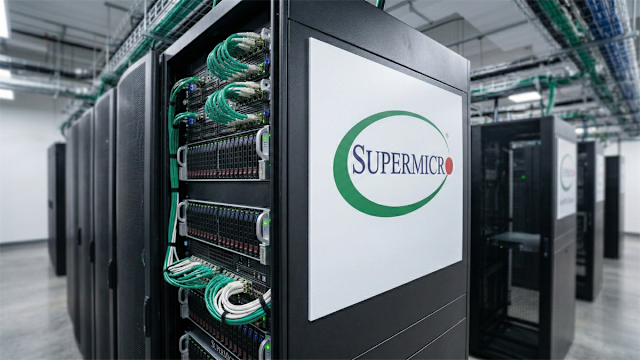
Super Micro builds the server racks that power AI data centers, including liquid-cooled systems designed around Nvidia’s newest chips, serving customers from major cloud providers to mid-size enterprises.
Its core selling point is pre-assembled infrastructure that allows customers to deploy data centers faster than sourcing and integrating components independently.
Profitability also showed a notable shift in the most recent quarter, with gross margin jumping to 17.5% in the June quarter compared to 10.8% for the full fiscal year.
Net income for the June quarter reached $1,178 million, well above the equivalent period a year earlier, though the full-year operating margin of 7.09% still reflects a largely thin-margin business.
The central risk for investors remains the export case, which extends beyond the contractor who pleaded guilty to include additional defendants with closer ties to the company.
Co-founder Yih-Shyan Liaw, who joined the board in 2023, and a former sales manager based in Taiwan were also indicted in connection with the same smuggling scheme.
The indictment alleges that the servers carried Nvidia chips subject to U.S. export controls, with the scheme described as beginning around October 2023.
Super Micro says it fired the contractor and severed ties with the other defendants earlier this year, and last week named Mark Long as its new chief financial officer, reporting directly to Liang.
Neither action definitively answers whether internal controls were adequate when the restricted shipments were made, leaving a material question open for investors and regulators.
At 7.29 times estimated fiscal 2027 adjusted earnings, the stock trades well below the sector median of 21.01 times and its own five-year average multiple of 16.36.
The consensus forecast calls for earnings per share growth of 19.49% in fiscal 2027, meaning the market is not pricing in a contraction but is applying a steep discount to account for legal uncertainty.
For shareholders, the investment thesis rests on whether the legal exposure remains contained to a small number of individuals rather than reflecting systemic failures in the company’s compliance structure.
The discount embedded in the current valuation appears disproportionate to the demand backdrop unless the export investigation broadens materially beyond its current scope.
What resolves the debate in the near term is whether gross margin holds close to the June quarter’s 17.5% level or retreats toward the 10.8% average that defined most of the fiscal year.
