
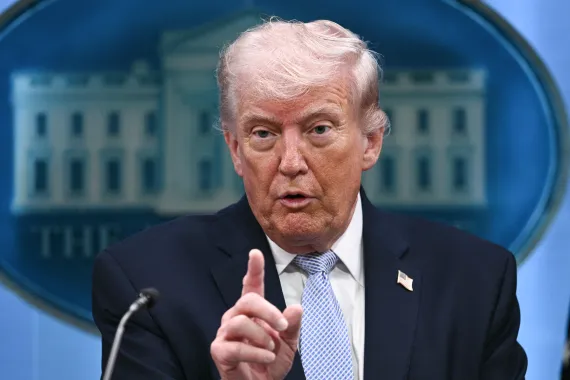
The Trump administration is laying the groundwork for a fundamental restructuring of how the United States responds to natural disasters, pushing far greater responsibility onto state and local governments.
A Politico analysis found that the administration has been far more willing to grant disaster declarations for Republican-led states, approving 89% of their requests, compared to just 23% for Democratic-led states.
That disparity has drawn sharp criticism from emergency management experts and Democratic officials, who argue federal disaster relief is being weaponized as a political tool rather than distributed based on need.
FEMA lost over 17% of its trained staff members in 2025 alone, a significant blow to the agency’s operational capacity at a time when climate-related disasters are increasing in both frequency and severity.
The staffing losses included hundreds of personnel who were on call to respond to disasters, meaning the agency’s ability to mount rapid, large-scale responses has been materially weakened.
The administration also withheld billions of dollars in funding that was intended to help states reduce their exposure to disaster risk, including money earmarked to protect homes, hospitals, and critical infrastructure from storm damage.
Lawsuits filed against the administration forced the restoration of some of those funds, but many communities remain without the resources they were counting on to harden their infrastructure ahead of future disasters.
The broader policy vision emerging from the administration is one of a minimalist FEMA, an agency that steps back in favor of an almost exclusive reliance on state, local, tribal, and territorial governments to manage disaster response.
That vision also includes a significant expansion of what officials describe as privatized self-reliance, placing more of the financial and logistical burden of disaster preparedness and recovery on individuals and private entities.
Critics warn that this approach will leave the most vulnerable communities, those with the fewest resources and the least political leverage, exposed during the catastrophic weather events that have become a defining challenge of the current era.
The structural shift represents one of the most consequential changes to federal emergency management policy in decades, with implications for millions of Americans living in disaster-prone regions across the country.
Whether Congress will intervene to check the administration’s remaking of FEMA remains an open question, as the agency’s reduced footprint becomes more visible with each major storm season.
