
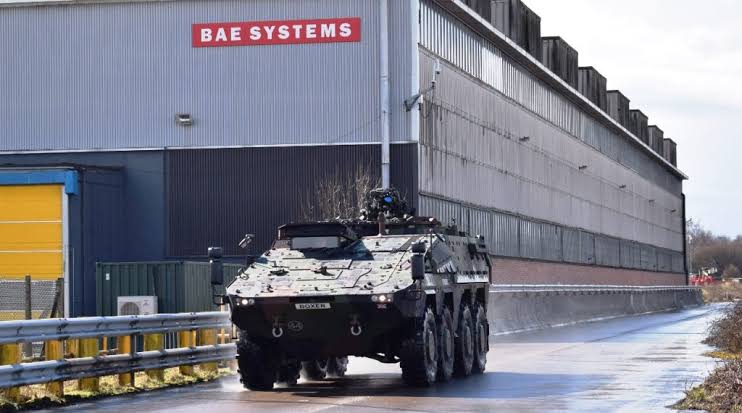
BAE Systems (LSE: BA.) has seen its share price fall roughly 20% from its March highs, raising questions about whether the pullback represents a genuine buying opportunity for investors.
Since October 2021, BAE Systems shares have more than trebled in value, delivering average annual price growth of approximately 25% per year across that period.
Despite that long-run outperformance, the stock has broadly traded sideways over the past 12 months, with some shareholders appearing to lock in profits after the earlier rally.
The group’s order backlog has grown to £84 billion as of June 30, a figure equivalent to nearly three times its projected 2025 revenue, reflecting strong demand across its defence contracts.
BAE Systems is currently the largest supplier to the UK’s Ministry of Defence, positioning it to benefit directly from government commitments to increase military spending in the years ahead.
The UK government has committed to reaching NATO’s defence spending target of 3.5% of Gross Domestic Product by 2035, though the precise funding pathway is not expected to be outlined until next year’s spending review.
For 2026, the company is forecasting earnings per share growth of between 11% and 13% year-on-year, with free cash flow projected to exceed £2 billion.
The 12-month analyst consensus suggests BAE Systems shares are currently trading at a 26% discount to fair value, even as the stock carries a forward earnings multiple of 22.4 times.
The company is currently yielding 2.2%, based on an 11% increase in its interim dividend being repeated when the final 2026 payout is declared, up from a yield of 1.5% just over six months ago based on 2025 payouts.
Investing in defence remains an ethically contested area for many investors, which some analysts argue limits the pool of capital available to support further share price appreciation.
Even Switzerland, a country defined by its policy of neutrality, spends approximately 0.75% of GDP on its military, illustrating that defence spending is widely viewed as a protective rather than purely aggressive act.
A significant proportion of BAE Systems’ revenue is derived from long-term contracts with repeat income streams, giving the business a degree of earnings predictability that many other industrial companies cannot match.
As of March, the stock was trading at 28.3 times expected earnings, meaning the current valuation represents a meaningful compression from where the market was pricing the shares just months ago.
Dividends are never guaranteed, but the combination of a growing yield and continued earnings momentum makes BAE Systems a stock that income and growth investors alike may find difficult to ignore.
In an increasingly uncertain geopolitical environment, defence contractors with deep government relationships and substantial order pipelines are likely to remain in high demand from both customers and investors.
