
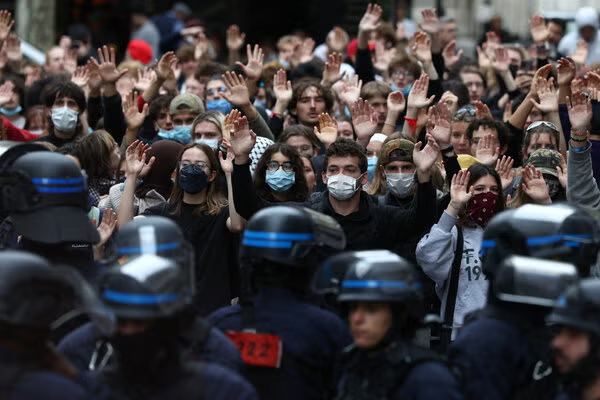
Cellphone videos filmed by French schoolchildren and circulating on social media show rats in toilets, leaking roofs, and broken heating systems across the country’s educational institutions.
At the Lycee Paul Eluard in the Parisian suburb of Saint-Denis, a center of the current protests, young people have reported vermin in the building and say burst pipes are a regular occurrence.
In nearby Pantin, pupils complained that windows could not be opened even when summer temperatures soared to 40 degrees Celsius, or over 104 degrees Fahrenheit.
Students across France are also reporting overcrowded classrooms and frequently cancelled lessons, with the protests showing no sign of abating anytime soon.
By EU standards, France invests a substantial amount in its education system, equivalent to 6.7% of its GDP, yet that spending has failed to translate into an adequate learning environment for millions of students.
A fragmented system of responsibility is a significant part of the problem, with the central government handling teacher pay and national curricula while local authorities at various levels are responsible for maintaining school buildings.
Over 80% of elementary school buildings in France are more than 50 years old, and an estimated 10 to 20% of all school buildings are considered to be in serious need of renovation.
Ile-de-France, which covers Paris and the surrounding region, approved a 10-year renovation and expansion program for the period 2017 to 2027 at a cost of 6.6 billion euros, or $7.4 billion.
According to OECD data, teachers at lower secondary schools in France earn only about half as much as their German counterparts after 15 years in the profession, contributing to a broader staffing crisis.
The French Court of Accounts recorded that 9% of lessons at state colleges were cancelled during the 2023-24 school year, and a study from 2024-25 suggests only around 12% of lessons cancelled at short notice are covered by substitute teachers.
OECD data published in September shows that more than one in three 15-year-olds in France no longer achieve a basic level of competence in mathematics, illustrating the deepening crisis in the education system.
French Education Minister Edouard Geffray announced that software would be used to identify schools in a particularly difficult situation, while the government said it intends to recruit more than 3,000 supply teachers at short notice.
Since 2017, class sizes in the first years of primary school have been halved in socially disadvantaged areas under President Emmanuel Macron’s government, with around 16,000 additional teaching posts created during that period.
France takes pride in its republican model of education, which is supposed to provide all children with equal opportunities regardless of background, but academic success in France is far more dependent on socioeconomic circumstances than in many comparable countries.
The draft budget for 2027 includes an additional 1.2 billion euros for the Ministry of Education, though plans to cut teaching posts on the grounds of falling pupil numbers have drawn sharp criticism from educators and students alike.
With the French presidential election just six months away, some members of the far-left France Unbowed party have associated themselves with the protesting students, and the government has accused the party of deliberately exploiting young people’s anger for political purposes, an allegation the party rejects.
