
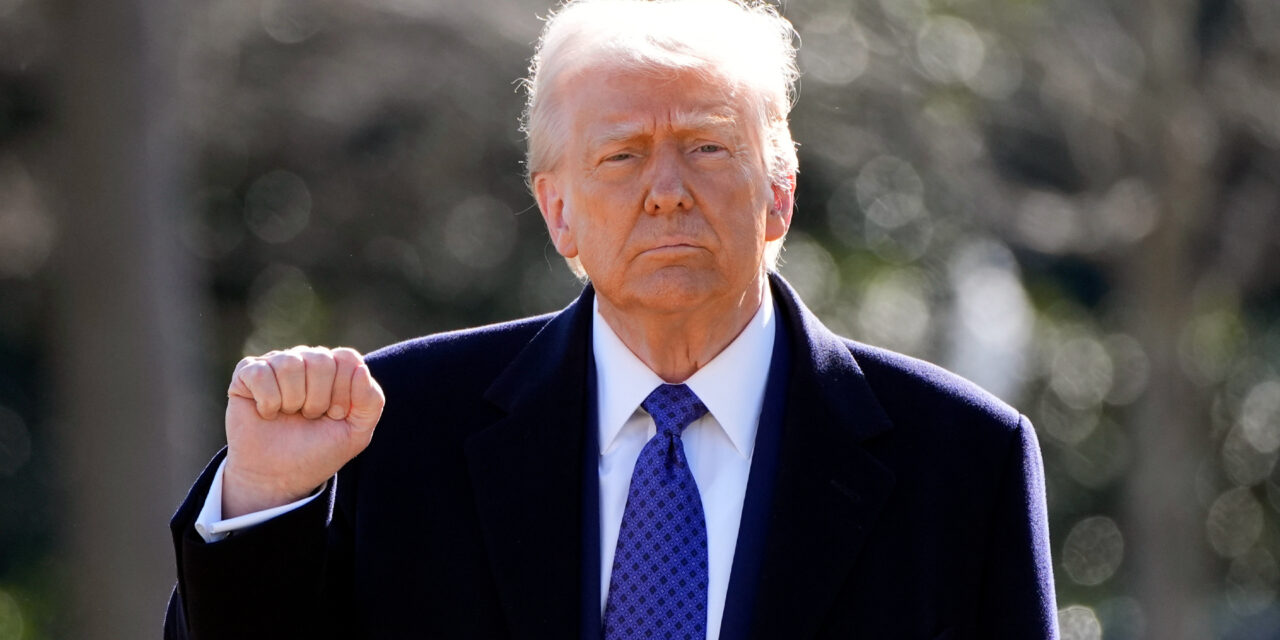
Donald Trump announced on his Truth Social platform that a series of government-funded advertisements promoting him and his administration would no longer be paid with taxpayer money.
“The radical Left is upset with the fact that I am taking ads, which I consider to be a positive promotion for our great USA, and paying for them with USA money,” Trump wrote, adding that future ads would instead be funded through donations.
The commercials aired in September during high-profile broadcasts including Saturday Night Live and football games, each marked with the line “paid for by the US government.”
The ads featured scenes including the capture of Venezuelan President Nicolas Maduro by US troops, alongside images of Trump himself and messages vowing to “expel the warmongers” and “throw off the sick political class.”
CBS reported that the US Department of Homeland Security paid an agency $20 million for a “national media campaign,” according to contracting records, drawing sharp criticism from political opponents and advocacy organizations.
Non-profit consumer group Public Citizen filed a formal complaint with the Federal Communications Commission, stating that “federal law explicitly prohibits using appropriated public funds for government propaganda, self-aggrandizement, or partisan political advertising.”
Patrick Malone, a professor in the Department of Public Administration and Policy at American University in Washington DC, said the timing of the ads was deeply problematic given their proximity to the midterm elections.
“You’re not supposed to use taxpayer dollars to pay for anything that’s campaign-related,” Malone told DW, adding that “weeks before the midterms, this is a real big issue.”
On November 3, voters will decide all 435 seats in the House of Representatives and roughly a third of the 100 Senate seats, with Republicans currently holding 53 Senate seats and 219 House seats.
A Reuters/Ipsos poll released Monday found that voters aged 50 or older preferred Republicans over Democrats by just 2 percentage points, compared to an 8-point Republican advantage in December, a troubling shift given that older Americans historically dominate midterm turnout.
Among voters under 50, Democrats led by 18 points, according to the same survey, compounding concerns within the Republican Party about its ability to hold its congressional majorities.
The poll also found that just 32% of Americans approved of Trump’s presidency, a figure described as unchanged from an earlier survey “that saw the leader’s rating at the lowest of his political career.”
Republican candidates have reportedly been reluctant to campaign alongside Trump, with one Republican operative telling Politico anonymously that if Trump visited a battleground state, their “candidates would come down with COVID” to avoid attending.
Senators Susan Collins of Maine and Dan Sullivan of Alaska, both facing competitive races, were among those who skipped Trump’s recent party convention, as did House candidates from swing states Arizona, Iowa, and Michigan.
At that convention, Trump urged supporters to “pretend” he was on the ballot and promised every eligible American voter a $5,000 payout if Republicans retained their majority in both chambers of Congress.
Delivering on that promise would cost the federal government over $1.2 trillion, though independent observers remain deeply skeptical it would ever materialize.
“He has no money to do that with. It would have to be authorized and appropriated by Congress,” Malone said, comparing the pledge to the unfulfilled promise that Mexico would pay for a border wall.
