
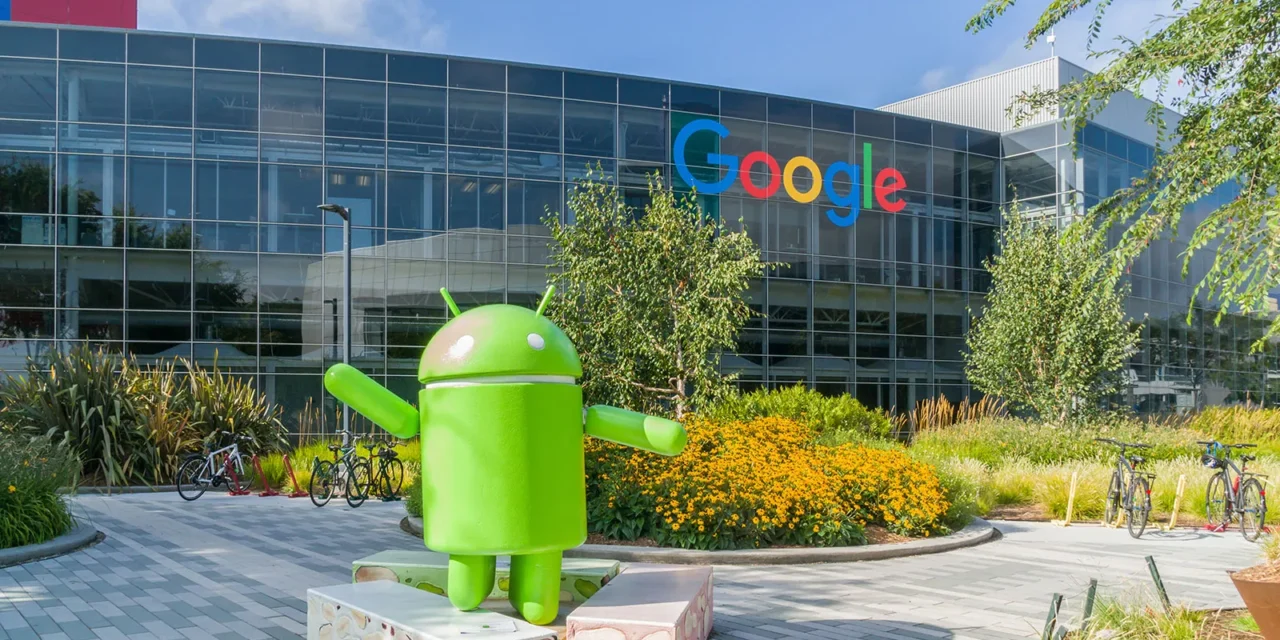
Alphabet (NASDAQ: GOOGL) and Meta Platforms (NASDAQ: META) are both central players in the artificial intelligence race, but a closer look at their financials and strategies reveals meaningful differences.
Alphabet operates as a diversified technology holding company, generating revenue primarily through digital advertising on Google Search and YouTube, alongside cloud computing and the Android ecosystem.
In fiscal year 2025, Alphabet posted revenue of $402.8 billion, representing year-over-year growth of 15.1%, while net income climbed to $132.2 billion, pushing the net margin to 32.8%.
The company’s balance sheet reflects considerable financial strength, with a debt-to-equity ratio of just 0.1x and a current ratio of 2.0x, meaning short-term assets comfortably cover near-term liabilities.
One of Alphabet’s most distinctive competitive advantages is its control over the entire AI technology stack, from custom Tensor Processing Units to model development inside Google DeepMind.
Alphabet also owns the distribution channels that few rivals can match at scale, including Search, Android, Chrome, YouTube, and Google Cloud, giving its AI products an immediate and vast audience.
Meta, meanwhile, generated a net margin of 30.1% in fiscal year 2025, with free cash flow of $46.1 billion and a current ratio of 2.6x, reflecting solid near-term liquidity across the business.
Meta’s debt-to-equity ratio stands at 0.4x, suggesting a conservative but slightly higher reliance on debt compared to Alphabet, even as the company continues spending heavily on AI data centers.
On valuation, Alphabet trades at a forward price-to-earnings ratio of 16.4x compared to Meta’s 24.6x, making it the cheaper option on that measure, though Meta holds a marginally lower price-to-sales ratio at 8.6x versus 9.2x.
Meta’s AI investments have so far paid off largely in indirect ways, through sharper ad targeting and greater user engagement, creating a longer and less certain path from spending to measurable profit.
The concern surrounding Meta’s AI strategy is that its heavy internal spending resembles the metaverse era, where billions of dollars were deployed without a clear return on investment materializing.
Alphabet, by contrast, is already integrating AI into products that generate revenue daily, embedding tools like Gemini directly into Search, which remains one of the most profitable digital platforms ever built.
Alphabet does face real risks, including a Department of Justice antitrust case that could require structural changes or mandatory data sharing, along with margin pressure from expensive AI infrastructure investments.
Both companies carry exposure to advertising market cycles, data privacy regulations, and intensifying competition from rivals including Microsoft, but Alphabet’s vertically integrated AI model provides a more self-contained growth engine.
As Magnificent Seven constituents, both stocks are broadly expected to outperform the broader market over the long term, and neither would be considered a poor investment for a diversified portfolio.
For investors choosing between the two today, Alphabet’s ownership of the chips, models, and distribution infrastructure gives it a more complete and self-funding position in the AI economy than Meta currently holds.
