
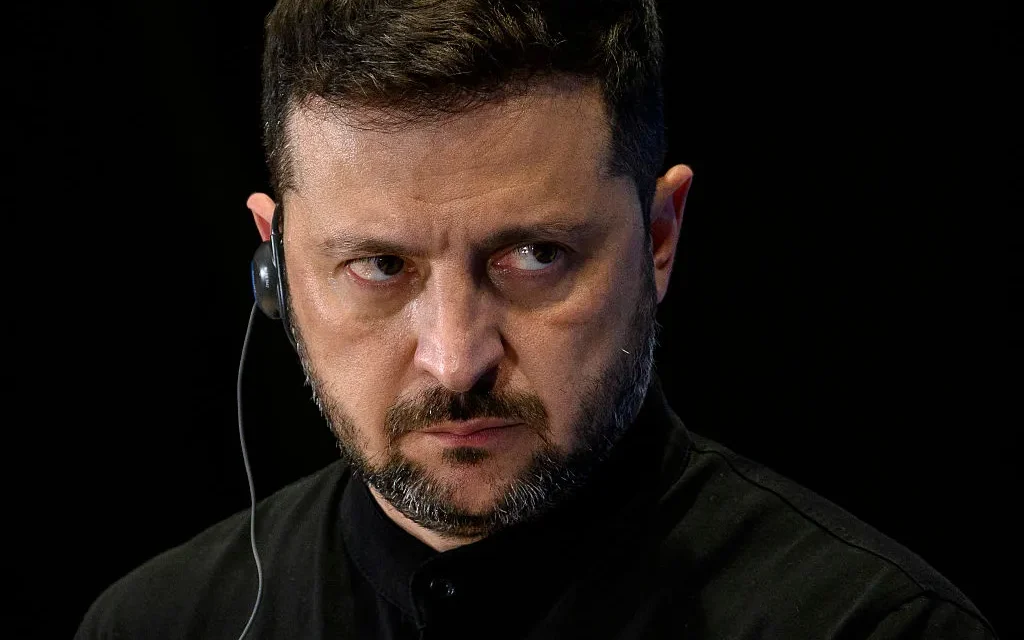
Ukrainian President Volodymyr Zelenskyy ignited a diplomatic dispute with South Korea after publicly revealing that Ukraine had transferred two captured North Korean soldiers to Seoul.
Speaking at the UN General Assembly on September 23, Zelenskyy announced that Ukraine had “sent two North Korean prisoners of war to the Republic of Korea,” captured during fighting in Russia’s Kursk region in January 2025.
South Korea’s Foreign Ministry responded swiftly, summoning Ukraine’s ambassador to Seoul, Andrii Vieshkin, and demanding an explanation for what it called Kyiv’s “unilateral disclosure” of the transfer.
Seoul said the public announcement violated a prior agreement to keep the prisoner transfer confidential, and demanded an official apology from Ukraine over the breach.
Zelenskyy’s spokesperson, Dmytro Lytvyn, denied any such confidentiality agreement existed, writing on Facebook that it was wrong to keep secret where such prisoners were being transferred.
South Korean presidential spokesperson Kim Sung-wan swiftly called Lytvyn’s denials false, saying Ukraine had itself requested confidentiality, allegedly fearing domestic criticism over not securing a prisoner swap.
Seoul had agreed to secrecy partly for diplomatic reasons and partly to protect the prisoners’ families, who remain living in North Korea, Kim added.
Nataliya Butyrska, an Asia-Pacific expert at the New Europe Center in Kyiv, told DW that the two countries lacked a continuous, trust-based dialogue, particularly under the current government in Seoul.
“We should actually be natural partners — we should be standing shoulder to shoulder, with North Korea fighting against Ukraine,” Butyrska said. “But that’s not the case, due to a lack of trust.”
Butyrska noted that Russia had actually demanded the return of the two North Korean soldiers, with Moscow refusing to release Ukrainian prisoners of war for six months in pursuit of that goal.
“There was even a period of six months when the Russians refused to release any Ukrainian prisoners of war,” Butyrska said. “They were not prepared to undertake any swap, because they wanted the North Koreans.”
Korea expert Mykola Polishchuk, based in Ukraine, said South Korean President Lee Jae Myung was caught off guard by Zelenskyy’s comments and was now seeking to redirect blame toward Kyiv.
“President Lee Jae Myung was surprised by the incident, and now wants to shift the blame in part on Ukraine,” Polishchuk said, adding that the transfer was always going to become public knowledge eventually.
“Ukraine has ended up mired in a scandal which it neither wanted nor planned for,” Polishchuk added, describing Seoul’s confidentiality claims as a rushed political explanation.
Shim Sangmin from the Asan Institute for Policy Studies in Seoul said the real complication was South Korea’s parallel effort to rebuild relations with Pyongyang, which the prisoner transfer now threatens to undermine.
“South Korea has been pursuing the transfer of the prisoners for a long time. And now everybody seems to be happy that those Korean prisoners are in custody,” Shim said, before noting the reconciliation effort as the key complicating factor.
Shim said the Lee government is “more open to the idea of reestablishing ties” with Russia, which may explain Seoul’s growing reluctance to deepen military cooperation with Ukrainian forces.
Butyrska warned that the fallout points to a further cooling of ties between Kyiv and Seoul, with the South Korean government now even less likely to offer Ukraine meaningful support.
“The South Korean government wasn’t particularly friendly toward us to begin with, and will now likely keep its distance,” Butyrska said, suggesting quiet diplomacy might have yielded better results for Ukraine.
While South Korea does not sell weapons directly to Ukraine, it supplies Poland, Finland, the Czech Republic, and Romania, and continues to expand its integration with European military supply chains.
Polishchuk believes any military technology cooperation between Ukraine and South Korea is now off the table entirely, though trade and humanitarian assistance are expected to continue given Seoul’s obligations to the United States.
