
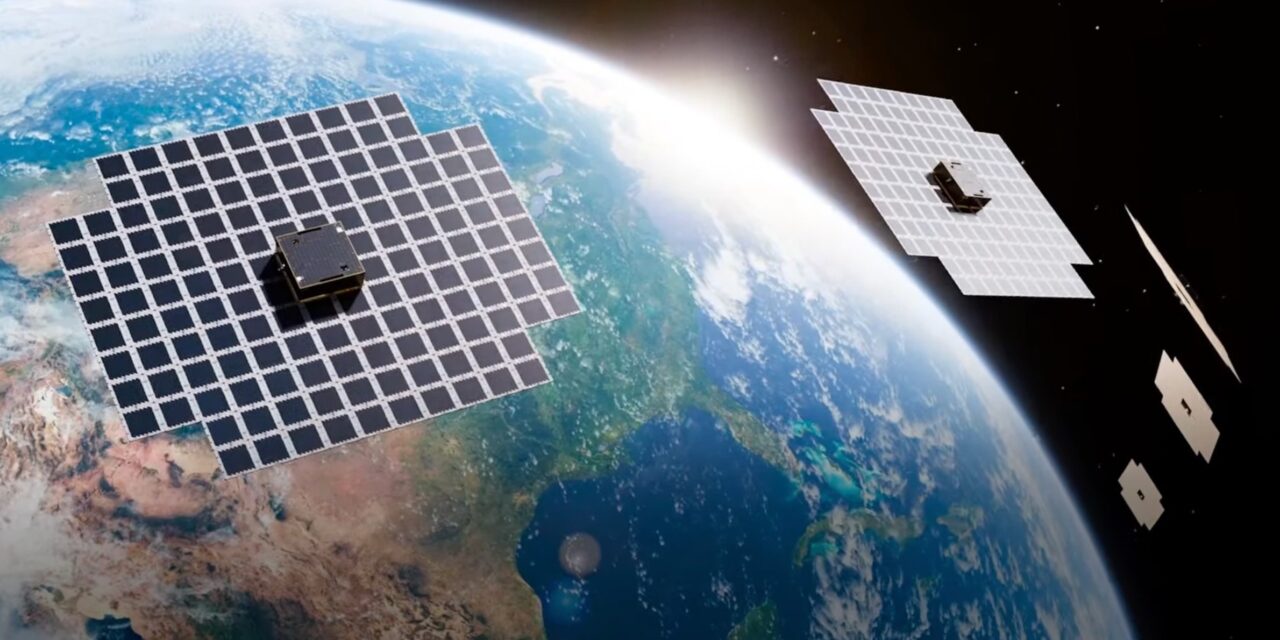
No company has ever successfully built a cellular broadband network in space capable of connecting directly to ordinary, unmodified smartphones.
AST SpaceMobile (NASDAQ: ASTS) is attempting precisely that, with 13 spacecraft already in orbit and a target of approximately 45 satellites deployed by early 2027.
The company is racing toward commercial service at a pace that has rewarded patient investors with 351.89% gains over five years, even as shorter-term volatility tests conviction.
ASTS shares are down 19.43% year to date, trading at $58.52, well below the 52-week high of $133.86 but comfortably above the 52-week low of $45.22.
A price target of $89.40 has been set for the stock, implying upside of 52.77% from current levels, with a buy recommendation issued at moderate confidence.
Q2 2026 revenue came in at $31.52 million, missing the $34.4 million analyst estimate but representing year-over-year growth of 2,626.6%, a figure that underscores how quickly the business is scaling.
Management reaffirmed full-year 2026 revenue guidance of $150 million to $200 million and reported pro forma liquidity above $3.7 billion following a July convertible note offering at a 1.625% coupon.
The bull thesis centers on ASTS having invented an entirely new market, with management targeting approaching $1 billion in revenue during the first full year of commercial service, expected in 2027.
A backlog of roughly $1.3 billion, partnerships with more than 60 mobile network operators covering over 3 billion subscribers, and government awards exceeding $100 million all support the long-term revenue case.
A Japan J-LEO opportunity valued at up to approximately $1 billion adds further optionality, and FY2027 revenue consensus currently sits at an average of $650.8 million, with a high estimate of $834.1 million.
The bear risks are real: Q2 capital expenditure hit approximately $610 million, FY2026 consensus EPS stands at -$2.2839, and analysts have issued four downward EPS revisions in the trailing 30 days.
A BB7 launch incident produced a $125.9 million loss in Q2, a stark reminder that satellite deployment carries physical risk that no amount of financial engineering can eliminate.
If the 2027 commercial ramp slips, the bear-case price target of $72.17 becomes the likely floor for the stock.
For comparison, Rocket Lab (NASDAQ: RKLB) posted Q2 2026 revenue of $234.07 million and carries a market cap of $38.64 billion, more than double ASTS’s $17.54 billion, though Rocket Lab operates in launch and space systems rather than direct-to-device connectivity.
Globalstar (NASDAQ: GSAT), the closest direct-to-device peer and the company powering Apple’s satellite service, reported Q2 2026 revenue of $64.77 million and trades at a $10.73 billion market cap, a valuation that includes a takeout premium tied to a pending merger with Amazon.
That takeout premium on GSAT arguably validates the premium multiple being assigned to ASTS, as it signals that large technology companies view direct-to-device satellite connectivity as strategically critical infrastructure.
Looking further ahead, price targets of $90.16 for 2027, $115.85 for 2028, $141.94 for 2029, and $176.75 for 2030 reflect a scenario in which ASTS successfully executes its constellation buildout and commercial service ramp.
Those projections carry meaningful execution risk, and actual outcomes will depend heavily on launch cadence, government contract activation, and the revenue-sharing terms ultimately negotiated with mobile network operator partners.
