
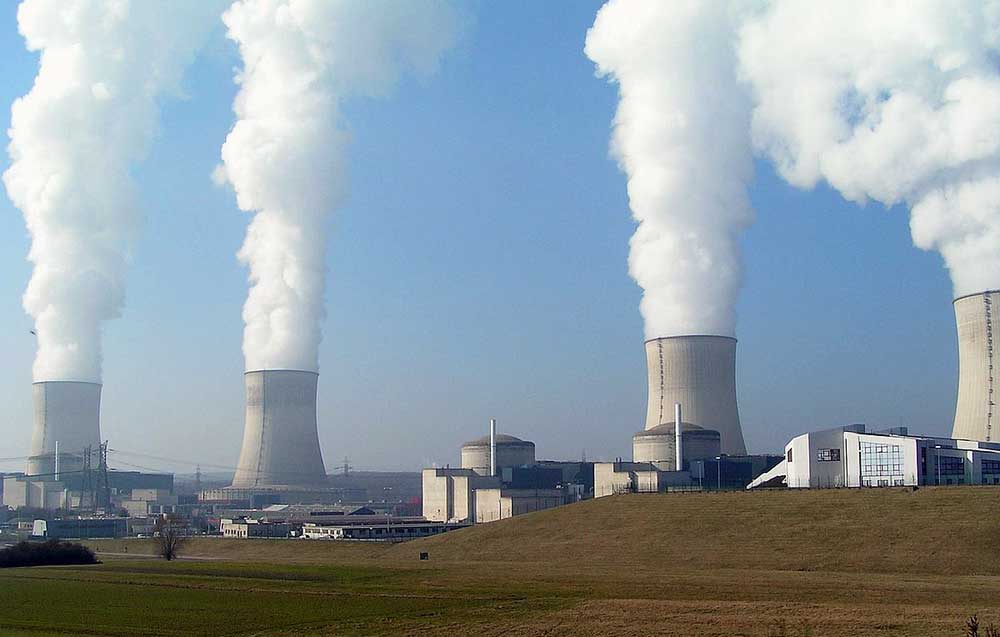
Southeast Asian governments are revisiting nuclear power as electricity consumption climbs sharply, driven by new factories, electric vehicles, and a regional rush to host data centers.
No Southeast Asian nation currently operates a commercial nuclear power plant, but several countries are reviving plans that had been stalled for years following the 2011 Fukushima disaster in Japan.
Vietnam is among the most aggressive movers, with state-owned Petrovietnam and South Korea’s KEPCO agreeing on September 8 to deepen cooperation on the planned Ninh Thuan 2 nuclear plant.
Vietnam wants to bring its two Ninh Thuan plants into operation by 2035 and pursue at least one small modular reactor (SMR) project alongside that effort.
Indonesia plans an initial 500 megawatts of nuclear capacity with units targeted to begin operating in 2032, while the Philippines is working toward its first 1,200 MW of nuclear capacity from the same year.
Thailand’s latest draft power plan proposes its first SMR by 2037, while Malaysia and Singapore remain at the research and study stage.
The International Energy Agency (IEA) reports that Southeast Asia’s electricity generation has risen by around 60% since 2015, with coal supplying most of that increase and pushing its share of regional generation from 37% to 47%.
The region’s electricity demand is forecast to grow by an average of 5.3% a year between 2026 and 2030, creating urgent pressure on governments to identify reliable, low-carbon sources of power.
Alvin Chew, a senior fellow at the S. Rajaratnam School of International Studies (RSIS) at Nanyang Technological University in Singapore, said the war in Ukraine and the ongoing Middle East crisis have heightened energy-security concerns for developing nations across the region.
“Nuclear energy is deemed to be the viable solution to address both challenges of climate and energy security,” Chew said, noting that most Southeast Asian governments have committed to net-zero emissions by 2050 or 2060.
SMRs have broadened the range of viable nuclear projects, with Jie-Sheng Tan-Soo, assistant professor and director at the Lee Kuan Yew School of Public Policy in Singapore, explaining the appeal of the newer technology.
“In the past, deploying nuclear energy generally meant building very large conventional reactors, involving long construction periods, enormous upfront investments and requiring electricity grids capable of absorbing very large generating units,” Tan-Soo said.
“SMRs have changed the nuclear conversation in Southeast Asia because they potentially make nuclear compatible with smaller grids, smaller countries and more incremental investment,” he added.
The rapid expansion of data centers is also pushing nuclear back onto the policy agenda, with the IEA expecting electricity consumption from Southeast Asian data centers to more than double by 2030.
Julius Cesar Trajano, a research fellow with the Centre for Non-Traditional Security Studies at RSIS, noted that more than 70% of existing regional data-center capacity is concentrated in Singapore and Johor in southern Malaysia.
Despite the growing momentum, significant obstacles remain, including the need to establish independent regulators, train specialist workforces, and develop credible systems for radioactive waste and emergency response.
Geography presents an additional layer of difficulty, as parts of Southeast Asia are vulnerable to earthquakes, volcanoes, and tsunamis, making site selection and emergency planning particularly sensitive for any nuclear program.
Public opinion remains deeply divided across the region, with a Philippine government survey finding more than 70% of respondents supporting nuclear energy, while Indonesia’s Energy Transition Outlook 2026 reported 78% of respondents ranked nuclear as their least-preferred energy source.
“The biggest obstacle is the political will to proceed with adoption of nuclear energy, which, to a certain extent, is dependent on public perception,” Chew said.
Tan-Soo offered a measured outlook, saying that while political momentum is clearly stronger today than a decade ago, the distance between ambition and reality remains vast.
“But moving from announcing a nuclear ambition to financing, licensing, constructing and safely operating a reactor is an enormous step,” he said.
