
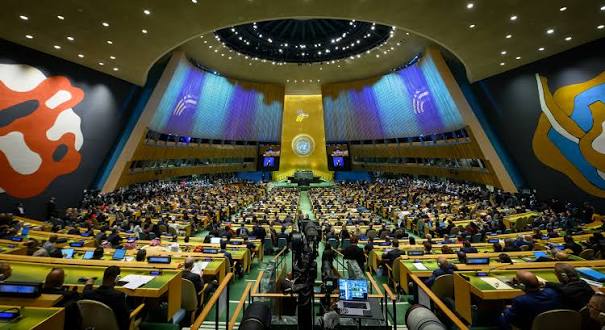
The United Nations General Assembly has voted to endorse the use of equal-area map projections, dealing a symbolic blow to centuries of cartographic misrepresentation of Africa’s true size.
A total of 164 UN member states voted in September to encourage the adoption of the Equal Earth projection and other equal-area maps, replacing the 16th-century Mercator projection that has long distorted continental proportions.
The Correct the Map campaign, sponsored at the UN by Togo, was also backed by the African Union, marking a significant moment of institutional support for the initiative.
Robert Dussey, the foreign minister of Togo, described the vote as a source of genuine national and continental pride, telling DW it reflected Africa’s long-overdue push for recognition.
“Finally, Africa is fighting to regain its place in the community of nations,” Dussey said. “The place it has been reserved to this day is unfair. It does not correspond to Africa’s reality, not in historical, geographical or economic terms.”
Dussey made clear the debate extended well beyond cartography, framing it as a broader effort to redress misperceptions about Africa’s political, economic and cultural standing in the world.
The United States was the only UN member state to reject the resolution, a decision that drew attention given President Donald Trump’s own use of maps as political tools, including executive orders renaming the Gulf of Mexico as the Gulf of America and Lake Ontario as Lake America.
French historian Romain Tiquet from the African Worlds Institute told DW the resolution reflects a much wider global conversation about the decolonization of knowledge that has been building since the late 2000s and early 2010s.
“Who established the categories through which we conceptualize the world? From which locations? And what power dynamics result from this? And cartography fits right into this context,” Tiquet said.
Several African governments have extended this push into formal education, with Mali making the significant decision in October 2025 to remove French history from its school curriculum, replacing it with a focus on Malian history and ancient West African kingdoms.
Mali’s break with France has been years in the making, having ended military cooperation with France in 2022, and subsequently joining Burkina Faso and Niger to form the Alliance of Sahel States in 2023.
Philemon Mtoi from Tumaini University Makumira in Tanzania welcomed Mali’s curriculum shift, arguing that a nation without a grounded understanding of its own history lacks clear direction and purpose.
“This decision is important because it seeks to strengthen patriotism and foster a stronger sense of national identity,” Mtoi said, describing it as both an act of decolonization and an important step toward intellectual independence.
Mtoi noted that Ghana, Namibia, South Africa, Kenya and his own country, Tanzania, had adopted similar approaches, with Tanzania now requiring “Tanzanian history and ethics” as a compulsory subject taught in Swahili.
He cautioned, however, that decolonizing curricula should not mean erasing knowledge of global history entirely, arguing that understanding major events like the French Revolution remains important but can be introduced at a later educational stage.
Beyond formal education, the non-profit Africa No Filter has been working to challenge harmful media narratives through its new #NotWaiting campaign, which targets both international audiences and Africans themselves.
Africa No Filter’s report titled “The cost of media stereotypes to Africa” estimates that biased media coverage could be costing the continent up to $4.2 billion annually in inflated interest payments.
Francois Bouda, an officer for arts and culture at Africa No Filter, said the campaign is built on the recognition that internal perceptions must change alongside external ones, with Africans encouraged to reject a self-image of dependency and limitation.
“We are addressing Africans because we, too, need to change the way we view the African continent. We’ve accepted the image of a continent incapable of taking care of itself, one that is poor and has no opportunities. We’ve internalized this and come to believe it, even though many positive things are happening,” Bouda said.
The #NotWaiting campaign draws on voices from across the continent and the diaspora who are, as Bouda put it, not waiting for an external hand to dictate what path to follow, centering the stories of everyday Africans driving real change.
A promotional video for the campaign captures the spirit of the movement directly: “We’ve been building all along. From village roads to crowded cities, across the 54 countries that make up the continent, millions of ordinary people doing extraordinary things every day.”
