
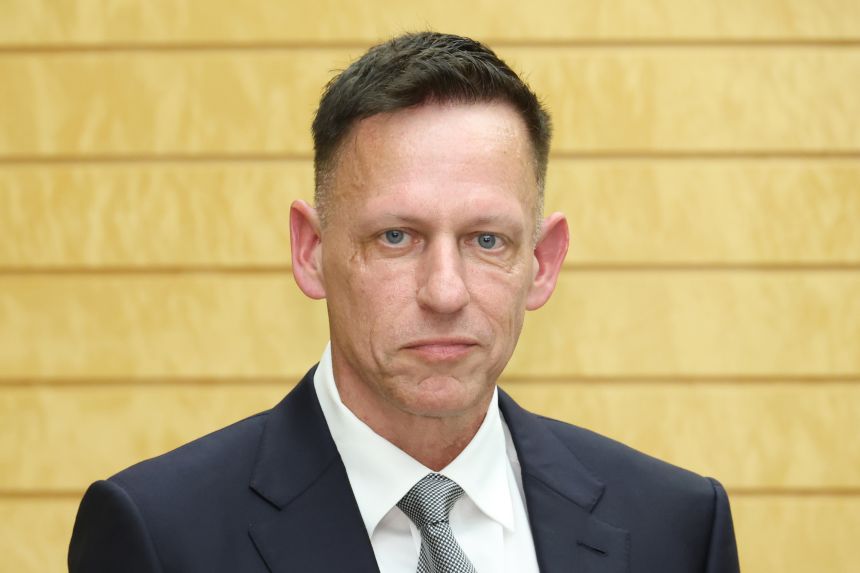
Peter Thiel may not command headlines the way Donald Trump or Elon Musk do, but few figures rival his combined influence across technology, finance, and global politics.
Born in Frankfurt am Main in 1967, Thiel moved to the United States with his family at just one year old, later spending six years in South African-occupied Namibia between 1971 and 1977.
His ascent in the tech world began with PayPal, the digital payments giant that also counted Musk among its early figures, before Thiel became the first outside investor in Facebook.
Today his portfolio extends to partial ownership of Musk’s SpaceX, OpenAI, and numerous other companies, with Forbes valuing his personal wealth at $35.7 billion.
His most consequential venture, however, remains Palantir, the surveillance, AI, and data-analytics company that has secured billions in government contracts with the Pentagon and US Immigration and Customs Enforcement.
Palantir released a 22-point manifesto in April that drew widespread criticism, with detractors arguing it bore the hallmarks of what they described as “techno-fascism.”
Several European nations, including the UK, the Netherlands, France, Germany, and Spain, have begun reevaluating or severing governmental and military ties with Palantir over mounting security concerns.
Thiel has recently relocated to Argentina, where he has reportedly held discussions with right-wing President Javier Milei as that government pursues regulations designed to attract foreign investment and develop AI data centers.
His political reach stretches back to 2016, when he donated $1.25 million to Trump’s first presidential campaign and addressed the Republican National Convention at a time when Silicon Valley was broadly seen as Democrat-leaning territory.
His political philosophy resists easy categorization, though he has been described as a libertarian nationalist who consistently argues that “technology is the alternative to politics,” and who harbors deep distrust of regulation, elected officials, and liberal elites.
Max Chafkin, who wrote a 2021 biography of Thiel, offered a sharper assessment to Time magazine, stating: “It’s bordering on fascism. He talks about how companies are better run than governments because they have a single decision-maker — a dictator, basically. He is hostile to the idea of democracy. That’s pretty scary when you consider the role the companies that he’s been involved in play.”
Those contrarian instincts surfaced early at Stanford University, where Thiel founded the Stanford Review to push back against the prevailing liberal campus ideology, a posture that foreshadowed his current contempt for ideas labeled “woke.”
Thiel describes himself as a “small ‘o’ orthodox Christian,” a faith that visibly shapes his conservative politics even as his marriage to American financier Matt Danzeisen appears to sit in tension with it.
In recent years he has become increasingly preoccupied with the concept of the antichrist, delivering lectures around the world that frame the threat not as a biblical figure but as a force that delivers apocalypse “by playing on our fears of technology and seducing us into decadence with the antichrist’s slogan: Peace and safety.”
Those he has cast, however vaguely, as soldiers of this antichrist include environmental activist Greta Thunberg, whom he characterizes as a “Luddite who wants to stop all science,” along with governments seeking to regulate AI.
He also accused Pope Leo XIV of “working for the Chinese communists” in July, after the pontiff warned of the “risk of dehumanization” posed by artificial intelligence.
His relationship with Vice President JD Vance is among his most strategically significant, with many observers believing Thiel is positioning himself to protect his interests should Vance, widely seen as Trump’s most likely Republican successor, eventually reach the presidency.
The two men met in 2011 when Thiel spoke at Yale Law School, and Vance later wrote in Christian magazine The Lamp that Thiel “defied the social template I had constructed — that dumb people were Christians and smart ones atheists.”
Thiel went on to donate $15 million to Vance’s 2022 Senate campaign, the largest single donation ever made to a US Senate candidate, cementing a relationship that has since grown into one of Washington’s most closely watched political partnerships.
As Thiel told the Washington Post back in 2014, “I’ve built some great friendships over the years with people I’ve worked with. And I think that’s a really important part of what enables one to be successful in the long run in our society.”
