
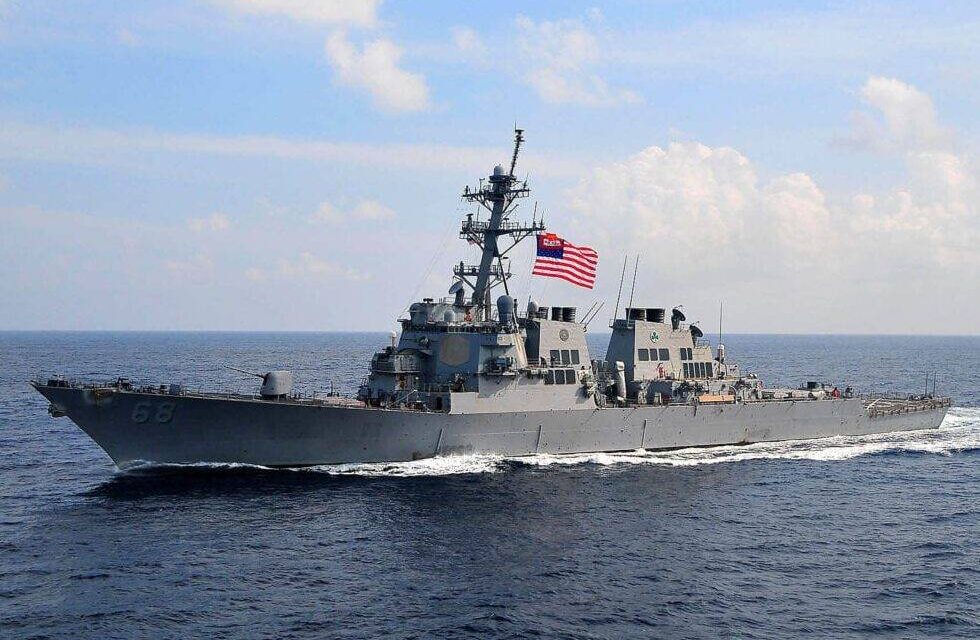
The U.S. military destroyed five Iranian oil tankers linked to the Islamic Revolutionary Guard Corps (IRGC) after Iran attempted missile launches at U.S. Navy warships in the region.
U.S. Central Command, known as Centcom, confirmed the strikes, saying forces targeted crude oil carriers operating as part of a broad Iranian shadow network.
American forces disabled four tankers in the Gulf of Oman: the M/T Kaviz, M/T Charminar, M/T Horizon 1, and M/T Riesco.
A fifth vessel, the M/T Derya, was struck near Kharg Island in the northern Persian Gulf, completing what Centcom described as a coordinated retaliatory operation.
Before opening fire, U.S. forces directed the crews aboard each vessel to abandon ship, and no U.S. personnel were reported harmed in the operation.
Centcom stated that “Iran has used the tankers as part of a multibillion-dollar shadow network that funds the IRGC and its regional proxies,” adding that “Iran has no means by which to defend these vessels.”
The Tuesday strikes followed a day after Iran launched attacks against U.S. Navy ships, incidents that Centcom had not publicly acknowledged, according to reporting from The Wall Street Journal.
The escalation did not begin this week. On the prior Saturday, U.S. forces had already “permanently disabled” three IRGC crude oil tankers near Kharg Island and in the Gulf of Oman in an earlier retaliatory operation.
The day after that Saturday strike, Iranian state media reported that the IRGC attacked a remotely operated U.S. military vessel in the Strait of Hormuz, further intensifying the confrontation between the two nations.
The series of strikes and counter-strikes is unfolding against a volatile energy market backdrop, with Brent crude trading at $97 per barrel on Tuesday as tensions in the region showed no sign of easing.
The IRGC’s shadow oil network has long been a source of concern for Washington, with billions of dollars allegedly funneled through tanker operations to finance militant proxies across the Middle East.
The rapid exchange of military actions between the U.S. and Iran marks one of the most significant escalations in the Persian Gulf in recent years, raising questions about broader regional stability and energy supply security.
