
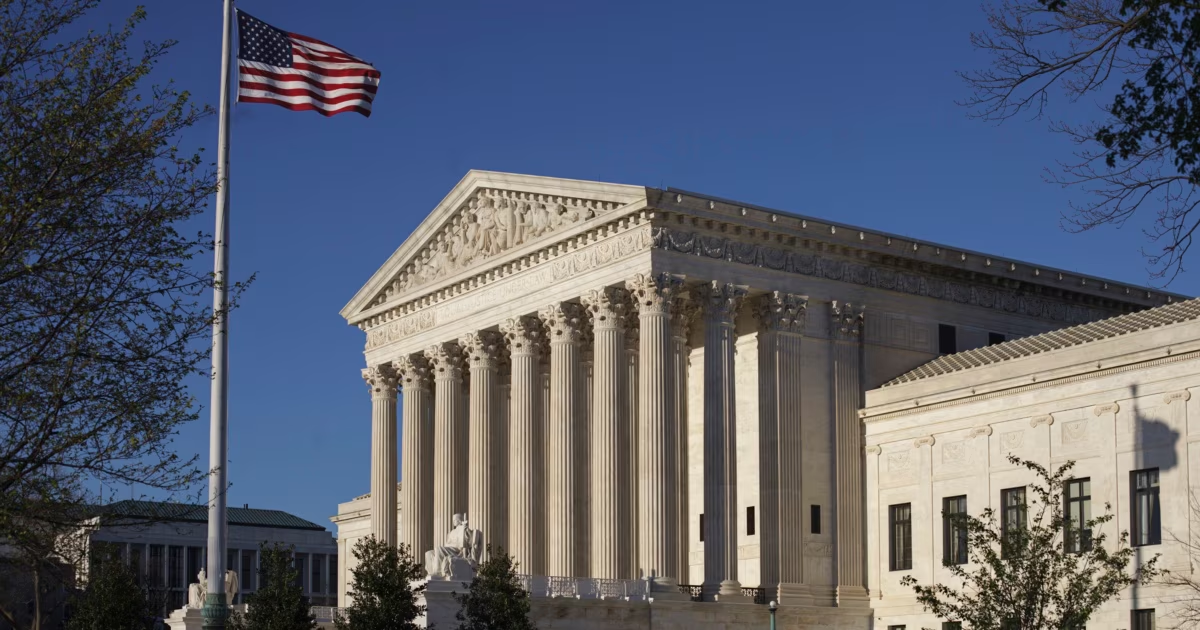
The Supreme Court has ruled 5-4 in favor of allowing construction of a massive White House ballroom to continue, lifting a lower court block on above-ground work.
Five conservative justices, including all three of Trump’s appointees, Neil Gorsuch, Brett Kavanaugh, and Amy Coney Barrett, sided with the president, along with Justices Clarence Thomas and Samuel Alito.
Chief Justice John Roberts broke from the conservative majority, joining the court’s three liberal justices in dissent against the decision.
The majority held that one member of the National Trust for Historic Preservation’s “mere offense, disagreement, or distaste” was insufficient to establish legal standing to sue.
By ruling on standing, the majority sidestepped the broader constitutional question of whether Trump had the authority to demolish the East Wing without congressional approval.
Trump tore down the historic East Wing last fall to make way for the planned 90,000-square-foot ballroom and military complex on the White House campus.
Court records indicate a 250-person crew is currently working on the ballroom 20 hours a day, seven days a week, with the project described as under budget and ahead of schedule.
“We have a lot of very happy construction workers,” President Trump told reporters in the Oval Office, adding that the $400 million project was “under budget and ahead of schedule.”
Trump celebrated the ruling on Truth Social, writing: “I am pleased to report that the United States Supreme Court has just ruled in favor of the Ballroom/Military Complex being built without any further contingency, doubt, or threat.”
The president predicted the finished structure would be a source of national pride, writing that “when completed in the Summer of 2028, the magnificent Ballroom and Military Complex will be something that the entire Country is very proud of.”
Legal scholars note the ruling fits a broader pattern of the administration treating narrow procedural victories as broader endorsements of its agenda before courts have fully weighed in on legality.
Melissa Murray, a professor at New York University’s School of Law, explained that when the court lifts an injunction on the shadow docket, it “basically allows the government to continue doing what it was doing,” with significant real-world consequences.
The ruling is not a final determination on the legality of the ballroom project, and the National Trust for Historic Preservation’s underlying legal challenge remains active and could return to the Supreme Court.
The Trump administration has maintained throughout the dispute that it does not need express congressional authorization and that it followed all required review and permitting processes.
