
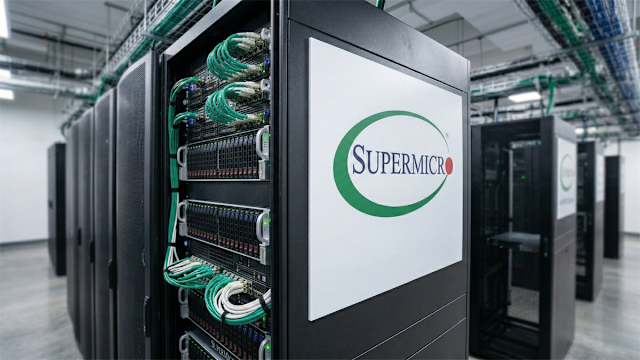
Super Micro Computer (NASDAQ: SMCI) has delivered a strong 35% year-to-date gain, yet its AI-server peers have left it looking like a distant also-ran in the same infrastructure boom.
For broader context, the SPDR S&P 500 ETF Trust (NYSEARCA: SPY) is up 13% year to date, while the iShares U.S. Technology ETF (NYSE ARCA: IYW) has rallied 26% across the same period.
Against that backdrop, the three major AI-server providers have produced dramatically different outcomes for investors following the same underlying demand story.
Dell Technologies (NYSE: DELL) closed Friday at $524.14, up an extraordinary 320% year to date, while Hewlett Packard Enterprise (NYSE: HPE) finished at $52, up 118% for the year.
Super Micro Computer closed Friday at $39.59, a solid gain in absolute terms but a stark underperformance compared to the two diversified rivals riding the same AI infrastructure wave.
That gap reflects what the market views as a fundamental difference in margin quality and cash generation, even as AI-server demand remains historically strong across all three companies.
Super Micro did most of its heavy lifting in a single August earnings window, reporting Q4 FY2026 non-GAAP EPS of $1.70 against a consensus estimate of $0.9575, on revenue of $11.12 billion that grew 93.2% year over year.
Non-GAAP gross margin jumped sharply to 17.6% from just 10.1% the prior quarter, and CEO Charles Liang disclosed more than $60 billion in new orders during the quarter alongside a record backlog entering fiscal 2027.
Management guided FY2027 revenue to a range of $65 billion to $72 billion, well above FY2026’s $39.1 billion, and that combination of margin recovery and forward book pulled SMCI stock off its April low of $27.
Dell’s results illustrate why it commands such a higher market premium, with Q2 FY2027 non-GAAP EPS of $7.04 on revenue of $46.97 billion, $60.9 billion in AI orders during the quarter, and full-year revenue guidance lifted to $192 billion.
Dell also produced $2.2 billion in operating cash flow and returned a record $4.3 billion to shareholders in the same quarter, a cash conversion story that Super Micro simply cannot match right now.
Hewlett Packard Enterprise reported Q3 FY2026 non-GAAP EPS of $1.11 on revenue of $12.21 billion, with networking revenue up 74.9% year over year, and raised its FY2026 non-GAAP EPS guidance to a range of $3.75 to $3.85.
HPE also framed FY2027 free cash flow at a minimum of $5 billion, while Super Micro’s FY2026 operating cash flow came in at negative $6.8 billion on a $12.9 billion inventory build.
That negative cash flow figure is the central obstacle preventing SMCI stock from reaching $50, as it acts as a direct counterweight to the company’s otherwise impressive margin recovery narrative.
Getting from $39.59 to $50 requires the market to assign a higher multiple than sell-side analysts currently model, and the rating mix on the stock leans toward hold rather than buy.
The path runs through the fiscal 2027 report cycle, with Q1 FY2027 guidance calling for revenue of $14.5 billion to $15.5 billion and non-GAAP EPS of $1.01 to $1.10, leaving little room to disappoint.
CFO David Weigand pointed to improved backlog terms as the primary mechanism for repairing the cash flow situation, with stronger DCBBS mix and cleaner working capital also cited as contributing factors.
Closure on the board’s independent review of export-control-related transactions remains an open overhang, and resolution there would support a rerating toward the $50 level.
With a beta near 2 and a 52-week range running from $19.48 to $58.78, SMCI is a high-volatility position that rewards careful sizing until the cash-conversion cycle shows genuine improvement.
