
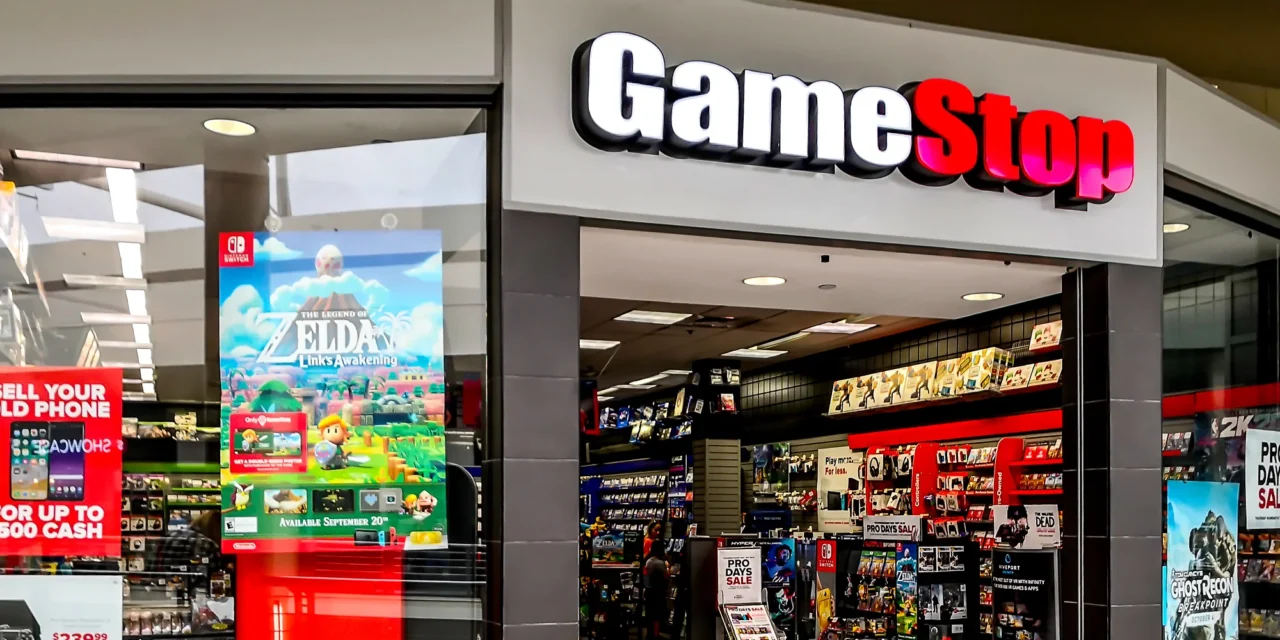
GameStop (NYSE: GME) is approaching its September 8 earnings report with options traders positioning for a significantly larger-than-usual price move in either direction.
The market is currently pricing in a 9.04% swing, well above the stock’s average one-day post-earnings move of 6.6% recorded over the past four quarters.
Investors are weighing sharply improving operating profitability against declining sales figures and increasingly unpredictable investment gains tied to GameStop’s growing asset portfolio.
Preliminary results have already removed some of the uncertainty heading into the report, with GameStop guiding for Q2 sales of $780 million to $800 million, down from $972.2 million in the same period a year earlier.
The revenue decline reflects the prior year’s Nintendo Switch 2 launch boost, a planned program of store closures, and the divestiture of the company’s France operations.
Profitability, however, tells a markedly different story, with operating income expected to land between $150 million and $170 million, more than double last year’s $66.4 million figure.
Net income for the quarter is projected to reach between $290 million and $310 million, though the composition of those earnings warrants close scrutiny from investors.
Approximately $238 million of gains stemmed from GameStop’s eBay investment and a related derivative position, partially offset by roughly $75 million in losses on digital assets and related receivables.
At the close of the quarter, GameStop held approximately 43.4 million eBay shares valued at $4.95 billion, making equity market movements a significant variable in the company’s reported financial performance.
The underlying operational turnaround nonetheless appears meaningful, with GameStop posting $143.3 million in operating income during Q1, compared to a $10.8 million operating loss recorded in the same quarter a year prior.
Selling, general and administrative expenses also declined during that period, suggesting the company’s cost-reduction efforts are gaining traction alongside its store-closure program.
GameStop’s business model has been substantially transformed in recent years, as aggressive store closures and the buildup of an investment portfolio have shifted how the market evaluates the company’s financial health.
The September 8 report is expected to be less about whether the company meets its preliminary guidance and more about the quality and sustainability of the underlying operating improvement.
Analysts and investors will be watching gross margin trends, SG&A reductions, and any management commentary on retail demand conditions across the company’s remaining store network and e-commerce operations.
With options pricing a larger-than-normal reaction ahead of the release, even modest surprises around margin performance, investment exposure, or capital-allocation strategy could produce an outsized move in the stock.
