
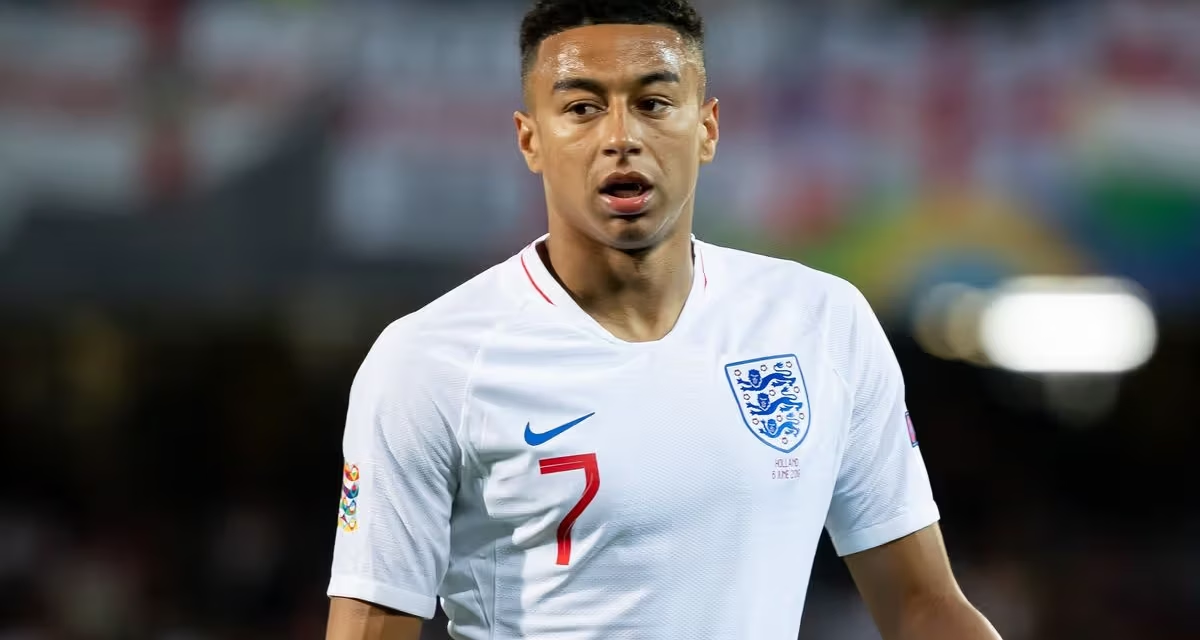
Former Manchester United and England forward Jesse Lingard has appeared in advertising for Concierge First, a company that purports to sell steeply discounted business and first-class airline tickets, but which several customers say has taken their money and vanished.
An investigative report by iBusiness.News uncovered the story and Lingard’s involvement.
In one clip, Lingard films himself on a plane thanking “Cam and the team” at Concierge First for arranging first-class flights at up to 80% off, urging viewers to “get in touch with them.”
“I recently used Cam and the team at Concierge First to arrange my first-class flights and they saved me up to 80%, which is really good,” Lingard said in the advert.
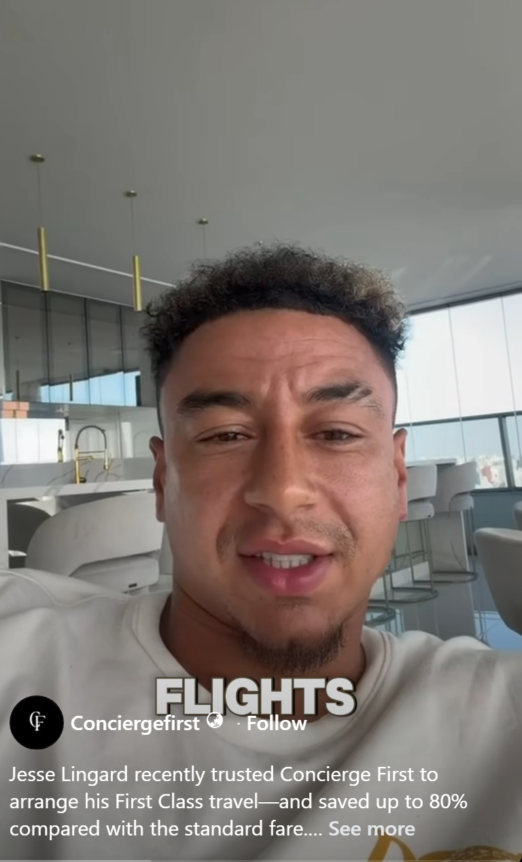
“Concierge First are the real deal guys, so get in touch with them,” he added.
The ads run primarily as paid promotions on Facebook and Instagram, and dozens of Brits have fallen victim to the scam.
Multiple people who paid the company say they never received tickets. One London-based customer described paying over £2,000 for business-class Emirates return fares to Dubai — roughly half the price listed on the airline’s own site — only for Concierge First to stop responding once the payment cleared.
“I paid Concierge First over £2,000 for Business-class return tickets to Dubai with Emirates, which was around half of the price I was seeing online on the airline’s own website,” the victim told iBusiness.News.
“After I paid them, they stopped responding and never provided the tickets,” he added
The company claims on its website to be a registered UK limited company, citing a specific registration number, but no matching entry exists on Companies House.
The identity of “Cam,” the figure referenced in Lingard’s advert, remains largely unconfirmed; an Instagram account under that name is linked to the company but offers little verifiable detail.
It isn’t clear whether Lingard actually endorsed Concierge First or whether his likeness was used without consent in an AI-generated clip — a distinction that’s becoming harder to establish across the industry.
His representatives, JL Commercial, did not respond to questions sent by iBusiness.News about his involvement, payment, or whether the footage was synthetic.
Other public figures, including rapper ArrDee and influencer Ed Matthews, have also appeared — genuinely or synthetically — in Concierge First promotions.
A wider pattern
Lingard’s case fits a fraud model that has scaled rapidly since 2023, when Tom Hanks first warned fans that an AI-generated version of him was being used to sell a dental plan he had nothing to do with.
Since then, deepfaked or misappropriated celebrity endorsements have moved from novelty into a major fraud category: deepfakes now account for roughly 11% of all fraud, with supplements the category where synthetic celebrity endorsements have found their most reliable market.
The playbook is consistent regardless of product. Scammers typically hook victims through social ads or spoofed news sites featuring a “leaked” celebrity video, then build credibility by referencing the celebrity’s real ventures and seeding comment sections with fabricated testimonials.
Financially credible figures are especially prized: an Ontario woman lost $83,000 after seeing deepfaked videos of Canadian PM Mark Carney promoting a crypto platform, since a fabricated endorsement from a financial authority figure lends unregulated schemes institutional legitimacy that an ordinary scam ad can’t.
An April 2026 investigation found a surge of celebrity deepfake ads clearing platforms’ automated ad review entirely, underscoring how little friction currently stands between fraudsters and paying audiences — Lingard’s flight-scam adverts being only the latest example.
