
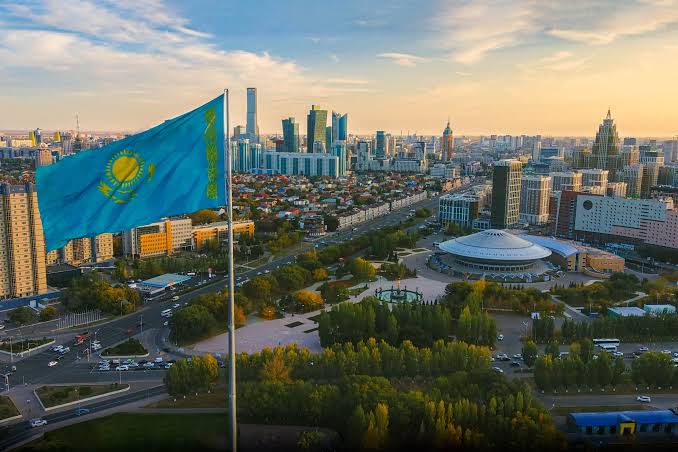
Kazakhstan is heading to the polls on August 23, when citizens will elect 145 members of a newly restructured single-chamber parliament known as the Kurultai, replacing the previous two-chamber system.
All seven registered parties have been admitted to the vote, conducted exclusively through party lists, with the ruling party Adilet, which translates to “Justice,” widely expected to dominate the outcome.
Luca Anceschi, Professor of Eurasian Studies at the University of Glasgow, says the new parliament will do the same as the previous one, “which is pretty much to represent whatever the regime wants them to do.”
Stefan Meister, Head of the Center for Order and Governance in Eastern Europe, Russia and Central Asia at the German Council on Foreign Relations, agrees, noting that the ruling party’s victory is also reflected in recent opinion polls.
Both experts conclude that the elections are designed to consolidate President Kassym-Jomart Tokayev’s power and further weaken the bloc previously aligned with former president Nursultan Nazarbayev, who led the country from 1991 to 2019.
Constitutional amendments already approved allow Tokayev to seek another seven-year presidential term in 2029, further entrenching his long-term hold on the country’s political institutions.
Former Kazakhstani senator Zauresh Battalova, who now heads the NGO Foundation for the Development of Parliamentarism in Kazakhstan, says what matters is not the number of chambers in parliament but “the scope of its powers, its autonomy and its ability to oversee the executive branch of government.”
Battalova also criticizes the exclusion of independent candidates from the electoral system, telling DW that “the election will be held exclusively on the basis of party lists, in the absence of a political opposition and with limited party competition,” adding that “the scope for genuine political choice remains extremely narrow.”
On the question of whether Europe will push back against the democratic deterioration, Anceschi is blunt, saying “the days when the European Union and individual EU member states were more critical of the rule of law and governance in Central Asia are gone, unfortunately.”
Meister explains that since the start of the war in Ukraine, the EU has adopted a more pragmatic approach toward Central Asian states, prioritizing alternative trade routes and access to the region’s abundant natural resources over governance concerns.
In 2025, Kazakhstan became the second-largest oil exporter to the EU, with a total share of 12.8%, amounting to 55.8 million tons of crude oil, surpassed only by the United States, according to the European Council of the EU.
Anceschi captures the geopolitical reality bluntly, saying “wherever you buy your oil and gas from, you are never going to buy it from a democracy, unless it is Norway, so in that sense, there is not much of a choice.”
On the foreign policy front, Kazakhstan has carefully avoided taking sides in the conflict between Russia and Europe, with Anceschi describing the country’s current position as a “geopolitical comfort zone,” saying “they are affected by the conflict, but they are not participating.”
Kazakhstan has neither officially opposed European sanctions against Russia nor joined them, threading a careful diplomatic needle as external pressure on the region continues to mount from multiple directions.
Meister notes that Anceschi characterizes even this foreign policy balancing act as serving domestic political ends, with Anceschi saying “foreign policy is becoming an instrument for achieving internal stability” with “only one ultimate goal, which is the preservation of authoritarian rule.”
Meister highlights growing cooperation among Central Asian states, which are increasingly acting as a unified bloc under external pressure while actively working to reduce tensions among themselves and diversify their international partnerships.
According to Meister, Kazakhstan “does not want to be too dependent on Russia, it has seen what Russia is doing in Ukraine, and it does not want to be dependent on China,” making Europe an attractive alternative both as a market for its resources and as a potential investor in its economy.
