
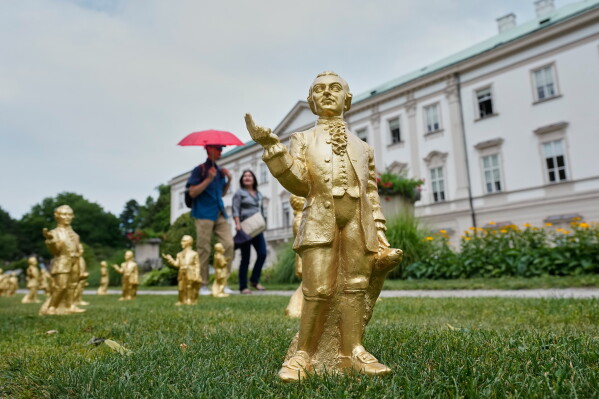
A major public art exhibition in Salzburg has been thrown into disarray after more than 200 gold-colored Mozart figurines vanished from a prominent outdoor installation, AP News reported.
The Mozarteum Foundation confirmed that 210 of the 320 figures installed in the city’s Mirabell Garden had disappeared, forcing organizers to shut down the garden portion of the display ahead of schedule.
The theft has disrupted a carefully planned project marking the 270th anniversary of composer Wolfgang Amadeus Mozart’s birth in his home city of Salzburg.
Organizers had kept a number of replacement figures in reserve, but the scale of the losses was far too large for those reserves to make any meaningful difference.
Adding to the difficulty, the manufacturer of the figures is currently on summer holiday, leaving no quick or practical path to restoring the installation.
Several dozen figures remain on display at the Mozarteum and at Mozart’s birthplace, with that portion of the exhibition expected to continue until the end of August.
The polymer figures depict Mozart alongside his dog Pimperl, a detail chosen to reflect the composer’s everyday domestic life in Salzburg rather than his legendary status.
German conceptual artist Ottmar Hörl, the creative force behind the installation, said he designed the display to present Mozart “as a normal human being despite his genius.”
Hörl, who is known for large-scale installations featuring identical figures of famous personalities, was candid about the emotional toll of the theft, saying “the worst thing for an artist is when his work dissolves.”
The artist said he does not believe tourists casually walked off with the 50-centimeter figures, pointing instead to something more deliberate and coordinated.
“This is organized theft,” Hörl said, suggesting the figures were most likely removed at night after the garden had closed, adding, “I find it a bit cheeky.”
Hörl had planned to sell the figurines following the close of the exhibition for around 90 euros each, placing the total financial loss at roughly 20,000 euros.
This is not the first time one of Hörl’s public installations has been targeted, as a previous display in Bayreuth saw 100 figures of composer Richard Wagner disappear under similar circumstances.
Despite the losses, Hörl took a philosophical stance on the risks that come with working in public spaces, noting that outcomes “range from destruction to theft.”
“When you work as an artist in a public space, you mustn’t complain about what is happening there,” Hörl said. “That’s just how it is.”
