
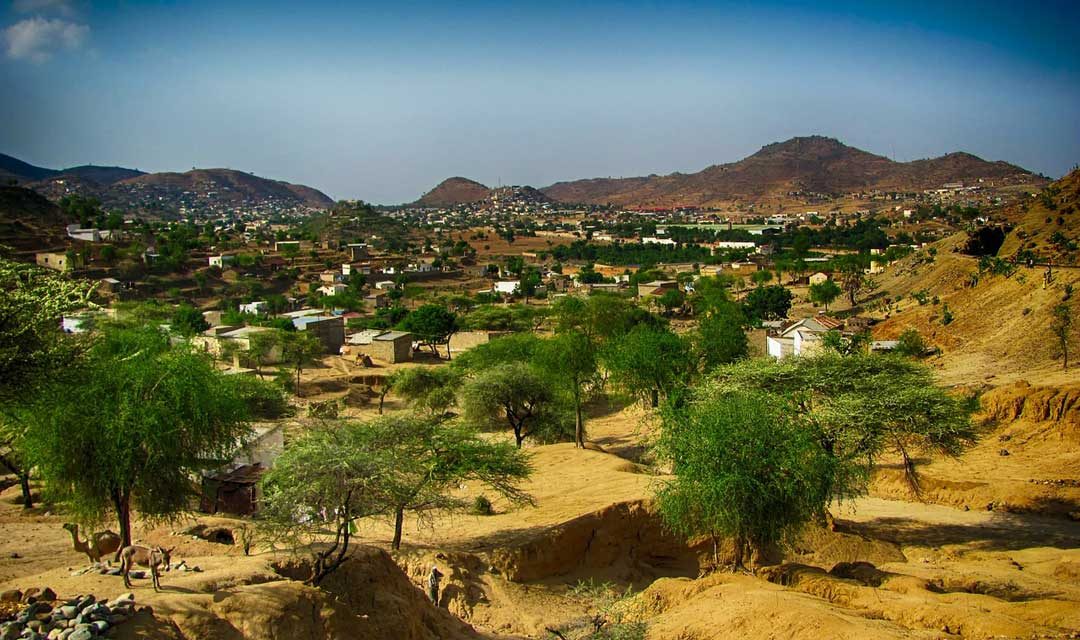
Eritrea, a small autocratic state on the Red Sea coast, is rapidly gaining geopolitical significance as competing regional and global powers scramble for influence across the Horn of Africa.
Long-standing ruler Isaias Afewerki controls strategically vital coastal infrastructure, including the ports of Assab and Massawa, giving the country outsized leverage relative to its size.
In July, diplomatic consultations in Cairo brought together Egypt, Somalia, Eritrea, and a high-ranking US envoy to coordinate responses to security challenges across the Horn of Africa and the Red Sea.
Eritrea’s coastline near the Bab-al-Mandab Strait stretches more than 1,000 kilometers, bordering Sudan to the northwest and Djibouti to the southeast, making it a critical maritime node.
Abdurahman Sayed, director of the Horn of Africa Centre for Regional Integration in London, told DW: “Yemen lies on the other side of the Red Sea, which makes Eritrea’s location particularly interesting, as Yemen is in a state of crisis and maritime security in the region is at risk.”
Sayed added: “The only safe route in this area runs through Eritrea, where there are currently no security concerns,” underscoring the country’s value as a stable transit corridor.
Iran-backed Houthi militants have been attacking merchant vessels from the Yemeni coastline, intensifying the strategic importance of alternative and secure maritime routes through Eritrean waters.
Yemen has simultaneously been enduring one of the world’s worst humanitarian crises for a decade, with the UN Refugee Agency documenting the devastating toll of ongoing violence, economic collapse, droughts, and floods.
Despite its strategic appeal, Eritrea ranks among the world’s most repressive states, frequently second only to North Korea in international freedom indexes, with no elections held since its founding 32 years ago.
Sayed cautions that Eritrea’s authoritarian stability carries a fundamental vulnerability: “The country is ruled by a single man, and there are no constitutional institutions. That makes the state very vulnerable should this strongman be removed from power.”
With no clear successor identified within 80-year-old Afewerki’s inner circle, analysts warn that the country’s carefully maintained security could collapse should the president exit power.
Sayed notes that regional heavyweights, including Saudi Arabia and Egypt, which controls the Suez Canal, are actively working to maintain stable relations with Asmara given its irreplaceable maritime position.
The Red Sea has emerged as the world’s most important sea route for Gulf states, and the war with Iran has further reinforced the significance of chokepoints such as the Strait of Hormuz and Bab el-Mandeb.
Should the Strait of Hormuz face repeated blockades, Gulf nations would require alternative routes through Saudi Red Sea ports, with Saudi pipelines running to the port of Yanbu-Al-Bahr representing a fragile and potentially compromised option.
Sayed is emphatic on Eritrea’s enduring value: “For this reason, Eritrea today is of great strategic importance. This has been the case for centuries and will continue to be the case.”
Landlocked Ethiopia has long sought sovereign sea access, a tension that has roots going back to 1993 when Eritrean independence stripped Addis Ababa of its direct coastal outlet.
Michael Woldemariam, a researcher at the School of Public Policy at the University of Maryland and the Atlantic Council, told DW: “The key context for Eritrea’s recent strategic maneuvers in the Horn of Africa and the Red Sea is the escalating tensions with Ethiopia.”
Woldemariam explained that “Asmara is seeking to forge partnerships that can serve as a counterweight to Addis Ababa,” with outreach extending to Egypt, Somalia, the UAE armed forces, Saudi Arabia, Ethiopian opposition groups, and the United States.
In May 2026, Eritrea and Egypt signed an agreement establishing direct freight connections between their respective Red Sea ports, creating a new trade corridor designed to expand independent regional supply chains.
Magnus Treiber, a migration researcher at the University of Munich’s Institute of Ethnology, warned that internal repression continues to drive mass emigration, with at least 700,000 people, roughly one fifth of the total population, having left the country since its founding.
Treiber noted: “The causes of flight have hardly changed. However, since the European Union now offers virtually no opportunities to seek asylum, Eritreans are now fleeing all over the world.”
