
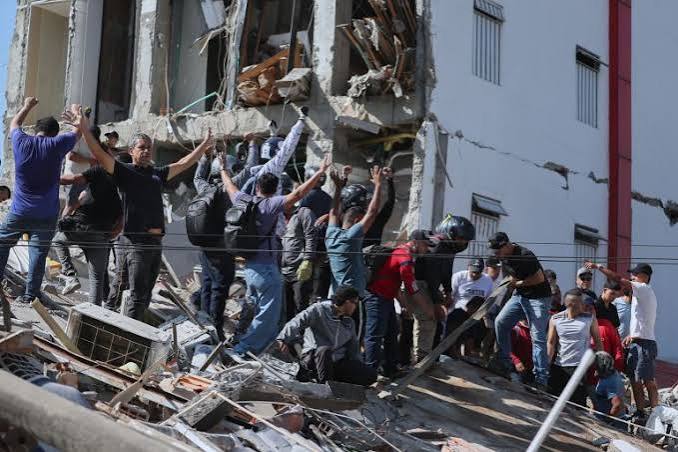
At least 67 people have been confirmed dead across two of Colombia’s worst-hit states following a powerful magnitude 7.4 earthquake that struck early Monday morning.
The US Geological Survey (USGS) initially measured the quake at 7.4, a figure Colombia’s own national authority later revised upward to match after an earlier, lower reading.
The epicenter was located near the eastern border of the Choco province, just south of the Tatama National Nature Reserve on Colombia’s Pacific coast.
The mayor of Cali, Alejandro Eder, confirmed that at least 20 buildings had collapsed across the city, with residents trapped inside multiple structures.
“Residents of Cali, we currently have at least 20 collapsed structures in the city with people trapped inside; we are already managing this emergency alongside all of Cali’s rescue agencies,” Eder said on Instagram.
Eder also stated, “I have requested support — specifically rescue personnel — from the mayors of Bogota and Medellin,” as rescue teams moved to free those trapped beneath rubble.
Authorities in Valle del Cauca, whose capital is Cali, reported at least 27 deaths, while officials in Risaralda confirmed 40 people had died across their state alone.
The mayor of Manizales, Jorge Eduardo Rojas, said in a radio interview that two people were killed in his city in the Caldas region, located northeast of Pereira.
Choco’s governor, Nubia Carolina Cordoba-Curi, was among the first officials to report the event, stating that injuries and severe building damage were recorded even in the regional capital of Quibdo, home to around 150,000 people.
“Although the epicenter was in San Jose del Palmar, in the capital Quibdo there are injuries and severe damage to buildings. We are already conducting the damage assessment to issue the first official report,” Cordoba-Curi said.
Colombia’s civil aviation authority reported damage at six airports, including those serving Pereira, Manizales, Quibdo, Armenia, Cartago, and Buenaventura, with Cali’s airport later added to the suspended list.
“For safety reasons, air operations at these terminals remain suspended until structural damage to the infrastructure is assessed,” the authority wrote online, signaling widespread disruption to domestic and regional air travel.
Colombia’s newly-inaugurated President Abelardo de la Espriella announced he had personally taken charge of the government’s emergency response centered on San Jose del Palmar.
“You are not alone. The state is present and taking action,” de la Espriella said, as federal resources were mobilized across the affected regions.
The USGS noted the quake struck approximately 107 kilometers below the surface, with tremors felt across most of western Colombia and into neighboring Ecuador, Panama, and Venezuela.
The closest major population center to the epicenter, Cartago, is home to roughly 140,000 people and sits approximately 30 kilometers from the quake’s origin point.
The USGS also recorded a magnitude 5.0 aftershock less than an hour after the initial event, raising concerns about further structural damage to already compromised buildings.
The so-called Ring of Fire, the world’s most seismically active belt of tectonic plates encircling the Pacific Ocean, runs along Colombia’s coastline near the epicenter, making the region historically vulnerable to major seismic events.
