
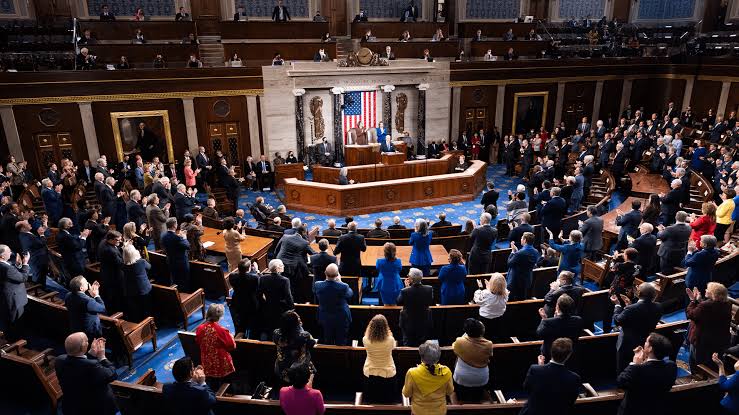
Bipartisan support is building in Congress to significantly expand federal investment in quantum computing, as rival nations accelerate their own programs across defense, cybersecurity and intelligence applications.
The House is expected to debate defense legislation later this year that would increase annual military spending on quantum development and application by 68%, bringing it to $567 million.
A parallel effort in the Senate is also underway to fund the technology, which researchers believe could transform fields ranging from drug discovery to encryption standards.
The congressional push follows action from the Trump administration, which in May announced plans to direct more than $2 billion into the quantum industry through federal investments.
In June, President Donald Trump signed an executive order to advance quantum research and development, alongside a second order requiring federal agencies to protect their IT systems against quantum-based cyberattacks.
Despite recent technological breakthroughs, investors remain skeptical of near-term commercial success, according to Philip Singerman, senior adviser at the Center for Strategic and International Studies.
Shares of leading pure-play quantum companies including D-Wave Quantum, Infleqtion and Rigetti Computing have fallen sharply since the start of the year as investor enthusiasm for the sector has cooled.
IonQ Inc. (NASDAQ: IONQ), based in College Park, Maryland, closed its $1.8 billion acquisition of semiconductor foundry SkyWater Technology after federal regulators ended their review without taking action to block the deal.
IonQ raised its full-year revenue forecast and its shares have since recouped most of their losses for the year, offering a rare bright spot in an otherwise bruised sector.
A mix of startups and major corporations, including Microsoft Corp. (NASDAQ: MSFT) and Alphabet Inc.’s (NASDAQ: GOOG) Google, are competing to apply quantum physics to build computers exponentially more powerful than existing machines.
China has established a $10 billion National Laboratory for Quantum Information Sciences, while Europe and the UK combined have committed nearly three times as much public funding as the United States, according to estimates from industry consultancy QBN.
“In China, you see a massive push toward quantum leadership,” said Dario Gil, under secretary for science at the Department of Energy. “That’s the one that I’m most focused on.”
The White House hosted a quantum tech summit in July with industry leaders focused on domestic supply chains, workforce development and private sector input, featuring officials from the National Science Foundation and the Departments of Defense, Energy and Commerce.
Also present at the summit were executives from International Business Machines Corp. (NYSE: IBM), PsiQuantum Corp. and Infleqtion, signaling the sector’s growing importance at the highest levels of government.
Quantum executives and lobbyists are increasingly engaging directly with elected officials, a shift noted by Infleqtion Chief Executive Officer Matt Kinsella.
“When we first started doing this two years ago, we struggled to get meetings with staffers on the Hill,” Kinsella said. “Now, we’re meeting directly with senators and representatives.”
The four pure-play quantum companies set to receive Commerce Department grants, including Infleqtion, D-Wave, PsiQuantum and Quantinuum, have doubled their total annual lobbying spending to $2.2 million, according to public disclosures.
“When your concern is access, not just your own access, but your competitors’ access, you’re forced to consider and play that game,” said Tad DeHaven, a policy analyst at the libertarian-leaning Cato Institute.
DeHaven also pointed to the Trump administration’s financial ties to the sector as a possible catalyst, noting that PsiQuantum raised $1 billion from investors including 1789 Capital, the venture capital firm where Donald Trump Jr. is a partner.
D-Wave, which was allotted $100 million by the Commerce Department, was taken public in 2022 under Emil Michael, who now serves as a top Pentagon official, raising questions about the intersection of political connections and federal funding decisions.
