
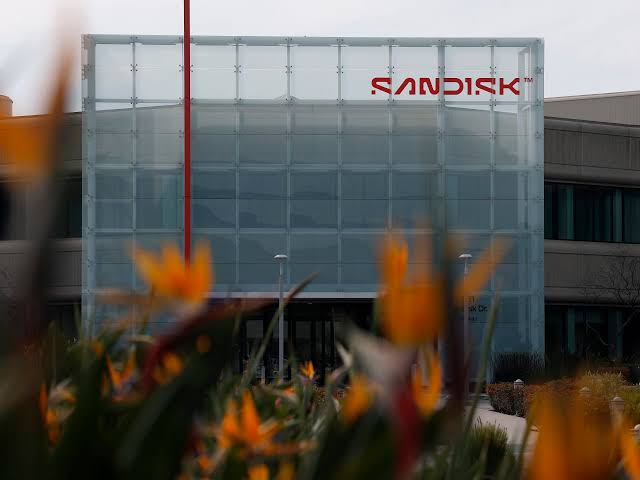
Sandisk (NASDAQ: SNDK) has emerged as the best-performing stock in the S&P 500 so far in 2026, with shares surging 570% year to date driven by intense demand for enterprise storage solutions.
The extraordinary rally reflects a severe memory chip supply shortage fueled by the artificial intelligence infrastructure build-out, which has fundamentally reshaped demand dynamics across the sector.
Wall Street’s median price target for Sandisk currently sits at $2,500 per share, implying roughly 57% upside from the stock’s current price of $1,590.
One analyst projects an even more aggressive move, forecasting a 91% gain to $3,040 per share by August 2027, when the company is expected to report full fiscal year financial results.
Sandisk develops storage solutions based on NAND flash memory, and has pivoted sharply from its consumer-focused origins toward enterprise solid-state drives that support AI workloads.
CEO David Goeckeler described the opportunity plainly, saying “NAND flash is emerging as the only economically viable solution to deliver the capacity, performance, and efficiency required to keep models accessible for real-time inference at scale.”
The company is actively expanding its enterprise SSD portfolio, with products based on Stargate, a new controller designed to improve enterprise SSD storage density, set to begin shipping this quarter.
In July, Sandisk began sampling chips built on its BiCS10 architecture, the 10th generation of its 3D NAND flash memory technology, which increases bit density by 59% compared to the previous generation.
BiCS10 chips are also 33% faster and significantly more power efficient than those built on the previous BiCS8 architecture, giving Sandisk a meaningful technical edge as customers seek higher-performance storage.
Sandisk reported third-quarter fiscal 2026 revenue of $5.9 billion, a 251% increase year over year, with particularly strong growth in its data center segment driving the headline figure.
Non-GAAP earnings reached $23.41 per diluted share in the quarter, compared to a loss of $0.30 per diluted share in the same period a year earlier, signaling a dramatic turnaround in profitability.
Wall Street’s consensus forecast calls for revenue to grow approximately 155% to $50 billion in fiscal 2027, a projection that underpins the bullish case for significant share price appreciation.
Investors remain cautious, however, given the historically cyclical nature of the memory chip industry, where periods of robust demand have repeatedly led to oversupply and steep price declines.
DRAM and NAND prices had dropped roughly 70% by 2023 after pandemic-era demand triggered a wave of overproduction, a dynamic that market participants fear could repeat as new manufacturing capacity comes online.
Several memory chip manufacturers are currently constructing new plants, with additional supply expected to reach the market in 2027 and 2028, potentially pressuring prices at a critical moment for the sector.
Sandisk has taken steps to reduce that cyclical risk, having signed five long-term supply agreements as of April, which CEO Goeckeler said “support durable, structurally higher earnings and a significantly more predictable and less cyclical business.”
Goeckeler added that the agreements represent “a fundamental evolution of our business centered on deeper customer alignment, enhanced visibility, and long-term value creation,” framing the deals as a structural shift rather than a short-term hedge.
The stock currently trades at 18 times sales, but if that multiple compresses to 9 times sales by the time fiscal 2027 results are reported, and revenue hits the $50 billion consensus estimate, Sandisk’s market value would reach $450 billion.
That scenario would represent 91% upside from Sandisk’s current market capitalization of $235 billion, translating to a share price of approximately $3,040.
The key variables remain the pace of new supply entering the market, the durability of AI-driven storage demand, and whether long-term customer contracts prove sufficient to insulate Sandisk from the pricing volatility that has historically defined the memory chip industry.
