
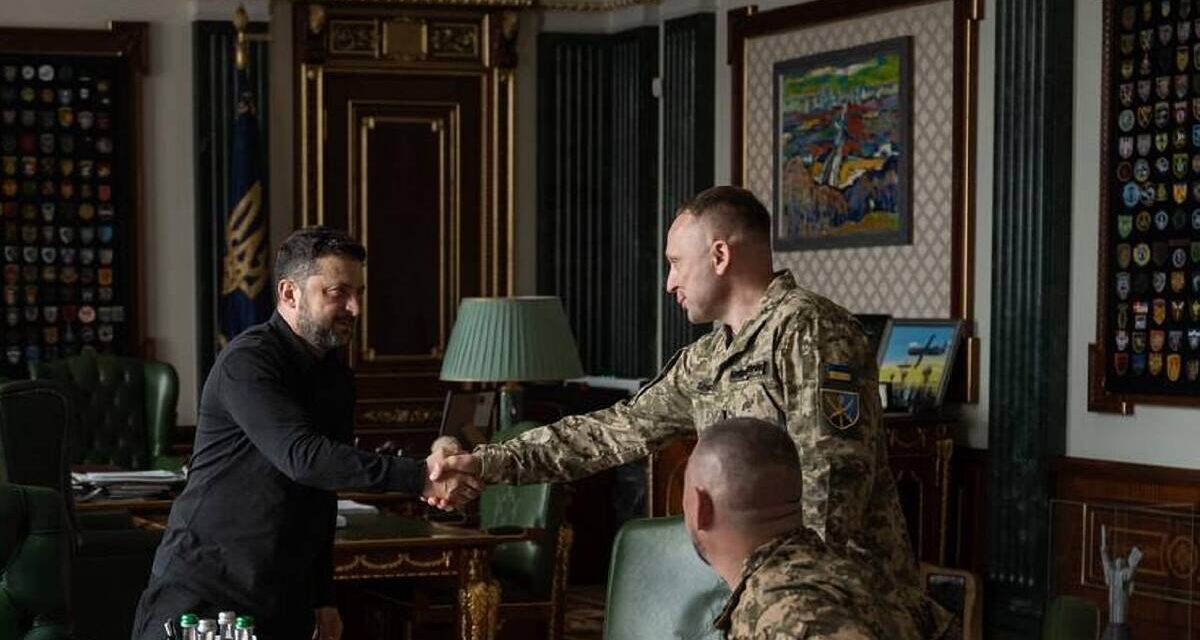
Ukrainian President Volodymyr Zelenskyy has appointed Major General Mykhailo Drapatyi as the new commander-in-chief of the Armed Forces of Ukraine, effective Tuesday, July 21.
Zelenskyy tasked Drapatyi with developing a modern defense strategy and continuing the military reforms that had recently been set in motion under the previous leadership.
The appointment follows a sweeping cabinet reshuffle in which former Defense Minister Mykhailo Fedorov was removed after a major dispute with then-commander-in-chief Oleksandr Syrskyi over the strategic direction of Ukraine’s war effort.
Fedorov’s dismissal triggered mass protests across parts of Ukraine, with demonstrators demanding both his reinstatement and the removal of Syrskyi from command.
Zelenskyy has since dismissed Syrskyi, while also appointing Yevhen Khmara, formerly head of Ukraine’s Security Service, as the new defense minister, with Fedorov not returning to his post.
Drapatyi had been the only senior general to publicly defend Fedorov following his removal, writing on Facebook that Fedorov’s appointment to the ministry “was a serious attempt to change conditions in the military system that were in place for years.”
He described a fundamental shift in civil-military relations under Fedorov’s tenure, writing: “Cooperation between the troops and the Defense Ministry changed. There was a new willingness to listen to commanders, to take decisions more quickly and to support changes that came from the units themselves.”
Born in 1982, Drapatyi is a decorated tank officer who first distinguished himself during the Donbas conflict beginning in 2014, earning a reputation as a resolute frontline commander during what was then known as the anti-terror operation.
Following Russia’s full-scale invasion in 2022, Drapatyi coordinated the successful defense of Kryvyi Rih as deputy commander of the Ukrainian Joint Forces, and later helped liberate strategically important areas in the country’s south.
His reputation as a military crisis manager was further cemented when he halted the Russian offensive near Kharkiv in 2024, propelling him to the role of head of Ukraine’s ground forces and eventually Commander of the Joint Forces.
In June 2025, Drapatyi submitted his resignation after a Russian missile strike on a training ground under his command killed at least 12 soldiers and injured more than 60 others, citing his “personal sense of accountability for this tragedy.”
Zelenskyy declined to accept that resignation, and Drapatyi’s willingness to take moral responsibility for the incident only deepened his standing among both troops and the public.
Some observers noted that his subsequent assignment to defend the Kharkiv region in autumn 2025 appeared designed to limit his influence, with speculation that Syrskyi sought to sideline Drapatyi as a potential rival.
Analysts remain divided on whether Zelenskyy’s personnel decisions reflect sound leadership or reactive damage control driven by public pressure.
Oleksandr Khara of the Ukrainian Center for Defense Strategies viewed the protests as a democratic corrective, saying: “The president listened to the response from civil society and the military and drew his conclusions. Society has succeeded in steering events back onto a democratic course.”
Oleksiy Melnyk of the Kyiv-based Razumkov Center offered a sharper assessment, arguing the reshuffle represented an avoidable crisis of Zelenskyy’s own making.
“This will definitely not turn out to his advantage. It is regrettable that the president has learned nothing from previous lessons, because exactly one year ago there was a similarly triggered home-grown crisis,” Melnyk told DW.
The leadership transition comes at a critical moment for Ukraine, with ongoing military pressure along multiple front lines and the need for strategic coherence more urgent than ever.
Drapatyi now assumes command of a military that is navigating both battlefield challenges and significant internal reform, with the eyes of Ukraine’s allies and its own population closely watching his next moves.
