
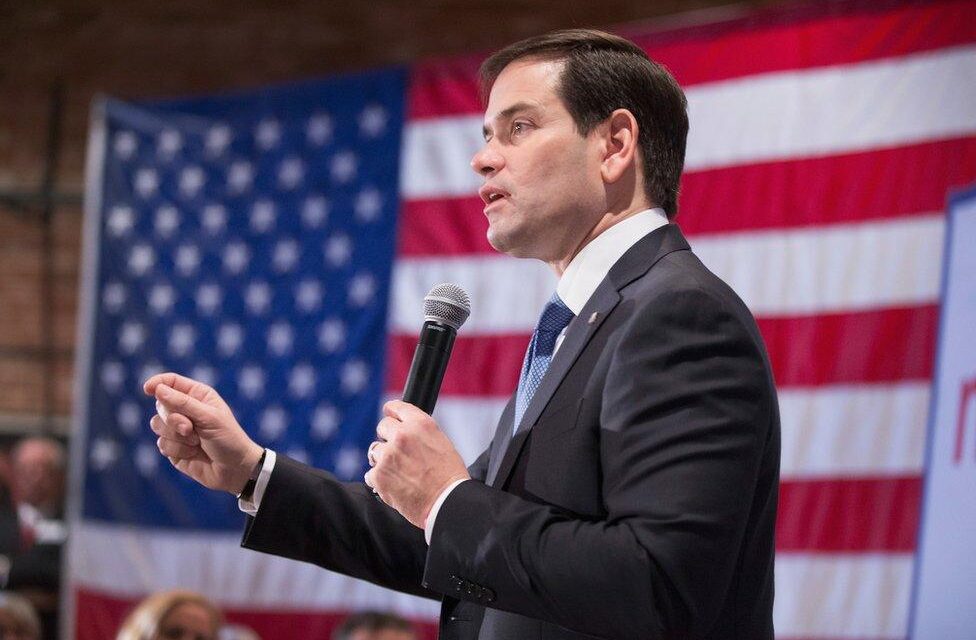
Secretary of State Marco Rubio convened leaders from more than 60 countries Thursday to address what the Trump administration characterizes as a rising threat of left-wing political terrorism.
The gathering represents one of the administration’s most prominent foreign policy moves ahead of the November congressional midterm elections, a period Republicans are using to sharpen ideological contrasts.
Rubio urged attendees, drawn mostly from European and Latin American countries, to unite against what he described as a long-standing “blind spot” in global counterterrorism doctrine.
“So many people in positions of power have repeatedly dismissed acts of violence and even terrorism as legitimate forms of political expression, so long as they served a left-wing cause,” Rubio said in opening remarks.
He drew a pointed contrast in his remarks, stating: “A bomb planted by a neo-Nazi group was ‘a nefarious and murderous act of evil.’ It is, but a bomb planted by a Marxist revolutionary; well, that’s just merely a tragic excess of idealism.”
Studies, including a report published last year by the Center for Strategic and International Studies, complicate the administration’s framing of an alarming leftward surge in political violence.
The report found that left-wing terrorism attacks as of July 4, 2025, had surpassed those from the far right for the first time in more than 30 years, but analysts note the shift reflects a very low starting point and a concurrent drop in far-right incidents.
From 1994 through 2000, there was an average of 0.6 left-wing incidents annually compared with 20.6 on the right, and from 2016 to 2024 those figures stood at four per year on the left and 22.7 on the right.
The report’s authors caution that right-wing terrorism could easily return to elevated levels and stress the importance of fighting terrorism across the entire political spectrum.
Rubio’s personal history has shaped much of his worldview on this issue, as he is the son of Cuban immigrants who arrived in Miami in May 1956, before communist leader Fidel Castro rose to power in Havana.
He told conference attendees that the Cuban government’s intelligence and ideological network “helped to build the far left in our country and in our hemisphere,” framing the current threat in deeply personal terms.
Stephen Miller, Trump’s deputy chief of staff and main architect of the administration’s immigration policy, followed Rubio’s remarks with a forceful call to action directed at the assembled officials.
“If your civilization is your home, you must defend it with the same passion and force as if an enemy intruder is inside your own house where your family lives,” Miller said, adding: “That is the level of dedication and urgency that is required.”
President Donald Trump has repeatedly stated that the Democratic Party’s ascendant left are communists who want to “completely destroy the traditional American way of life” and even engage in assassinations.
Vice President JD Vance has similarly called out communism as a political shift “something we haven’t seen in the U.S.,” while House Speaker Mike Johnson has decried “radical candidates” who are “self-described, self-identifying Marxists.”
The administration’s ideological push has intensified following the election of democratic socialist Zohran Mamdani as New York City mayor and several of his proteges winning New York City congressional primaries last month, defeating incumbents.
Critics note the administration has repeatedly conflated democratic socialism, which centers on universal healthcare and higher taxes on the wealthy, with communism, under which private ownership is largely eliminated.
The State Department designated four antifa or anti-fascist groups in Europe as foreign terrorist organizations in November, marking one of the administration’s earliest concrete moves targeting left-wing organizations.
Treasury Secretary Scott Bessent addressed the conference Thursday, arguing that targeting these groups’ financial networks is the most effective means of neutralizing their activities.
“We have spent decades developing the world’s most sophisticated financial counterterrorism capabilities, and now we are mobilizing some of the same tools that we have deployed against terrorists abroad to confront this emerging threat here at home,” Bessent told the conference.
Rubio also announced a new visa restriction policy Thursday giving the State Department broad authority to deny entry to individuals who have supported, incited, or provided logistical or financial assistance to designated terrorist groups.
