
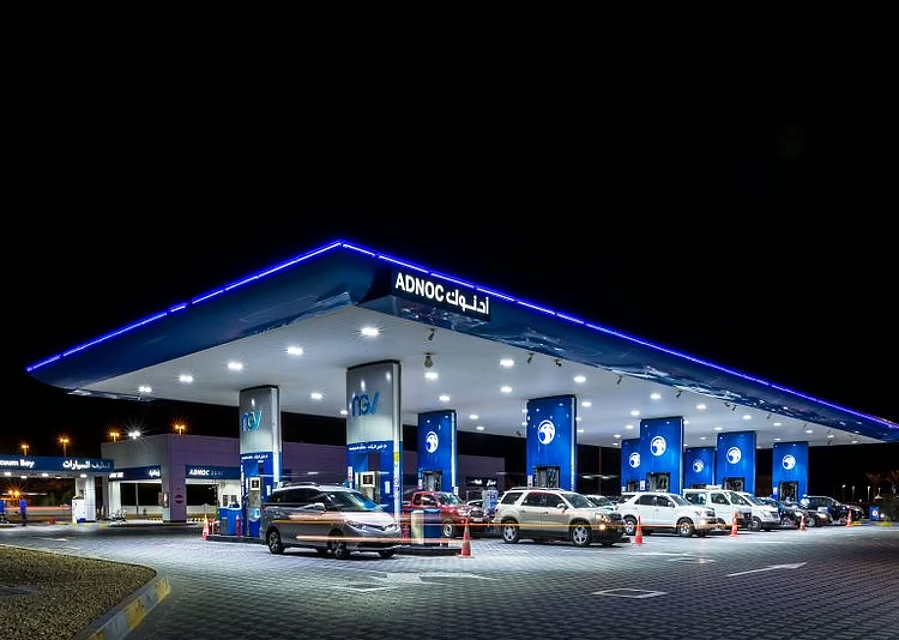
Abu Dhabi-based petroleum retailer ADNOC Distribution is acquiring Shell’s petrol stations and fuel business in South Africa in a deal valued at approximately $1 billion.
The transaction gives Abu Dhabi a foothold in Africa’s fuel market and represents one of the most visible recent examples of a broader Gulf investment trend across the continent.
According to UK-based think tank Chatham House, Gulf Cooperation Council member states have collectively invested more than $100 billion in Africa over the past decade.
The UAE accounts for roughly $59 billion of that total, while Saudi Arabia contributes approximately $26 billion, making both nations the dominant Gulf investors on the continent.
“For the Gulf states, Africa isn’t some far away region — it’s right in their neighborhood,” said Stephan Roll, a senior fellow in the Africa and Middle East division at the German Institute for International and Security Affairs.
Roll noted that eastern Africa sits along central trade routes and that the two regions have maintained deep social and economic ties for decades, making the Gulf’s growing engagement a natural progression.
Maddalena Procopio, a senior policy fellow in the Africa program at the European Council on Foreign Relations, pointed to economic diversification as the central driver behind the Gulf’s shift in strategy toward Africa.
“One of the biggest reasons why they started to look at Africa differently, especially over the past 10 years or so, has been the need to diversify away from hydrocarbons and also strengthen their own economic projection,” Procopio explained.
She added that Gulf states began recognizing Africa as “an incredible potential market, where they could basically have revenues in sectors that they haven’t ventured into.”
Analyses from institutions including the Brookings Institution, Chatham House, and the African Development Bank identify energy, ports, logistics, agriculture, and critical raw materials as the primary focus areas for Gulf investment.
Those sectors are strategic, securing key trade routes and access to raw materials such as copper, cobalt, and lithium, which are essential for electric vehicle manufacturing and artificial intelligence development.
Saudi Arabia and the UAE are primarily channeling capital into renewable energy and the processing and distribution of petroleum products, while Qatar remains focused on more selective economic partnerships.
Experts regard the UAE as the most deeply engaged Gulf state in Africa, with Roll arguing that its ports, logistics operations, and economic interests cannot be separated from its broader foreign policy and security objectives.
Control over strategically positioned ports offers the UAE not only commercial advantage but also political leverage over critical global trade routes, a dimension Procopio confirmed was unique in scale among Gulf states.
Saudi Arabia’s approach is considerably more targeted, with Roll describing Riyadh as concentrating on specific sectors, particularly energy, while also playing a significant role in development financing through bilateral channels and multilateral bodies such as the Islamic Development Bank.
Procopio attributed the divergence in investment strategies to fundamental differences in each country’s economic structure and development model.
“The UAE’s development model has been based abroad because the country is very small,” she said, adding that it “needs to trade with the rest of the world to grow.”
She also noted that the UAE’s commercial footprint carries a “strong political dimension, with investments aiming to project power and to challenge Saudi Arabia’s regional standing.”
For many African nations, Gulf capital is arriving at a critical moment, with the African Development Bank warning that the continent’s financing needs are expanding even as Western development funding contracts and Chinese lending slows.
Unlike China, Procopio noted, Gulf states tend to prefer direct investment over loans, meaning African nations often access Gulf financing more easily and with fewer political conditions attached.
However, Chatham House has cautioned that Gulf investments are heavily concentrated in ports, supply chains, and raw materials, raising concerns that they primarily serve the strategic interests of the investing states rather than African economies.
The Brookings Institution has similarly warned that some deals risk reducing African nations to raw material suppliers, and argued that investment directed toward manufacturing and industrial development would be far more beneficial.
Roll acknowledged the tension, arguing that new dependencies created through strategic infrastructure and unprocessed commodity exports remained a genuine challenge regardless of the investment source.
Procopio urged caution in drawing conclusions too early, noting that partnerships between African countries and Gulf states are still at a formative stage, and whether the capital will ultimately support industrialization remains an open question.
