
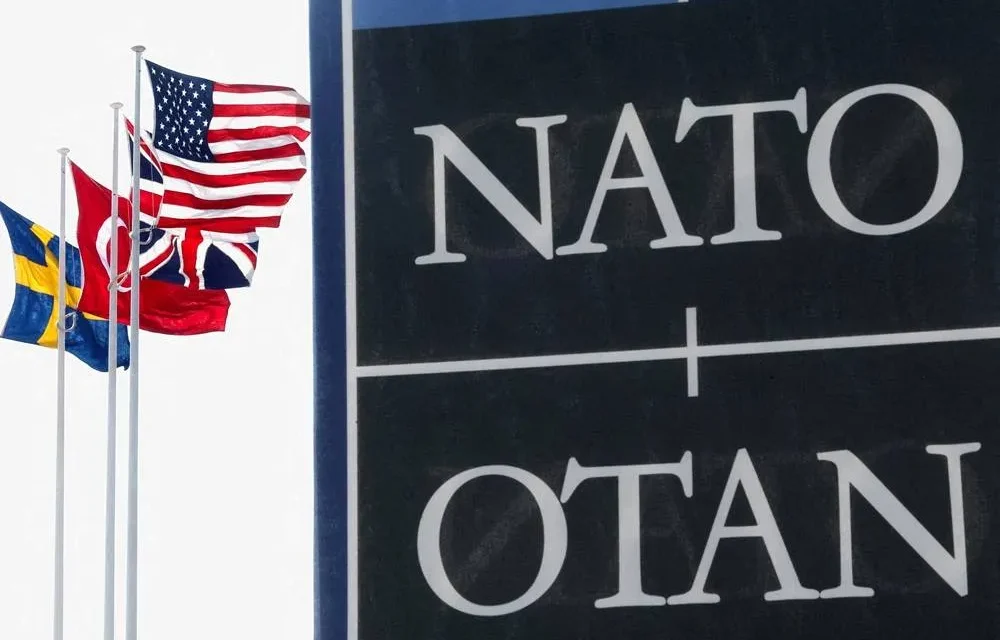
The 2026 NATO summit in Ankara concluded this week with a landmark announcement that will reshape global defense spending for years to come.
NATO allies officially committed to more than €50 billion, roughly $57 billion, in new defense procurement deals, signaling a historic shift in how European nations approach their own security.
The announcement came alongside a separate €70 billion military aid pledge for Ukraine, underscoring the sheer scale of Western defense mobilization now underway.
U.S. President Donald Trump’s repeated warnings that European allies can no longer unconditionally rely on American protection have accelerated the continent’s push toward strategic autonomy.
Total defense and security spending by European allies and Canada has already reached approximately 4% of GDP, just one year into a 10-year program targeting 5% of GDP by 2035.
Among the headline corporate deals, Lockheed Martin (NYSE: LMT) joined forces with German defense prime Rheinmetall (OTC: RNMBY) to establish the first European facility for manufacturing, integrating, and distributing ATACMS tactical missiles at Rheinmetall’s artillery plant in Germany.
RTX Corp. (NYSE: RTX) announced plans to double its Stinger missile production through expanded European partnerships, while Northrop Grumman received a procurement order for Triton uncrewed aircraft to enhance NATO’s maritime surveillance capabilities.
Allies also launched NATO’s Drone Edge initiative, committing $40 billion to counter-uncrewed systems investment over the next five years, one of the summit’s most forward-looking defense technology programs.
The cascade of capital flowing from these deals is expected to translate into a multi-year revenue supercycle for defense contractors on both sides of the Atlantic, strengthening the long-term growth outlook for the entire industry.
Rather than betting on individual defense primes, which carry risks including supply-chain bottlenecks, regulatory compliance burdens, and project cancellations, analysts argue that defense ETFs offer a smarter path to capturing this spending boom.
The iShares U.S. Aerospace and Defense ETF (NYSE: ITA), with net assets of $14.27 billion, holds 49 U.S. companies and has surged 27.8% over the past year, charging 38 basis points in fees.
RTX holds the second-largest position in ITA at 15.41% weightage, while LMT and Northrop Grumman (NYSE: NOC) each hold spots in the fund at 4.25% weightage respectively.
The Invesco Aerospace and Defense ETF (NYSE: PPA), with a market value of $8.24 billion, offers exposure to 62 companies across defense, homeland security, and aerospace, and has gained 22.9% over the past year.
PPA charges 58 basis points in fees, with RTX occupying the top position at 7.47% weightage, LMT fourth at 5.98%, and NOC sixth at 4.75%.
The Themes Transatlantic Defense ETF (NYSE: NATO) broadens the investment universe to 85 aerospace and defense companies headquartered across NATO member countries, carrying a net asset value of $40.74 per share.
NATO has rallied 13% over the past year, charges just 35 basis points in fees, and counts RTX, LMT, Airbus, and NOC among its top ten holdings.
For investors seeking exposure to what many analysts are calling a generational defense spending cycle, these broad-basket ETFs offer diversified access to the contractors best positioned to benefit from the Ankara summit’s historic commitments.
