
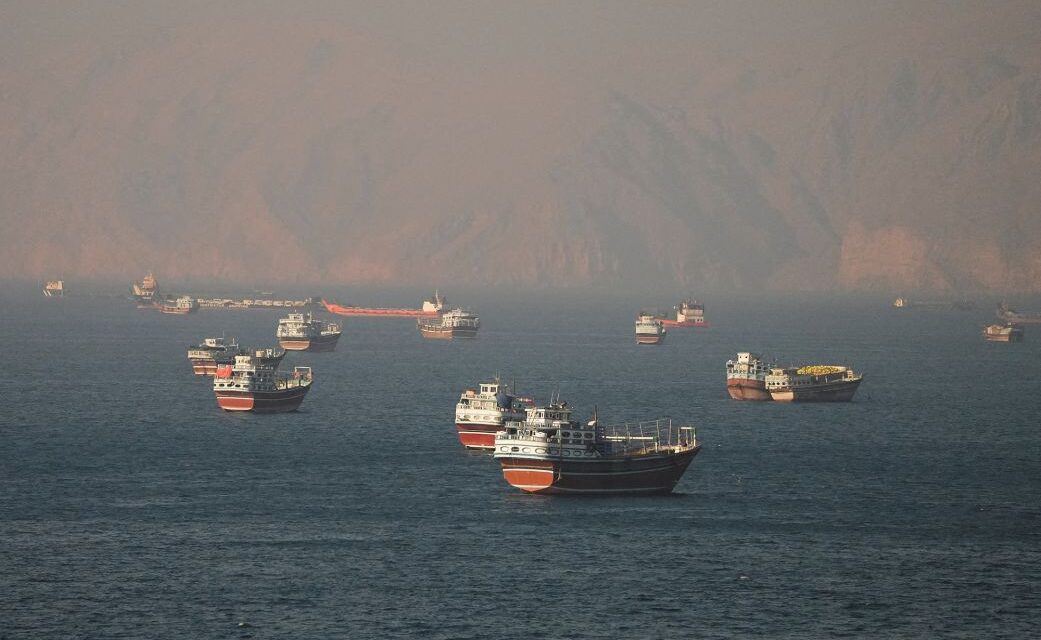
The International Maritime Organization has suspended its effort to evacuate stranded vessels through the Strait of Hormuz following a drone attack on a merchant ship off the coast of Oman.
IMO Secretary-General Arsenio Dominguez said the evacuation plan will remain on hold until the agency can confirm safety guarantees for ships on the evacuation list and in the broader region.
A U.S. official, speaking on condition of anonymity to discuss a sensitive situation, told the Associated Press that Iran’s paramilitary Revolutionary Guard flew a drone into the merchant vessel Ever Lovely.
The attack came just hours after Iran threatened vessels to stop using the U.N.-backed route through the strait without permission from Tehran.
Dominguez confirmed that the vessel that was struck was not part of the official evacuation effort organized by the IMO and Oman.
The United Kingdom Maritime Trade Operations center said the vessel sustained damage but reported no injuries or environmental effects from the incident.
Iran’s Persian Gulf Strait Authority, a new government agency established to control shipping in the strait, wrote on X that transit outside its own designated routes “will not be covered by the guarantee of safe passage.”
The naval arm of the Revolutionary Guard also issued a formal warning Thursday against using the new route, calling it “unacceptable and completely dangerous” in a statement carried by Iran’s state-run IRNA news agency.
“The only authorized route for passing through the Strait of Hormuz is the one declared by the Islamic Republic of Iran,” the Iranian force said, adding that “violators will be dealt with.”
On Wednesday, a Guard soldier threatened one tanker over the radio, warning “You are in range of my missiles and maybe (I) fire on you,” according to private security firm Ambrey.
U.S. Secretary of State Marco Rubio, visiting Gulf allies to reassure them of Washington’s commitment, said the U.S. would ensure ships are able to transit the strait freely, stating “If that stops, then we’re going to have a problem.”
Rubio met with foreign ministers from the six-nation Gulf Cooperation Council in Bahrain, pledging that “there is no part in this deal that’s undertaken that in any way undermines the security, the stability or the prosperity of any of our partners in the Gulf region.”
Bahrain’s Foreign Minister Abdullatif bin Rashid al-Zayani said the interim agreement brought a glimmer of hope but stressed that it was “critically important that Iran adheres to its obligations.”
Oil prices briefly dipped below the prewar level of just under $73 per barrel on Thursday, a signal that markets believe the broader situation may be slowly stabilizing.
Last week, 125 vessels crossed the strait, up sharply from just 33 the week before, according to marine data and analysis firm Lloyd’s List Intelligence.
According to S&P Global, Wednesday saw 78 transits through the strait, the most since the war began, though still well below the prewar daily average of 130 or more.
Shipping company Maersk confirmed its container ship the Maersk Baltimore, along with another chartered vessel, successfully made it through the strait on Thursday.
The strait, which carries roughly a fifth of the world’s oil and natural gas, has been a flashpoint since Iran claimed it mined the central corridor after U.S. and Israeli forces attacked Iran on Feb. 28.
The U.S. and Iran are still negotiating an interim peace deal under a memorandum of understanding signed last week, giving both sides 60 days to finalize details including the future of Iran’s stockpile of highly enriched uranium.
A separate flare-up between Israel and Iranian-backed Hezbollah in Lebanon also threatens the wider regional truce, with Lebanon’s health ministry reporting three people killed by an Israeli strike on a car in southern Lebanon on Thursday.
