
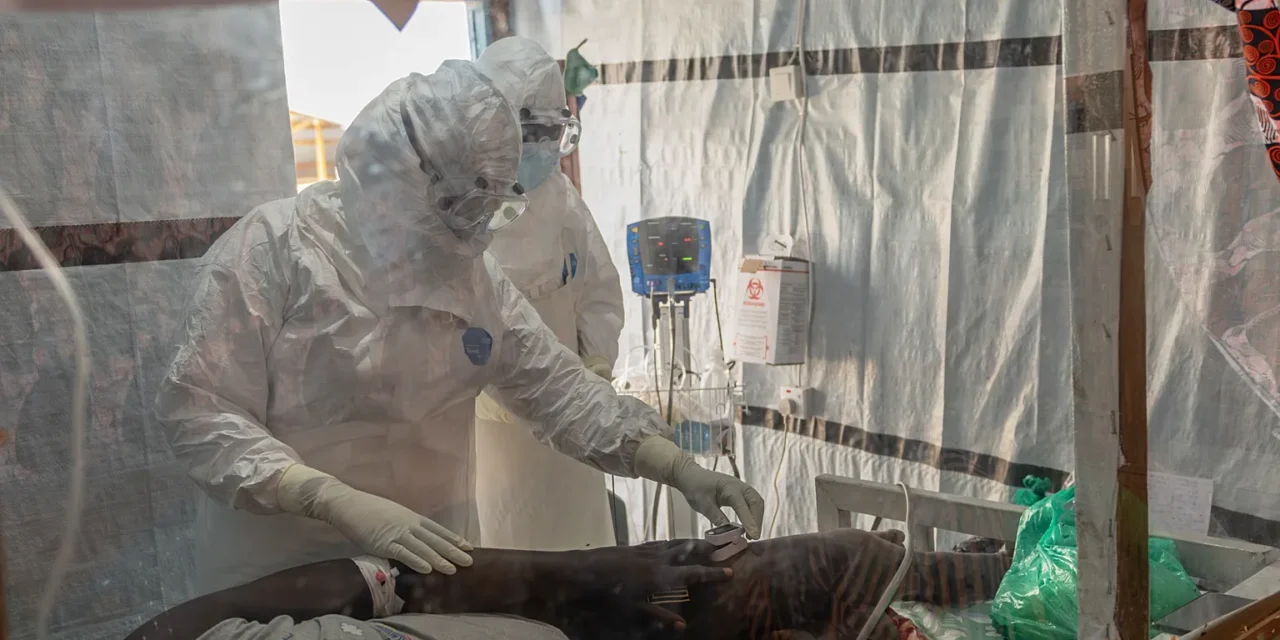
The Democratic Republic of Congo is facing the worst opening month of any Ebola outbreak in African history, with officials confirming more than 1,000 cases and 267 deaths.
The current outbreak involves the comparatively rare Bundibugyo ebolavirus strain, which the World Health Organization formally confirmed on May 15, though experts believe it had been circulating for weeks or months before that date.
“This is the largest number of confirmed cases in the first month of an Ebola disease outbreak in Africa,” said Abdirahman Mahamud, the WHO’s director of health emergency alert and response operations, in a press release.
Mahamud made the remarks at a briefing in Geneva after returning from a visit to the Bunia treatment center, located in the epicenter of the outbreak.
He added that “the response needs to expand to keep pace with the expanding outbreak,” but acknowledged that this process was beginning to happen on the ground.
Cases have now spread into at least three of war-torn eastern Congo’s crowded displacement camps, further complicating containment efforts in an already volatile region.
Abdoulaye Wone of the International Organization for Migration told the same Geneva briefing on Tuesday that 25 cases had been confirmed at the camps, including 14 deaths.
There have been more than 20 Ebola outbreaks across Africa since the 1970s, according to the US Centers for Disease Control and Prevention, including a West African outbreak that killed 11,000 people between 2014 and 2016.
A separate Congo outbreak beginning in 2018 resulted in 2,229 recorded deaths, making the current surge all the more alarming for international health authorities monitoring its trajectory.
Meanwhile, Kenya’s Health Minister Aden Duale told a Kenyan court on Tuesday that he had ordered an immediate halt to the construction of a US-backed Ebola quarantine facility at an air base in the central town of Nanyuki.
Duale had been found in contempt of court on Monday for failing to observe previous judicial orders to suspend construction pending an evaluation by the judiciary.
The tented facility at the Laikipia Air Base, roughly 200 kilometers from Nairobi, was designed to house approximately 50 isolation beds and serve as a treatment center for US nationals who might contract Ebola amid the Congo outbreak.
Justice Patricia Nyaundi Mande discharged Duale without further punishment after receiving his assurance, but warned him against any further disobedience of court orders.
“I have directed the immediate and complete cessation of any intended construction, site preparation, or related activities concerning the Laikipia Air Base facility pending the hearing and determination of the substantive petition or until further orders of this court,” Duale said at Tuesday’s sentencing hearing.
The construction plans, first announced in May, sparked sometimes violent public protests and resulted in three deaths in the vicinity of the facility.
Rights groups successfully petitioned the court on the grounds that the facility was being built secretly and without public consultation, while flight tracking data and satellite imagery pointed to continued preparations at the site despite the initial court order.
Kenya has never recorded a case of Ebola, and public concern over bringing infected patients onto its territory fueled much of the domestic backlash against the facility.
The sole US citizen to have contracted Ebola in the current outbreak, a doctor working as a medical missionary in eastern DRC, was transported to Germany for treatment at a specialist facility in Berlin rather than to the Kenyan site.
Kenya does not share a border with Congo but sits directly east of Uganda, which borders the outbreak’s epicenter in Ituri province in eastern DRC, making it a logical logistical staging point in the region.
