
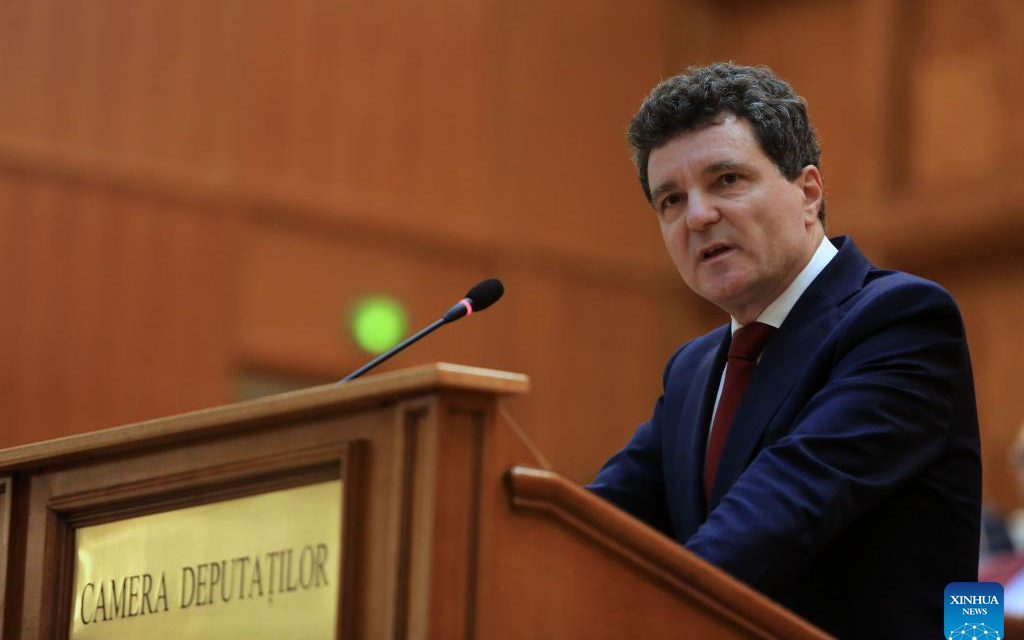
Romania’s political crisis deepens as President Nicusor Dan nominated Adrian Vestea of the National Liberal Party (PNL) as the country’s new prime ministerial candidate on Sunday.
Vestea currently serves as president of Brasov county council, though his record has drawn significant scrutiny from critics and political observers.
He graduated from a university of questionable academic standards and notably failed to secure repairs to access roads at a major Romanian NATO military base.
Dan bypassed constitutional requirements by making the nomination without first consulting parliament, and went further by failing to inform his own PNL party leadership before announcing the pick.
PNL Chairman Ilie Bolojan, who currently heads the government as interim prime minister, condemned the move as a “hostile act” and an “attempt to divide the PNL.”
Several commentators have accused Dan, once regarded as a champion of the rule of law, of disregarding democratic and constitutional principles in his pursuit of political survival.
Romania’s four-party coalition collapsed in April 2026 after the Social Democrats withdrew and brought down the government through a vote of no confidence, backed by far-right parties.
The country has been operating without a stable government for two months while grappling with one of the European Union’s highest budget deficits, which exceeded 9% of GDP in 2024.
Romania faces mounting pressure from the EU to implement administrative, tax, and judicial reforms, with billions of euros in EU funding at risk if the country fails to act.
Dan has been attempting to form a new pro-European government at any cost, largely to prevent early elections that would likely hand far-right parties a parliamentary majority.
The political arithmetic remains deeply unfavorable, as the PNL and the Save Romania Union (USR) have said they will not govern alongside the Social Democrats, yet no government can be formed without them while excluding the far right.
Vestea belongs to a small PNL faction still willing to cooperate with the Social Democrats, making him a strategic but divisive choice that fractures his own party.
Pro-Russian far-right parties have gained considerable ground in Romania in recent years, with three such parties collectively winning 35% of the vote in the 2024 parliamentary election.
The Alliance for the Union of Romanians (AUR) emerged as the most prominent far-right force from that election, underscoring the growing appeal of nationalist politics amid widespread disillusionment.
Romania’s political troubles were further complicated in 2024 when the Constitutional Court annulled the presidential election following concerns about Russian interference after far-right candidate Calin Georgescu won the first round.
Dan won the subsequent election as a moderate, pro-European candidate, campaigning under the slogan “honest Romania” and pledging transparency and a path out of the country’s prolonged crisis.
Philosopher and political commentator Andrei Cornea, writing in the weekly Revista 22, offered a stinging assessment of how far the president has strayed from his original image.
“It seemed to us that Nicusor Dan, whatever mistakes he may have made from our perspective, remained a democrat,” Cornea wrote, adding: “For a long time, we believed that Nicusor Dan was ‘our president.’ Once again — for the umpteenth time — we were wrong. Now we know: He is ‘their’ president!”
