
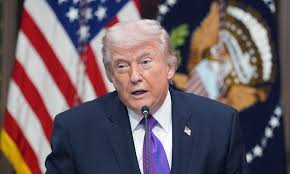
Vice President JD Vance attended diplomatic negotiations in Switzerland on Sunday while President Donald Trump issued a sharp threat against Iran on social media.
Trump posted a direct warning, writing: “Iran must immediately stop their highly paid PROXIES in Lebanon from causing trouble. If they don’t, we’ll hit Iran very hard again, just like we did last week, only harder!!!”
The threat came as Vance met with Pakistani Prime Minister Shehbaz Sharif and Staff Field Marshal Asim Munir, two of the key figures brokering the ongoing negotiations.
Also present at the Swiss talks were an Iranian delegation, mediators from Qatar, and Rafael Grossi, the chief of the International Atomic Energy Agency.
The discussions center on a Memorandum of Understanding signed by both the U.S. and Iran last week, a fragile agreement already facing significant stress from renewed hostilities in Lebanon.
Iran announced on Saturday that it had closed the Strait of Hormuz, citing continued Israeli strikes against Hezbollah in Lebanon, which Tehran said violated the terms of the tentative deal.
U.S. Central Command pushed back on that claim, stating that shipping through the Strait of Hormuz was proceeding normally despite Iran’s announcement.
Iran’s nuclear program also featured prominently in the talks, with Iranian President Masoud Pezeshkian declaring: “What is certain is that we will never back down from the right to enrich uranium, and the other side is also forced to accept it.”
Despite a ceasefire announced on Friday, Israeli forces and Hezbollah exchanged heavy fire throughout Saturday, further straining what was already a delicate diplomatic situation.
The Lebanese National News Agency reported that at least 16 people, including civilians, were killed in Israeli strikes on Saturday, with Israel saying it acted in response to Hezbollah firing projectiles overnight.
Hezbollah said it fired those projectiles in response to Israel moving toward Lebanese territory, a claim that illustrates how quickly the cycle of retaliation has undermined the ceasefire framework.
Despite the deteriorating situation on the ground, the interim head of the United Nations Interim Force in Lebanon told reporters that Sunday marked the first day with no recorded attacks from either side since the war began on March 2.
Vance projected confidence to reporters on Sunday, saying: “We’ve already made great progress over just the last few hours, and I expect that we’ll make additional progress in the hours to come.”
When asked about Israeli Prime Minister Benjamin Netanyahu, Vance said talks had seen “great progress” and acknowledged that “these things are always a little bit messy” before remaining optimistic.
Vance added: “There, of course, are going to be sometimes disagreements about precisely how to get there, but I actually feel great about where we are in Lebanon. There’s still some additional wood to chop, but we’re going to keep on working.”
The Vice President also asserted that the U.S. has “done more to stop the conflict in Lebanon than any government anywhere in the world,” signaling Washington’s determination to position itself as the central force behind any resolution.
Neither Israel nor Lebanon has signed the Memorandum of Understanding, though the agreement calls for respect of Lebanese sovereignty and a full halt to military operations in the country.
