
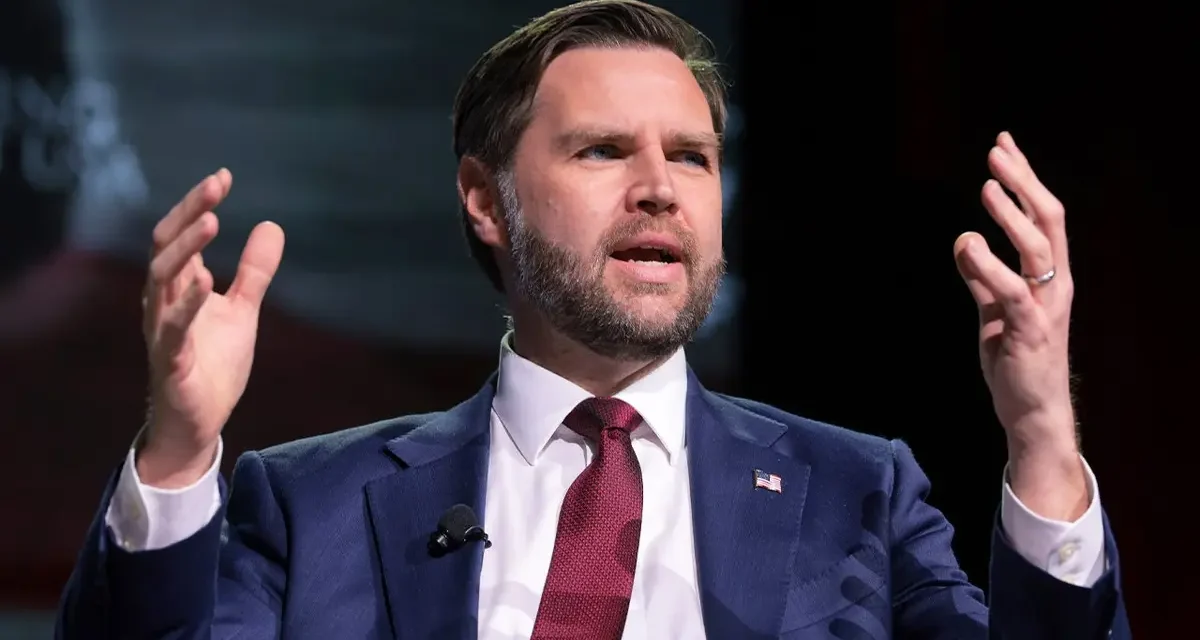
Vice President JD Vance abruptly delayed his trip to Switzerland to negotiate peace terms with Iran, leaving hundreds of journalists waiting in the alpine city of Lucerne without explanation.
The delay cast immediate doubt over the memorandum of understanding signed by President Trump on Wednesday, raising questions about the deal’s durability from its earliest hours.
The agreement promises to end all military operations across all fronts, including in Lebanon, but Israel has continued its heavy bombardment of the country in open defiance of those terms.
Lebanese media reported at least 18 people were killed in overnight Israeli strikes, while Israel confirmed four of its own soldiers were killed in fighting in southern Lebanon.
The short memorandum delivered at least one immediate result, with the United States lifting its naval blockade on Iran following the signing of the preliminary accord.
The deal also promises to reopen the Strait of Hormuz, the critical waterway through which much of the world’s oil, gas, and fertilizer must pass to reach global markets.
President Trump celebrated the development on Truth Social, writing: “Ships of the World, start your engines. Let the oil flow!”
Trump himself acknowledged the agreement’s fragility at the G7 summit in France, saying: “It’s a memorandum of understanding. If I don’t like it, if they don’t behave, we’ll go right back to dropping bombs right smack in the middle of their head.”
The document establishes a 60-day window, extendable by mutual agreement, for both sides to resolve decades of deep-rooted hostility between Washington and Tehran.
The three-and-a-half month conflict has killed thousands of people across the Middle East, rocked the global economy, and pushed millions into poverty, according to the United Nations.
Iranian Foreign Minister Abbas Araghchi made clear that Tehran views Israel’s withdrawal from southern Lebanon as a non-negotiable condition, stating: “Without the withdrawal of Israeli forces from the territories they occupied during this war, the war has not fully come to an end.”
Israeli Prime Minister Benjamin Netanyahu was not a party to the negotiations, though Trump said he sent Israel a copy of the document before signing it, and Netanyahu has insisted his troops will remain in southern Lebanon for as long as Israel’s security requires.
Israel’s far-right national security minister, Itamar Ben-Gvir, wrote on social media: “Trump’s agreement does not bind us. We are not partners to this agreement that does not ensure our security.”
The rift between Trump and Netanyahu has become strikingly public, with Trump telling The New York Times of the Israeli prime minister: “He’s a very difficult guy.”
Vance pushed back against Israeli government critics, warning at a press conference that “Donald J. Trump is the only head of state in the entire world who is sympathetic to the nation of Israel at this moment in time.”
Trump acknowledged at a news conference this week that economic concerns drove the deal, saying he signed the agreement because he “didn’t want to see an economic catastrophe,” as gasoline prices soared and inflation spiked across the United States.
The memorandum offers sweeping financial concessions to Iran, including a commitment for the U.S. to work with regional partners to create a reconstruction fund of “at least $300 billion,” which Vance said Gulf Arab nations would finance.
The deal also promises to unfreeze Iranian funds and assets worth potentially tens of billions of dollars, with Mohsen Rezaei, military adviser to Supreme Leader Mojtaba Khamenei, telling CNN that Iran wants to see the release of $24 billion.
The Trump administration also plans to issue sanction waivers allowing Iran to immediately sell its oil, a significant concession that surrenders a major point of leverage at the start of the 60-day talks.
The framework goes well beyond the Obama-era Joint Comprehensive Plan of Action, which Trump had long called “the worst deal ever,” as it opens the door to ending all U.S. and international sanctions that have kept Iran cut off from the global economy since the 1979 Revolution.
On Iran’s nuclear program, the commitment Iran made in the memorandum that it “shall not procure or develop nuclear weapons” mirrors the same promise it made in the 2015 nuclear accord, offering Trump no new concessions on the issue.
The current framework was negotiated bilaterally by Steve Witkoff and Jared Kushner, and an Iranian diplomat told NPR on condition of anonymity that talks faltered in the last round because “the Americans at the table did not understand the subject.”
Republican Senator Bill Cassidy of Louisiana delivered a sharp rebuke of the administration’s conduct, saying Iran had learned “that threatening the Strait of Hormuz works,” and calling the offensive against Iran “the worst foreign policy blunder in decades.”
Former Secretary of State Antony Blinken posted on X that “the only ‘achievement’ of the ceasefire is the likely reopening of the Strait of Hormuz — which was open before the war started. And we will apparently pay Iran to do so.”
Iran enters the coming negotiations having demonstrated its ability to choke off global energy markets, securing from the Trump administration financial concessions that may ultimately exceed anything achieved under the Obama administration.
